


Writer: Helena Bergström
Updated: September 2026 | Do you need to think about eating healthily at Christmas? Christmas tables, Christmas sweets and long dinners are part of Christmas for many of us, and at the same time, tips appear every year on how to make Christmas a little more ”healthy”. But how much does a few days of Christmas celebration really matter? For most people, eating habits over time are more important than individual meals – and food is so much more than just nutrients.
 Tweet
 Share
 Share
 Pin
 Share
 Share
Table of contents
Do you need to eat healthy at Christmas?
The short answer is that you can of course eat healthily even at Christmas, but you don't need to consider some festive days as a major health problem. For most people, it's the big picture that matters: what we eat and how we live over the long term.
It is sometimes said that It's more important how you eat between New Year's and Christmas than how you eat between Christmas and New Year's.. It's not an exact scientific rule, but a pretty good way to describe the importance of our habits over time.
Furthermore, concepts like ”healthy” and ”unhealthy” food are quite blunt. A food or meal does not need to be assessed in isolation – it is the whole and the eating pattern that is interesting.
Anyone who needs to adjust their diet for medical reasons may of course need to think differently even during Christmas and follow the advice that applies to their own situation.

Food is more than nutrition – especially at Christmas
Food is not just about protein, fat, carbohydrates, vitamins and minerals. It also has social, cultural and emotional meanings – and perhaps this is especially evident during holidays.
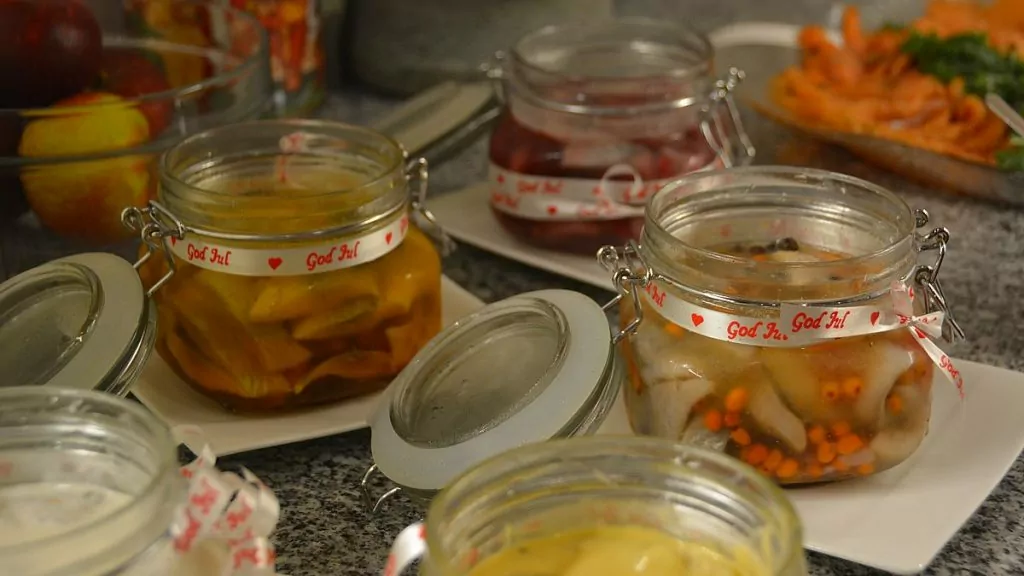
A certain herring may have always been on the family Christmas table. Someone absolutely wants Jansson's temptation, while someone else can't imagine Christmas without meatballs or a special kind of Christmas candy. Flavors and smells can evoke memories and traditions can create community.

In other words, Christmas food can serve more functions than just providing us with nourishment. Eating something you really enjoy with people you love can also be an important part of Christmas.
READ MORE: Christmas table and Christmas food in Sweden – traditions and dishes


The Christmas table contains a lot that fits well into the diet.
Christmas food is sometimes presented as synonymous with "unhealthy food", but of course it's not quite that simple. On a traditional Swedish Christmas table there are a lot of foods that fit well into the general dietary guidelines.
Herring and salmon contribute vitamin D and healthy fats, among other things. Many Christmas tables also feature different types of cabbage. Kale, red cabbage and Brussels sprouts contributes fiber, vitamins and minerals, among other things, and nuts are another example of foods that fit well into a healthy diet.
At the same time, a traditional Christmas table often contains things that, according to general dietary advice, we are advised to eat less of, such as cured meats, sweets and alcohol.
This doesn't necessarily mean that you have to divide the Christmas table into a "good" and a "bad" side. Again, it's the overall picture over time that's important.
Choose what you actually like
A Christmas table can be enormous. Herring, salmon, eggs, ham, meatballs, prince sausage, Jansson's temptation, different kinds of cabbage, cheeses, bread, salads, desserts and Christmas sweets – sometimes there are almost more dishes than you can keep track of.
But you don't actually have to eat everything just because it's all there. We prefer to choose things we really like. For Peter, there must be meatballs, potatoes and beetroot salad. Christmas ham with mustard, preferably on a hard sandwich, is also important. And then herring and salmon.
For me, herring is a must, as is Jansson's temptation and preferably Brussels sprouts. We both like to have a nubbe with the herring, and then it should preferably be spiced brandy.
We drink the latter, of course, because we think it's part of Christmas – not for the sake of our health. Alcohol poses health risks even in small quantities, and the Swedish dietary advice therefore recommends avoiding alcohol or keeping consumption very low.

Christmas candy can also be Christmas candy
Of course, it is possible to make Christmas sweets with nuts, fruit and other ingredients that contain a lot of nutrients. But not everything we eat needs to be transformed into a ”healthier alternative”. If you like crackers, chocolate or marzipan, you can eat it because it is delicious.
For us, Anthon Berg's marzipan bread is a bit of a Christmas luxury that we like to treat ourselves to if we celebrate Christmas at home in Sweden. It's hardly something we eat for its nutritional content – we eat it because we love it and because it has become a part of our Christmas.
Maybe that's also a good principle for Christmas treats: choose something you really like and enjoy it.

Consider how Christmas food is stored
One health aspect that is easily forgotten when discussing Christmas food is food safety. A Christmas table often means that many dishes are on display at the same time, and leftovers can go in and out of the refrigerator for several days.
It is best to prepare smaller amounts of food at a time and add more as you go. Food that needs to be kept cold should not be left out longer than necessary, and leftovers that need to be saved should be cooled quickly and placed in the refrigerator. The Swedish National Food Agency recommends a temperature of around 4 degrees in the refrigerator.
Good management of leftovers not only reduces the risk of someone getting sick, it can also reduce food waste – and provide a few more tasty meals after the Christmas table.

Feel free to take a walk – but not to compensate for the Christmas meal
Getting exercise is good for your health all year round, and Christmas is no exception. During the Christmas holidays, a walk can also be a nice way to get fresh air and daylight and break up long periods of sitting still.
We try to walk regularly ourselves, both at home and when we travel. During Christmas it can be extra nice to get outside for a while between meals and other activities.
However, walking doesn't have to be seen as a way to "burn off" Christmas food or make room for the next meal. Food and physical activity don't have to be counted against each other in that way. Take a walk because it feels good to move!

This is how we think about Christmas food and health
We don't try to create a perfect "healthy Christmas table." If we celebrate Christmas at home in Sweden, we like to eat the Christmas food we really enjoy: herring, salmon, Jansson's temptation, meatballs, ham, Brussels sprouts, and other favorites.
However, we don't need to have everything that is traditionally found on a Swedish Christmas table. For example, we can easily skip the fish, jam and dip in the pot. And then we can have a nubbe with the herring and some marzipan bread when we feel like it.
If we are traveling over Christmas, however, it may be something completely different. Then there may not be any Swedish Christmas food at all – and that is also completely okay.
After all, Christmas is just a few days out of a whole year. For us, Christmas food should be delicious, traditional and enjoyable, without every bite needing to be judged on how ”healthy” it is.

You might also like:
 Sick while travelling? - Aunt Anna and the basil musks
 Christmas sweets and biscuits in different countries - a sweet round trip
 Christmas in Belgium - Aunt Anna refuses Christmas
 Newly opened spa hotel Strandvillan - a natural oasis in Ljunghusen, Skåne



 European cities in Christmas splendor – 12 beautiful cities to visit in December



 English (UK)
 Svenska
Ann says:
Yes, I definitely think you should think about it, no matter what day it is. Of course you should treat yourself, but if you exaggerate to a greater extent because it is Christmas for two weeks, there is a risk that you will feel terribly bad afterwards.
16 December 2020 - 8:45
Helena says:
As you say, there is a little difference if you party for just a few days or if it lasts for several weeks. It is important, as always, to find some kind of balance ðŸ™'
16 December 2020 - 17:23
Farhiya Hashi says:
There is no small difference, if you walk once a week you are less likely to risk getting dry indoor air and getting sick, while partying many times over several weeks gives you a higher chance of getting sick.
17 December 2021 - 11:06
Farhiya Hashi says:
Yes,I also believe that true.
17 December 2021 - 11:12
Veiken says:
Christmas this year is not like other Christmases. This year we're opting out of both fake Christmas food and people. There will be two of us. My husband and I. Christmas Eve will offer a sandwich cake, model seafood and salmon. Christmas Day offers a homemade saffron soup with cod, salmon and fresh prawns! Feels pretty good actually! 🙂
16 December 2020 - 10:29
Helena says:
It's certainly a different year this year! It sounds like you can still have a cosy, but different, Christmas this year! It sounds like a tasty menu 🙂
16 December 2020 - 17:24
Amanda (Swedish Passport) says:
Well, if you live a good and healthy life otherwise, it doesn't really matter what you eat during the Christmas holidays, so it's not something I usually think about 🙂.
16 December 2020 - 10:35
Helena says:
It is simply a matter of finding a balance that works for you and that you enjoy, and it sounds like you have done that! 🙂
16 December 2020 - 17:25
Lena+i+Wales+och+Spanien says:
I like what you say about it being more important what you eat between New Year and Christmas or between Christmas and New Year.
I normally eat healthily, but at Christmas I skip everything and eat whatever I want. I love food, but I'm not a big eater, so I don't have a big packed lunch, so there's no chance of overeating, even if it's good. And not everything on the Christmas table is unhealthy either.
Thanks for nice post! Like your food posts!
16 December 2020 - 12:15
Helena says:
It sounds like you've found a good balance! And if you know you're not over-eating, it's no problem to eat a little differently for a few days. By the way, I completely agree, not everything on the Christmas table is bad! And thank you, nice to hear that you like my food posts! 🙂
16 December 2020 - 17:28
Ditte says:
I think a good balance is always important and we have it all year round. Have always had. I am not a fan of Christmas food so for our part it will be "a little" of the so-called Christmas food; ham, salmon, herring, jansson, meatballs, red cabbage and some salads for late lunch on Christmas Eve.
But you can eat this at any time of the year. And in the evening, fresh lobster and other delicious seafood are served with champagne...
Lots of fresh air and walks refresh and energise you. And I think it's important to do what you like and what is possible right now. (Ideally, we are away over Christmas but it will not be this year. But there will be a time after this...)
16 December 2020 - 17:50
Helena says:
A good balance is probably too much! and to start from what you yourself prioritise and appreciate! A healthy walk balances a lot 🙂
23 December 2020 - 21:37
BP says:
This is probably the wisest thing I've read in a very long time - "it's more important how you eat between New Year and Christmas than how you eat between Christmas and New Year"! I can totally agree with that.
Just this year, I think many people want to "go the extra mile" to compensate for the shitty year 2020. A little extra luxury food, for example. However, I hope they do it without inviting a lot of relatives...
16 December 2020 - 19:36
Helena says:
Thank you, it's great to hear that you appreciate the post! In a way, you may want to compensate this year, and it may be perfectly ok as long as you are careful not to spread the infection further!
23 December 2020 - 21:39
Lena - gott för själen says:
What a great focus! There are better times to think about how and what you eat than at Christmas. And there are more important things to focus on at Christmas. Cosy socialising in a peaceful environment is the best!
Hug Lena
23 December 2020 - 21:34
Helena says:
Thank you, I'm glad you appreciated the focus! When you say that you are a public health scientist and work with food and physical activity, many people think that you only think about nutrients and calories, but that is not the case. As public health scientists, we have a slightly broader perspective 🙂.
23 December 2020 - 21:41