



Writer: Helena Bergström
Updated: October 2026 | What is there to see and do in Haparanda and Tornio? Much more than you might think! This is where Sweden and Finland meet, two time zones and two cultures. In addition, exciting history, roaring rapids, fine sandy beaches and a very special archipelago await. We spent several days here during our motorhome trip around the Gulf of Bothnia and were very impressed with the area.
 Tweet
 Share
 Share
 Pin
 Share
 Share
Table of contents
Haparanda and Tornio – attractions and experiences
Haparanda and the Finnish city of Tornio are located right next to each other, with a land border running right through the contiguous urban area. It’s easy to get around between the two cities, and during our visit we discovered both attractions in the city center and exciting excursion destinations in the surrounding area. Here are our 16 best tips for things to do in Haparanda and Tornio!

1. Take a selfie on the border between Sweden and Finland
One of the most fun things to do in Haparanda and Tornio is to take photos on the border between Sweden and Finland. The border has a long and dramatic history, but today you can easily walk between the two countries.
At the Rajalla På gränsen shopping center there is a large red heart that is half in Sweden and half in Finland. Here you can stand with one foot in each country, or take a photo of yourself together with someone with the border between you.
It's a simple but quite special experience. Imagine being able to walk from one country to another in just a few steps! Also, don't forget that there is an hour's time difference between the countries. Finland is one hour ahead of Sweden.

2. Discover Haparanda city center and the city's history
Haparanda is a quiet little town with a mix of older wooden houses, grander buildings and more modern developments. We enjoyed strolling around here and discovering the urban environment at our own pace.
Some of the buildings that stand out are the old water tower, Haparanda City Hotel and Haparanda Folk High School. The City Hotel is particularly interesting, with its history from the time when border trade, travel and international contacts characterized the city.

Haparanda gained special significance when Finland became part of Russia in 1809 and the Torne River became the border between Sweden and the Russian Empire. During World War I, Haparanda also became an important hub for people and goods passing between East and West.
In several places in the center there are information signs that tell about the history of the city, including border trade, smuggling and life on the border. If you want to take a coffee break, you can, for example, stop by the JoLa pastry shop, where we were greeted by friendly staff and delicious pastries.



3. Walk across the border and discover Tornio
When you visit Haparanda, it's almost a given that you'll also discover the Finnish city of Tornio. The cities are so close together that you can walk across the border, but at the same time it feels like you've arrived in another country.
Tornio is one of Finland's oldest cities, founded in 1621, when Finland was still part of Sweden. The city has a long history as a trading post, and its location close to the border has shaped its development for several hundred years.
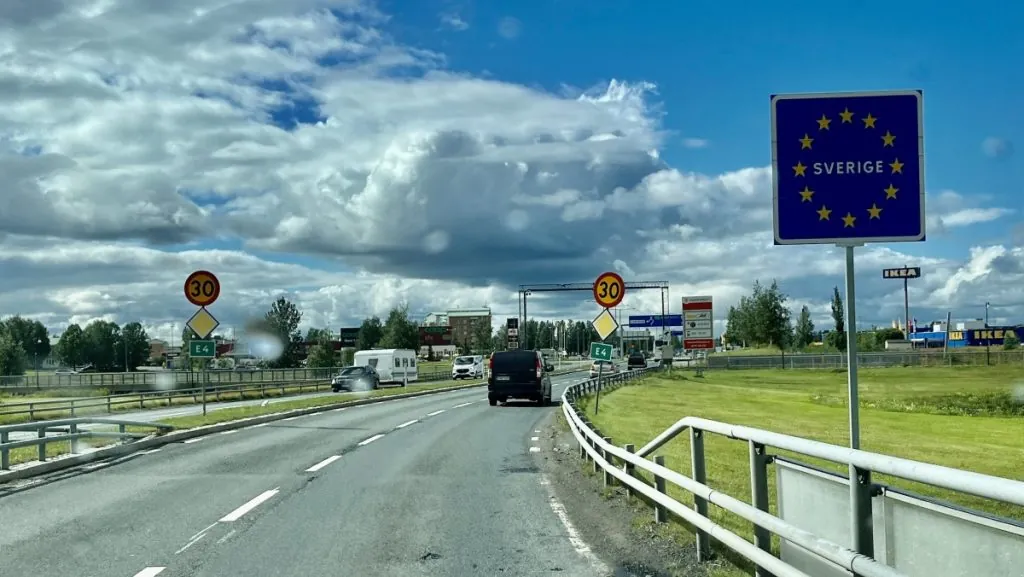
Here you can stroll through the city center, look at buildings and shops or sit down at a café. Torneå also has several attractions that we will tell you more about further down, including Nedertorneå Church and the beautiful Arboretum park.
If you want to delve deeper into the area's history and culture, there is also the Tornedalen Museum, which tells the story of life on both sides of the border. We haven't visited the museum ourselves, but it may be an interesting complement for those who want to learn more about Tornedalen.
4. Visit Kukkolaforsen and see the traditional whitefish fishing
Kukkolaforsen is one of the most special sights in the Haparanda area and is located on the Torne River, a bit north of the city. Here the water rushes forward with impressive force, while the place has a long and fascinating cultural history.
Kukkola rapids are primarily known for their traditional whitefish fishing, where fishermen use long-handled nets from special wooden stands out by the rapids. The fishing method has been used for a very long time and is still a living tradition.
There are also historical buildings, a fishing museum and a sauna museum by the rapids. There is also a restaurant and various accommodation options. We thought it was a fantastic place to visit, both for the nature experience and for the opportunity to learn more about the local culture.
READ MORE: Visiting Kukkolaforsen - whitefish fishing and sauna culture

5. Visit Sweden's easternmost mainland point
Did you know that Sweden's easternmost point is located in Haparanda municipality? It is located on the island of Kataja, which is shared between Sweden and Finland. But even if you don't have the opportunity to get out to the island, you can visit Sweden's easternmost point on the mainland.
It is located on Sundholmen, near the spa hotel Cape East. Here is the border marker Riksröse 59, which marks the place at Sweden's easternmost mainland point. The actual border runs a bit further east, out in the Torne River.
It may not be an attraction that takes a particularly long time to experience, but we think there's something special about geographical extremes. And when you're in Haparanda, it's of course fun to be able to say that you've been as far east as possible on the Swedish mainland!

6. See Robinson's Island at Cape East
A slightly different attraction in Haparanda is the place where the TV show Robinson was filmed during the pandemic. When filming on a tropical island was not possible, the production was moved to the Haparanda archipelago.
One of the most well-known features of the program is the island council, where the participants gather to vote each other out. Such an island council was built near Sweden's easternmost mainland point, and parts of the props have remained after the recordings.
We of course took the opportunity to take a closer look at the location. It's a bit funny to see an environment that you associate with tropical islands and palm trees, but which is actually located in Norrbotten! The location is located near Cape East and can be combined with a visit to Riksröse 59. Just keep in mind that the props may change over time.


7. Discover the Haparanda Archipelago National Park
Haparanda Archipelago National Park is one of the area's great natural assets. The national park was established in 1995 and encompasses islands and water areas in the northernmost part of the Gulf of Bothnia. The largest island is Haparanda Sandskär, which offers long sandy beaches, sand dunes, forest and a rich birdlife. There is also a nature trail here for those who want to discover more of the island on foot.
What makes the archipelago special is its northern location, relatively untouched nature and large sandy beaches. The landscape is quite different from many other Swedish archipelagos.
During the summer there may be tour boats out to various islands in the Haparanda archipelago, including Sandskär. It is also possible to go out with your own boat. Check current boat trips and timetables before visiting, as traffic varies between seasons.

8. Enjoy the sandy beaches on Seskarö
If you want to experience the archipelago environment without having to go by boat, we highly recommend an excursion to Seskarö. The island is located in the Haparanda archipelago and is easily reached by car via bridge.
Seskarö is a beautiful island with forests, sandy beaches and a peaceful atmosphere. Here you will find Seskarö Havsbad & Camping and the Tromsöviken bathing area. There are also opportunities for walking and hiking in nature.
We especially appreciated the beautiful beaches and the peaceful environment. It's easy to associate Norrbotten with forests and mountains, but there are also lovely sandy beaches on the Gulf of Bothnia!


9. Visit Nedertorneå Church
Nedertorneå Church, in Finnish Alatornion kirkko, is located in Tornio and is one of the area's most interesting historical buildings. The current church was built in the late 18th century, but parts of an older medieval stone church are preserved in the building. The church was completed in 1797 and has a special architecture with a tall tower.
There is also a connection to the history of science. The church tower was used as one of the measuring points in the Struve Meridian Arc, a comprehensive project to measure the shape and size of the Earth. The Meridian Arc is now a UNESCO World Heritage Site. We thought the church was well worth a visit, both for the historical setting and for the connection to the World Heritage.


10. Stroll through the lush Arboretum Park
Another place we really liked in Tornio was the Arboretum, a beautiful park with a large number of different trees, shrubs and perennials. There are about 300 species and varieties of woody plants and a couple of hundred different perennials. The park is at its most beautiful during the growing season, when the greenery and flowers are at their best.
We found it very pleasant to walk around among the plants and discover the different parts of the park. It is also a nice place to sit down for a while and enjoy the peace and quiet. If you like gardens and parks, the Arboretum is definitely worth adding to your list of things to do in Tornio. Check the current opening hours before visiting.


11. Discover the World Heritage Site Struve Meridian Arc
Struve's Meridian Arch is one of the more unusual World Heritage Sites in Sweden and Finland. It is not a castle, a temple or a historic city, but a huge scientific project.
During the 19th century, a series of measurements were carried out along a stretch from Hammerfest in Norway to the Black Sea. The aim was to use triangulation to gain a more accurate idea of the shape and size of the Earth. The project was led by astronomer Friedrich Georg Wilhelm von Struve and ran from 1816 to 1855.
Since 2005, the Struve Meridian Arc has been a UNESCO World Heritage Site. It includes 34 preserved measurement points in ten countries. The Perävaara World Heritage Site is located in Haparanda Municipality, and the Nedertorneå Church is located on the Finnish side. In Haparanda, there is also information about the meridian arc and its history. It is fascinating to think how, with 19th century technology, such an extensive international research project was successfully carried out!

12. Experience the Torne River
The Torne River is an important part of the landscape and history of Haparanda and Torneå. The river is one of Sweden's major unregulated rivers and forms the border between Sweden and Finland for part of its course. We think the river is an attraction in itself. Here you can walk or cycle along the water and enjoy the view of the river landscape.

There are also opportunities for various water activities, such as canoeing and fishing, depending on the location and season. At Kukkolaforsen you can also experience the river from a much more dramatic side. For centuries, the Torne River has been both a connection and a border between people. This makes it more than just a beautiful waterway.

13. See Haparanda's unique church
Haparanda Church is a building that really stands out. The modern church, which was inaugurated in 1967, has an architecture that is quite different from many traditional Swedish churches. I (Helena) have to admit that my first thought when I saw the building was: ”Oh, so ugly!” Peter had a slightly more open mind, and after a while even I had to admit that the design is actually quite nice.
The church has a distinctive shape with a dark facade and a tall tower. Regardless of what you think of the architecture, it is a building that attracts attention. And maybe that is exactly why it is worth a visit? You don't have to think that all sights are beautiful to be interesting!

14. Discover the dramatic war history of the border towns
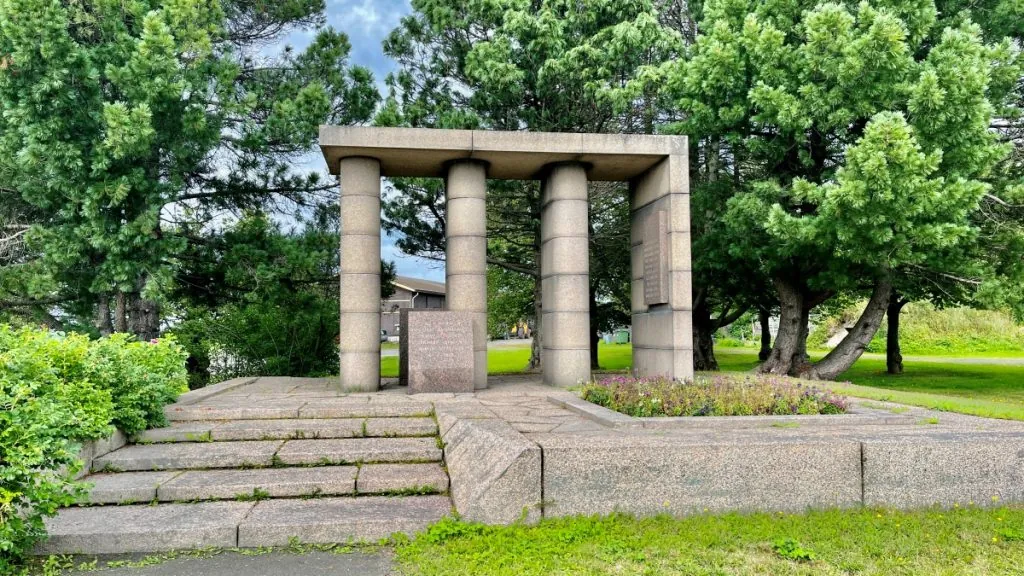
Haparanda and Tornio have played important roles during several dramatic periods in Nordic history. There are also several memorials here that tell the story of the events.
One of them is the memorial to the Battle of Tornio, which took place during the Finnish Civil War in 1918. Another is the War Children's Memorial, which commemorates the approximately 80,000 Finnish children who were sent to Sweden during World War II. Many of the children crossed the border at Tornio and Haparanda, often by train. For some, their stay in Sweden was temporary, while others stayed for a long time.


In the center of Haparanda there are also information signs that tell about war, border trade, smuggling and other events. We thought these stories gave another dimension to the visit.
It is easy to see Haparanda and Tornio as two quiet small towns today, but history shows that the border has had great significance for people far beyond the Tornio Valley.

15. Shop in two countries – IKEA and Rajalla On the border
Shopping is also a popular activity in Haparanda and Tornio. It may not be the first thing we look for when we travel, but here, shopping is an important part of the identity of the border towns.
Haparanda is home to Sweden's northernmost IKEA, which attracts customers from both Sweden and Finland. The department store is large and located in a shopping area with several other stores.


On the Finnish side you will find the Rajalla På gränsen shopping centre, which is located right next to the border. Here you will find clothing stores, other shops and eateries. When we visited the shopping centre, we actually parked our bikes in Sweden and then walked into Finland to look at the shops. That alone is a bit special!

16. Celebrate New Year's Eve twice in Haparanda and Tornio
Do you want to experience a different New Year's celebration? Then Haparanda and Tornio are an exciting alternative! Since Finland is one hour ahead of Sweden, you can celebrate the New Year twice. First it's midnight on the Finnish side, and an hour later it's time for the Swedish New Year.
Haparanda and Tornio also have a tradition of joint New Year's celebrations, where the time difference is part of the experience. Exactly how the celebration is arranged may vary from year to year, so check the current program if you are planning a New Year's trip. But surely it is a fun idea to be able to celebrate the stroke of midnight twice in the same evening?

Where can you stay in Haparanda and Tornio?
There are several options for those who want to stay one or more nights in Haparanda and Tornio. You can choose to stay centrally, close to the border between the countries, or seek out quieter environments by the river and the archipelago.
Hotels and other accommodations
In the center of Haparanda is the historic Haparanda City Hotel, which is a good choice if you want to be within walking distance of the city's attractions and Tornio. Another option is Cape East, which is located on the Torne River near Sweden's easternmost mainland point. Here you will find a hotel and spa in a natural environment. If you want to stay near the Kukkola rapids, there is also accommodation by the rapids, where you can combine an overnight stay with nature experiences and the cultural history of the Torne Valley. On the Finnish side, there are additional hotels and other accommodation options in Tornio.
Camping and motorhome parking in Haparanda and Tornio
If you, like us, are traveling by campervan, there are several options in and around Haparanda and Tornio. Some places to explore are:
- Haparanda Camping – camping in Haparanda.
- Cape East – residential area at Sundholmen where camping opportunities have been offered.
- Haparanda harbour – area where there has been the possibility of parking a mobile home.
- Kukkolaforsen Tourist & Conference – camping by the beautiful rapids.
- BestPark Toranda – RV parking on the Finnish side in Tornio.
- Seskarö Beach & Camping – an alternative for those who want to live near the sea and sandy beaches.
Always check current information about opening hours, service and overnight accommodation options before you go. A regular parking lot is not automatically a parking space for motorhomes.

You might also like:
 Things to do in Kalix - our top 10 tips
 Things to do in Luleå – 10 attractions and experiences
 Things to do in Piteå – 10 attractions and experiences
 Bothnian Coastal Route - FREEDOMtravel Themed Roads
 Things to do in Tylösand – 11 tips for a summer paradise





 English (UK)
 Svenska
Uffe says:
Thank you so much for this! There were places I didn't know about!
19 August 2023 - 9:31
Helena says:
Thank you for your comment Uffe! Glad our report was appreciated!
19 August 2023 - 18:02
Mariann says:
Some curiosities about Lenin in Haparanda and on his way to Tsarist Russia. For on 15 April 1917 he and his party arrived in town.
He came by train from the Alps and first stopped in Stockholm at the PUB to buy new clothes.
He is also said to have made stops in both Jörn and Boden.
There is apparently a plaque in the waiting room of the railway station commemorating the event.
21 August 2023 - 20:12
Lena i Wales och lite överallt says:
I have never been to Haparanda, but would love to go there. I don't know why this city has always fascinated me.
30 August 2023 - 9:00
Seppo says:
Haaparannalla
26 June 2024 - 9:35