


Writer: Helena Bergström
Updated: October 2026 | When we returned to Kenya in 2012, we did so under completely different circumstances than the first time. Now we were staying with Kenyan friends and had Nairobi as our base before and after a traditional wedding in the countryside. It gave us a different view of the capital – with traffic chaos, everyday life, parties, cultural clashes and great contrasts.
 Tweet
 Share
 Share
 Pin
 Share
 Share
Table of contents
Back in Kenya
The first time we traveled to Kenya, over Christmas and New Year 2007/2008, we happened to be caught in the middle of the unrest following the disputed presidential election. That trip ended with us fleeing across the border to Tanzania. Five years later, it was time for Kenya again.
This time the trip would be completely different. We had been invited to a traditional Kenyan wedding and would stay at the home of our Kenyan friends. Nairobi became our base both before and after the wedding, which took place in another part of the country.
We didn't see any lions and didn't check out Nairobi's major attractions. Instead, we got to see a little more of everyday life. And it was just as exciting.
A long journey to Nairobi
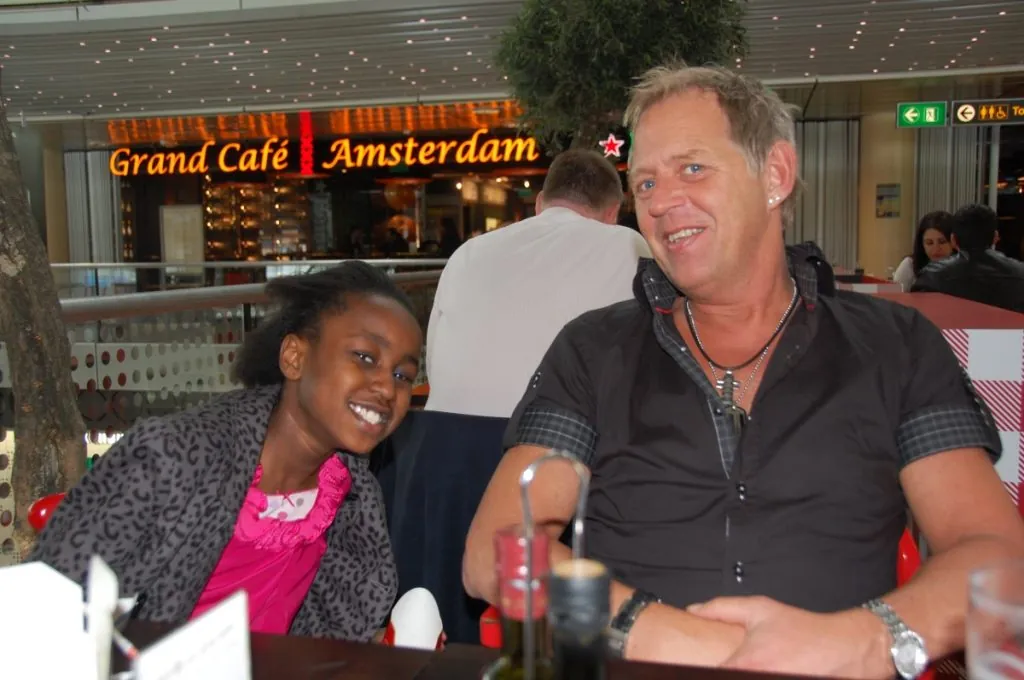
First we just had to get there. The flight went as planned to Schiphol in Amsterdam, but there it stopped. There was a problem with the engine and we had to leave the plane and wait for several hours.
When we finally got back on board, a passenger was missing. Then the person's luggage would also have to be found and unloaded. Another hour or so passed. When we finally landed in Nairobi, it was after midnight.
Some of our friend Rose's friends picked us up and drove us home to Merita, who we were staying with. We got our own room and were very well looked after from the start.

At home with Merita
Merita lived in an apartment in a gated community. There was a living room with a TV and stereo, a small kitchen, a simple bathroom and a few smaller rooms.
She seemed to be quite well off. She had a nice car, usually driven by a male driver, and a young female relative from the countryside helped her around the house. For us, it was one of several culture clashes during the trip.

Merita could stay on the couch and call the girl when she needed something. If she wasn't home, she could instead ask me (Helena=) to open the door when the doorbell rang. We weren't really used to that kind of household...
At the same time, Merita saw the arrangement in a different way: the young woman was a relative from the countryside and by letting her live and work with her, Merita could help her.
We also started to think about how different things can signal wealth and status in different environments. In Sweden, many people spend large sums on things like kitchens and bathrooms. Here we experienced that these things were not necessarily in the same focus, while nice clothes and a good car could be more important.
Of course, these were our observations from the people and homes we met – not a rule for how people in Kenya live.
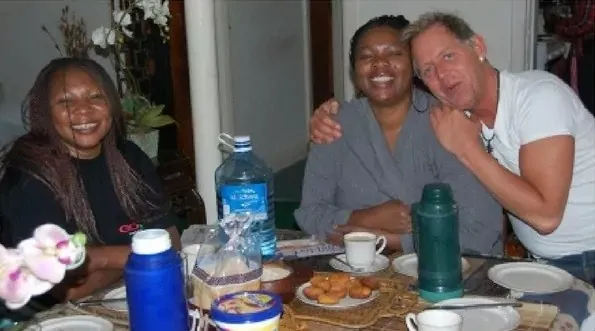
Tea, Blue Band and mandazi for breakfast
At Merita's we also got to try a very standard Kenyan weekday breakfast. It was often tea with milk and bread with Blue Band, a margarine that was in the kitchen instead of in the fridge. We usually also got fried eggs, kind of like an omelet, and sometimes small fried sausages.
The best were the mornings when it appeared mandazi. These are deep-fried, slightly sweet breads that are common in East Africa – and which we thought were fantastically delicious.
During the trip, we got to know much more of the everyday Kenyan food than during our first trip. At our friends' homes, we had a lot of ugali, sukuma wiki and various stews.

Traffic chaos in Nairobi
One thing is hard to miss in Nairobi: the traffic. There could be huge numbers of cars and sometimes everything would come to a complete standstill. When the queues got tighter, vendors would appear between the cars. Here you could buy a little bit of everything through the car window – from bananas to car tires.
At one point, even Peter got behind the wheel. It was important to be decisive. If you politely waited for everyone else to drive first, you could probably stand still for the rest of the day. Suddenly the road seemed to consist of any number of lanes, with cars lined up in all directions. Peter drove. And we arrived.
On your own in central Nairobi
One day we were dropped off in the city and had a few hours on our own. The part of central Nairobi where we walked felt calm and pleasant. People were hurrying between workplaces, many well-dressed in suits or other nice clothes, and we looked around in shops.
Peter was still smoking at that time and lit a cigarette on the street. Almost immediately a shopkeeper came up. This was a smoke-free street. Peter, of course, put out the cigarette.
At the time, it still felt a bit comical, as large vehicles rumbled past on the street at the same time, spewing black exhaust smoke. But rules are rules.
Then the rain started pouring down. We tried to find a café, which turned out to be surprisingly difficult. Eventually we found one – and later also a bar.

When the gift from NK suddenly felt completely wrong
We also had an errand to run. Back home in Sweden we had bought a nice present at NK for Rose's mother, whom we were going to meet at the wedding. We had chosen nice things for the kitchen. It had felt like an excellent present in Stockholm. After a few days in Kenya we began to have doubts.
In the homes we visited, we noticed that those who had financial means could often have help in the household. The kitchen therefore did not really have the role as a status symbol that we ourselves were used to from Sweden. Oh well.
Our well-thought-out NK gift suddenly didn't feel quite so well-thought-out. So we set out for Nairobi to find a better gift. Travel is educational in many ways. Sometimes you learn that you bought the wrong thing at NK.
When the car doors should be locked
We also got to see very different parts of Nairobi when we went around with our friends. In some areas they were suddenly very particular about one thing: Are all the doors locked?
We didn't always know exactly where we were or why a certain area was considered riskier than another. Our friends lived in the city and were much more knowledgeable than we were, so we did as they said.
It was yet another of the contrasts we associate with Nairobi. One moment we were walking around by ourselves among shops and offices. The next we were sitting in a car where our Kenyan friends were double-checking that the doors were really locked.

A dinner turned into a whole party
One evening our friends were going to pick us up so we could have dinner with some relatives. But the traffic in Nairobi had other plans. Time passed. And passed.
Time also didn't always seem to be quite as precise as we were used to back home. In the end, we had to get there in a different way, and once we got there, that "dinner" turned out to be much more than just a dinner.
The apartment was full of people. There was food, conversation and a lovely atmosphere, and everyone seemed to think it was fun that guests had shown up all the way from Sweden. It was a little pre-party for what was really the reason for our entire trip: the Kenyan wedding.

Go out dancing in Nairobi
Another night our friends took us out to a nightclub. It wasn't a tourist club. As far as we could see, we were the only white guests there.
Some of the music sounded a lot like the music that was played in clubs back home in Sweden at this time. But in between came Kenyan music. And then we actually had a little bit of a head start.
Our friends were Luo and had already played a lot of their favorite music for us. One of the songs that stuck was Otieno Aloka's "Kanungo Eteko"”. So when similar music appeared in the nightclub, it was no longer foreign. We recognized ourselves. And danced along.
Gigiri – a completely different side of Nairobi
At the wedding we had met Marta from Serbia, who studied with Rose in Sweden and was now doing an internship in Kenya. The next day she invited us to her house for Gigiri.
Suddenly we found ourselves in yet another version of Nairobi. Here we saw large villas behind walls and gates, embassies, lots of greenery and significantly more foreigners. We joked to ourselves that we had ended up in the ”mzungu area”.

There is a fairly natural explanation for the international feel. Gigiri is Nairobi's major diplomatic and international area, and is home to the United Nations Office at Nairobi, UNON. The UN itself describes Gigiri as a leafy diplomatic, business and shopping area. UNON is also the UN's only headquarters office in Africa and the global south.
We took a long walk in the green surroundings, visited Artcaffé and then followed Marta home.
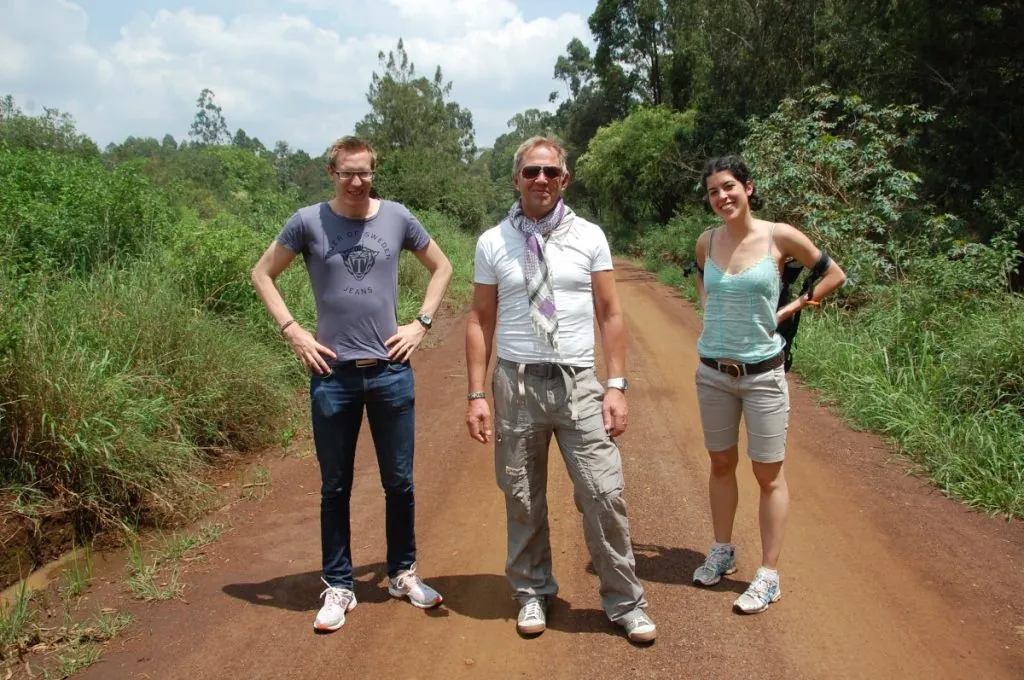
Today we know that the vast Karura Forest is located right next to Gigiri and the UN compound. The forest covers over 1,000 hectares and has walking and cycling trails, among other things. However, we do not know if this was the exact place we walked that day in 2012.
At Marta's house, we cooked together in a communal kitchen that she shared with about fifteen other people. Another place to live. Another environment. Another side of Nairobi.

Our Nairobi
This is of course not a complete guide to Nairobi. We did not visit all the major attractions and never tried to tick off any list of things you ”must” see.
Instead, we got to experience the city through the people who lived there. We had breakfast at Merita's house. Got stuck in traffic. Shopped for gifts. Danced with our Kenyan friends. Ended up at a party in an apartment. Walked among the villas in Gigiri. Saw how people lived and talked to them about things that we ourselves reacted to.
And maybe that's why Nairobi became interesting to us. The city could change completely in a short time – from hectic traffic chaos to well-dressed people on their way to work, from areas where our friends wanted their car doors locked to leafy Gigiri with large villas and an international feel.
Above all, this trip was something completely different from our first dramatic encounter with Kenya. This time we got to get closer to everyday life. And that's probably the side of Nairobi that we remember best.











 English (UK)
 Svenska