



Writer: Helena Bergström
Updated: August 2026 | Vatican City is the world's smallest independent state and is located in the middle of Rome. Despite its small size, the country is home to some of the world's most famous sights, including St. Peter's Basilica, St. Peter's Square, the Vatican Museums and the Sistine Chapel. We visited Vatican City during a trip to Rome and took a guided tour of the impressive museums. Here we share our experiences and tips for a visit to the world's smallest country.
 Tweet
 Share
 Share
 Pin
 Share
 Share
Table of contents
What is Vatican City?
Vatican City is the world's smallest independent state and is located as an enclave in the middle of Rome. The country is the center of the Roman Catholic Church and is home to St. Peter's Basilica, St. Peter's Square, the Vatican Museums and the Sistine Chapel.

The small state covers only about 0.44 square kilometers, but despite its size, it has many of the functions associated with an independent country. It has its own administration, postal service and security forces, and the Vatican City even issues its own euro coins.
Vatican City was formed in 1929 by the Lateran Treaty between the Holy See and Italy. The treaty resolved a long-standing conflict over the position of the Pope and granted Vatican City the status of an independent state.
It is also good to distinguish between Vatican City and the Holy See. Vatican City is the country and territory itself, while the Holy See is the central leadership of the Catholic Church, headed by the Pope. The world's smallest country
Vatican City – short facts
- Official name: Vatican City (Stato della Città del Vaticano)
- Location: An enclave in the middle of Rome, Italy
- Surface: Approximately 0.44 km²
- Founded: 1929 by the Lateran Treaty
- Head of State: The Pope
- Currency: Euro
- Best known for: St. Peter's Basilica, St. Peter's Square, Vatican Museums and Sistine Chapel
- UNESCO: The entire Vatican City is listed as a World Heritage Site
- Suitable for: History, art, architecture and culture
- Time consumption: At least half a day, preferably a full day for the Vatican Museums and St. Peter's Basilica
Visiting Vatican City
Visiting Vatican City works a little differently than visiting many other countries. You don't have to go through any of the usual border controls to enter St. Peter's Square, but can simply walk there from Rome.
However, it is important to distinguish between the different attractions. St. Peter's Square is open to the public without a ticket, but you need a ticket to enter the Vatican Museums and the Sistine Chapel. St. Peter's Basilica is normally free to enter, but you need to go through a security check and there may be queues.

The Vatican Museums have a separate entrance a short distance from St. Peter's Square, so if you want to see the museums, the Sistine Chapel, and St. Peter's Basilica, it's wise to plan your visit in advance and allow at least half a day.

Attractions in Vatican City
Despite being the world's smallest country, Vatican City is home to some of the world's most famous works of art and religious buildings. The Vatican Museums, the Sistine Chapel, St. Peter's Basilica, and St. Peter's Square are among the most popular attractions.

Vatican Museums
The Vatican Museums are not really a single museum, but a vast complex of museums, galleries, halls and palace rooms. The collections were built up by the popes over several centuries and include everything from ancient sculptures and Roman objects to tapestries, maps and Renaissance art.

We visited the museums with a guide, which made it easier to understand what we were seeing and finding through the huge collections.

Among other things, we passed long galleries filled with statues, tapestries and paintings. The buildings themselves are also so richly decorated that it is sometimes difficult to know whether to look at the artwork or the walls and ceilings.


The artworks are fantastic, but there are so many that after a while we almost felt "full" and had difficulty taking in more works.

Raphael's Room and the School of Athens
One of the highlights of the Vatican Museums is Raphael's Room, Raphael's Rooms. The rooms were decorated by Raphael and his workshop in the early 16th century and are among the Vatican's great art treasures.
The most famous work is the fresco The School of Athens, where Raphael gathered several of the great philosophers and thinkers of antiquity in a magnificent architectural setting. In the center are Plato and Aristotle, surrounded by Socrates and Pythagoras, among others. Even for those who are not particularly interested in art, it is special to suddenly stand in front of a work of art that has been reproduced countless times before.

Sistine Chapel
The Sistine Chapel is one of the great highlights of a visit to the Vatican Museums. The chapel is most famous for Michelangelo's paintings, not least the enormous ceiling depicting scenes from the biblical creation story. Here is the iconic scene where God's and Adam's fingers almost meet, as well as Michelangelo's powerful fresco Last judgement on the altar wall.
The chapel is still an important part of the Vatican's religious life. It is here, among other things, that the cardinals gather for the conclave when a new pope is to be elected. After all the halls and corridors through the Vatican Museums, it feels almost surreal to finally enter a room that you have heard about so many times. However, photography is not allowed here, which is why we cannot show any pictures.
St Peter's Church
St. Peter's Basilica, St. Peter's Basilica, is one of the world's largest and most important churches and one of the major attractions of Vatican City. The current church began construction in the 16th century on the site of an older basilica, and several of the Renaissance's leading architects and artists were involved in the work.

The interior is enormous and filled with artwork, chapels and monuments, including Michelangelo's famous sculpture Pieta and the enormous dome which is also associated with Michelangelo. Those who wish can also climb the dome to get a view of St. Peter's Square and Rome. Expect security checks and occasionally long queues to get to the church.

St. Peter's Square
In front of St. Peter's Basilica, the monumental St. Peter's Square spreads out. Designed by Gian Lorenzo Bernini in the 17th century, the square is framed by enormous colonnades that almost seem to embrace visitors.

In the middle of the square stands an Egyptian obelisk, surrounded by two fountains. Large crowds gather here for papal audiences, church services and other important occasions.
St. Peter's Square is also one of the places where it really becomes clear how strange Vatican City is. One minute you're walking down a street in Rome - and the next you're standing in the middle of the world's smallest independent state.

The Pope and the Swiss Guard
The Pope is both the supreme leader of the Roman Catholic Church and the head of state of the Vatican City. Vatican City is thus a very special state formation where religion and state are closely intertwined.
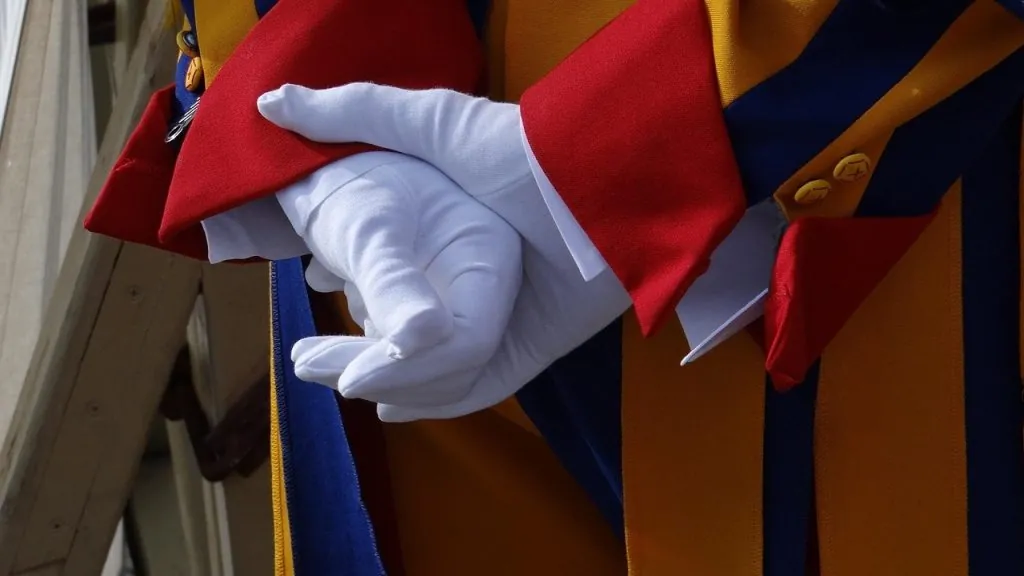
Another well-known symbol of the Vatican is Swiss Guard, whose colorful uniforms are hard to miss. The guard was founded in the early 16th century and is tasked with protecting the Pope and guarding certain parts of the Vatican.
To become a Swiss Guard, one must meet a number of specific requirements, including being a Swiss citizen and a Catholic. The Guard is small, but has become one of the Vatican's most photographed institutions.
Tickets to the Vatican Museums
The Vatican Museums are one of Rome's most visited attractions and it is wise to book your ticket in advance, especially during peak season. The Vatican Museums ticket also includes a visit to the Sistine Chapel.
There are both regular entrance tickets and different types of guided tours. We chose a guided tour ourselves, which was a good way to get more context for everything we saw.
Please note that the Vatican Museums and St. Peter's Basilica do not have the same entrance and ticketing system, so please check what is actually included when booking a ticket or guided tour.

Practical tips for your visit
- Book the Vatican Museums in advance, especially during high season.
- Allow plenty of time. The museums are much larger than you might imagine.
- Wear comfortable shoes. There will be a lot of walking and a lot of standing.
- Think about the attire. When visiting places such as the Sistine Chapel and St. Peter's Basilica, shoulders and knees must be covered.
- Be prepared for a lot of people. The Vatican is one of the most visited places in Rome.
- Please arrive early in the day. if you want to try to avoid the biggest crowds.
- Plan the order of the visit. The Vatican Museums and St. Peter's Basilica have different entrances.
- Don't take on too tight a program afterwards. A visit to the Vatican Museums can be both longer and more intense than you imagined.
Our experiences from the visit
We visited the Vatican Museums with a guide and it turned out to be a good choice. The museums are huge and without a guide it would have been difficult to understand what to focus on.
The guide held up a little yellow gadget so we could find her in the crowds – and it was really needed. In some places there were a lot of people and the group had to stick together so that no one would get lost along the way.

We saw an incredible amount of art, statues, tapestries and magnificent rooms. Towards the end we felt like we had had our fair share of paintings for a while… At the same time, it was fascinating to see some of the world's most famous works of art in person.
The biggest impression was made above all by the enormous and richly decorated rooms, Raphael's The School of Athens and of course the Sistine Chapel. The entire visit also gave a sense of the enormous art and cultural treasures that can be found within this very small country.

Video from Vatican City
Peter has filmed and edited a short film from the world's smallest country. Don't miss checking it out!
See more in Rome and Italy
If you visit Vatican City, it means that you are in the capital of Italy, Rome. Although Rome is a large city, this city feels cozy and pleasant. It is cozy just to stroll around the alleys and squares, but there are also a lot of interesting sights to explore such as the Colosseum, the Roman Forum, the Spanish Steps and the Trevi Fountain. Read more here:
FAQ – frequently asked questions about Vatican City
Where is Vatican City located?
Vatican City is located in the middle of Rome and is completely surrounded by Italy. It is therefore an independent state that is also located inside the capital of another state. From central Rome it is easy to get here on foot or by public transport.
Is Vatican City its own country?
Yes. Vatican City is an independent state and the world's smallest country both in terms of area and population. The state was formed in 1929 by the Lateran Treaty between the Holy See and Italy. Your current text describes the background to independence well.
How big is Vatican City?
Vatican City has an area of only about 0.44 square kilometers, making it the world's smallest independent state. Despite its small size, it is home to several large buildings, museums, gardens, and squares.
What is there to see in Vatican City?
The most famous sights are St. Peter's Basilica, St. Peter's Square, the Vatican Museums and the Sistine Chapel. The Vatican Museums also house enormous art collections and magnificent halls, including Raphael's Room with the famous fresco The School of Athens.
Are the Vatican Museums and St. Peter's Basilica the same attraction?
No. The Vatican Museums are a large museum complex that includes the Sistine Chapel, while St. Peter's Basilica is a separate attraction, so it's a good idea to plan your visit in advance if you want to see both.
Do you need a ticket to Vatican City?
You don't need a ticket to enter St. Peter's Square, but the Vatican Museums and Sistine Chapel require tickets. St. Peter's Basilica is normally free to enter, while some parts and special experiences may cost extra.
Do you need to book the Vatican Museums in advance?
It is wise to book tickets for the Vatican Museums in advance, especially during peak periods. When we visited the Vatican, we had booked a guided tour and were able to avoid the long ticket line.
How much time do you need in Vatican City?
Allow at least half a day if you want to visit the Vatican Museums and the Sistine Chapel. If you also want to see St. Peter's Basilica and spend time in St. Peter's Square, it's better to set aside the majority of the day.
What is the Sistine Chapel famous for?
The Sistine Chapel is best known for Michelangelo's famous ceiling paintings depicting the creation story and the fresco Last judgement. The chapel is part of the Vatican Museums' visitor route and is also used during the conclave when a new pope is to be elected. Your existing text already has a good foundation on the chapel's history and art.
Is there a dress code in Vatican City?
When visiting St. Peter's Basilica and the Sistine Chapel, a dress code applies. Shoulders and knees must be covered and overly revealing clothing is not acceptable. It is a good idea to consider this in advance, especially during hot summer days in Rome.
Can you see the Pope in Vatican City?
Sometimes. The Pope holds regular audiences and appears at certain services and other events, but this is not something you automatically get to experience on a regular visit. Anyone who would like to see the Pope should check the current program before traveling.
Why is Vatican City its own country?
Vatican City was established in 1929 by the Lateran Treaty to guarantee the independence of the Holy See and the Pope from the Italian state. Vatican City thus serves as the territorial base for the Holy See and the central leadership of the Catholic Church.
Is Vatican City on the UNESCO World Heritage List?
Yes. Vatican City was inscribed on the UNESCO World Heritage List in 1984. The World Heritage Site encompasses the unique collection of architecture, art, and historical monuments in the small state.



 English (UK)
 Svenska
Kattis says:
Vatican City is pretty cool to visit but as you point out quite crowded and long queues...but it really is one of those "must see once in a lifetime" things.
en: Oh, what fun! Where in Greece is Peter going then?:)
14 September 2017 - 7:43
Helena says:
Yes, it felt a bit like a "mouse see"... 😉 Peter goes to a place called Kassandra.
14 September 2017 - 17:46
JoY says:
The Swiss Guards look great in their colourful clothes.
Sometime in the early 1980s, the Pope waved to me from his window.
Hugs
14 September 2017 - 8:33
Helena says:
I didn't realise this was the Swiss Guard, but now I've read up on it, so thank you for letting me learn a bit more! 🙂
14 September 2017 - 17:47
Ama de casa says:
I was also waved to by the Pope, but in the 90s. Or if it was someone else they had put in the window? hard to say. Wasn't exactly alone there...
Rome has so much to offer! Especially that little country in the city 😀.
14 September 2017 - 9:17
Helena says:
How he waved to everyone then ... He certainly didn't wave to us. Could have been because he was abroad somewhere during our visit ... 😉.
14 September 2017 - 17:48
Steve says:
A lasting memory of my visit to Rome some 20 years ago was that everything became incredibly expensive as soon as you approached the Vatican. Tourist trap?
14 September 2017 - 9:42
Helena says:
We stayed close to the Vatican in a hotel that seemed affordable. We paid a lot for the tickets, however, because we booked a guided tour.
14 September 2017 - 17:50
Kors och Tvärs says:
To visit Rome without making a visit to the Vatican City is to miss something, I think. Sure, it gets a little slow with all the statues but still fascinating that they exist! We bought tickets in advance on Viatorcom.se and it worked very well. Didn't think it was soooo crowded either, but we were there in October.
14 September 2017 - 12:49
Helena says:
Well, we were still glad we made the visit! And I can imagine that it is a bit quieter in October. The beginning of September is perhaps still almost high season ...
14 September 2017 - 17:50
Britt-Marie Lundgren says:
Our most enduring memory of the Vatican is probably when we trotted up 551 steps to the dome of St Peter's Basilica and were able to look out over the whole of Rome and look down at all the statues on the roof. In 2012 it was free to take photos in the church. I visited the Sistine Chapel during my first chaotic visit to Rome and it was really packed with people.
14 September 2017 - 12:54
Helena says:
Cool with the view! We were also inside the Sistine Chapel. Lots of people and no photography allowed.
14 September 2017 - 21:32
Marina says:
It's amazing that this state exists! I'm sure many of them are "tourist traps", but it's definitely something I'll visit the day I come to Rome (it's still on my "to-visit-list").
14 September 2017 - 13:18
Ruth i Virginia says:
I have been to the Vatican twice. Both times it was the
Sistine Chapel that made the biggest impression on me. Taking
on the neck then to go and look up at the ceiling. 🙂
Everything is magnificent. Imagine the riches of the Catholic Church...
has and has had; not to mention influence, as in South America, for example.
Swiss guards are soooo attractive. If you have time, google and
read about the conditions that men have to fulfil in order to be able to
be accepted for the job. 🙂
14 September 2017 - 18:14
Matts Torebring says:
What a culture you have become. I see. Then we have one more country to visit. I knew it existed, of course, but it has been forgotten.
14 September 2017 - 18:37
BP says:
A great film again:-)
Spontaneously I think like you - slightly too many and rather overwhelming paintings, but an incredibly powerful overall impression!!!!
I also can't help but wonder how to clean the tapestries on the walls - what dust collectors;-)
That ball, on the other hand, is right up my street. Googled and found this, among other things:
http://vatican.com/photos/gallery/the_sphere_within_a_sphere-p44
14 September 2017 - 20:21
s p i n d e l t j e j e n says:
Love the Vatican! So powerful 😀 And beautiful!
15 September 2017 - 8:11
smillisen says:
it is actually called Vatican City
10 March 2021 - 9:41
Elisabeth says:
I have been at different times in Rome over the years, spring, summer or autumn. Often there have been lots of people, but you seem to have had an extra crowd when you were in the Sistine Chapel. I haven't gone with a guide group but went on my own with a guidebook. Don't know if that can make a difference.
16 September 2017 - 16:13