

Writer: Helena Bergström
Updated September 2026 | Uddevalla surprised us. We came for the Strandpromenaden and the sea, but found a city with an 11,000-year-old seabed, a royal spa, crazy castles and people we still talk about. And somewhere between the whales, the hot tub and two evil yellow parking surprises, Uddevalla started to become a really good story.
 Tweet
Tweet Share
Share Share
Share Pin
Pin Share
Share Share
ShareTable of contents
Uddevalla – the city we needed to discover twice
Uddevalla is located where the Bäveån River meets the Byfjord, in the middle of Bohuslän. We have visited the town several times and when we returned in 2026 we did something we wish we had done the first time: we slowed down. We walked instead of cycling, returned to places we already knew and looked for things we had previously missed.
The result was a completely different picture of Uddevalla. Here you will find one of Sweden's most beautiful promenades, the country's oldest seaside resort, world-class shell banks and a man who thought an ordinary house wasn't quite enough and therefore built a knight's castle. Add the Bäveån River, Bohuslän Museum, nature, the sea and a couple of experiences that didn't quite go as planned, and we have our nine favorites.
Quick guide: Uddevalla
TOP 5 SIGHTS IN Uddevalla - OUR BEST TIPS
1. The beach promenade and Gustafsberg
Walk along Byfjorden and end among the old wooden houses at Sweden's oldest seaside resort. Here you get sea, cliffs, history and one of the experiences that best sums up Uddevalla.
2. The shell banks
Walk on the seabed that 11,000 years ago was under a teeming sea with seals, belugas, humpback whales and killer whales. For us, Skalbankarna is one of Uddevalla's most fascinating places – especially when you understand what you are actually standing on.
3. Gustafsberg and Around the World
Drink from the ancient health spring and then continue on the 5.5-kilometer walk Around the World. The Bodele River, the 600-700 year old oak tree and the view over Byfjorden make this much more than just a walk.
4. Bäveån through the city center
Follow the river through central Uddevalla past the archipelago boats, the church, the clock tower and the small rapids. It's an easy way to discover the city on foot – and we recommend you start the parking app first. 😂
5. Ture Malmgren and Tureborgen
Get to know the newspaper man who wasn't satisfied with a strange villa but also built his own knight's castle with around 40 rooms. Ture Malmgren is one of the people who makes the story of Uddevalla much more fun to tell.
1. Walk the promenade to Gustafsberg
Our experience: Bike if you want to experience a lot in a short time. Walk if you want to discover more. We've tried both and this time we actually preferred to let go of the apostle horses.
The first time we experienced the Uddevalla Beach Promenade, we did it by bike. When we returned in 2026, we chose to walk instead – and discovered that the same path actually becomes a different experience when you slow down.
Art, rocks and a Syrian horse
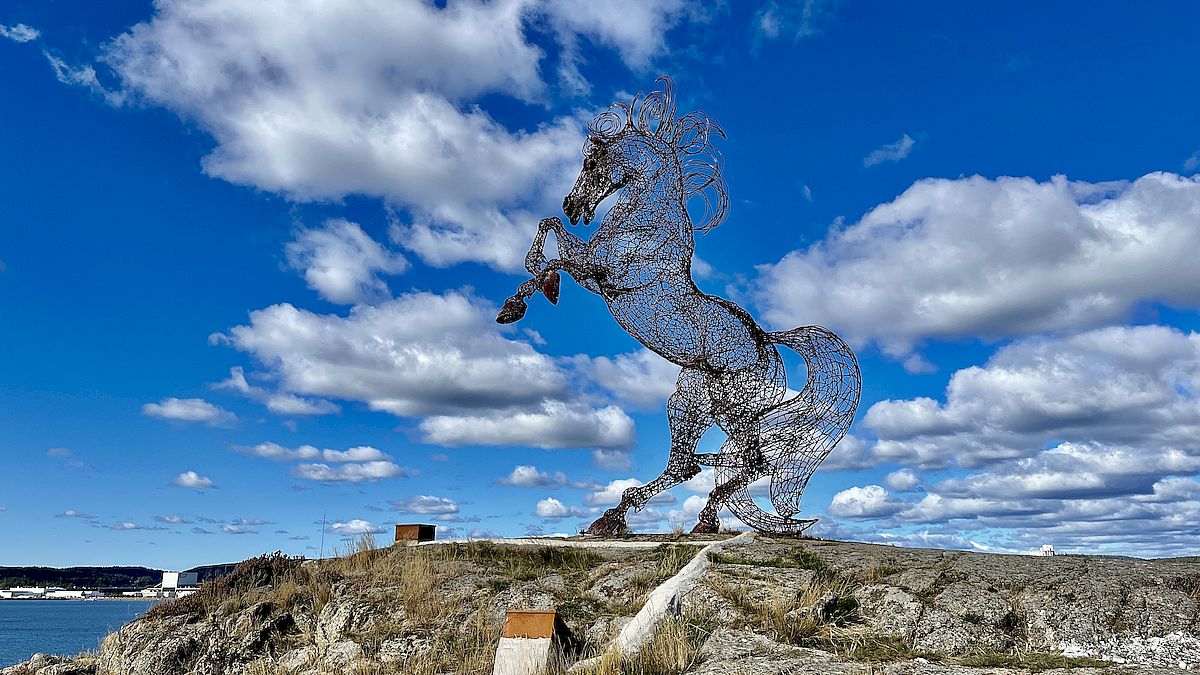
It is also when you walk that the smaller details begin to emerge. Along the walk you will encounter, among other things, the artwork Syrian Horse – a huge horse that's hardly something you just walk past without wondering what the hell it's doing there.
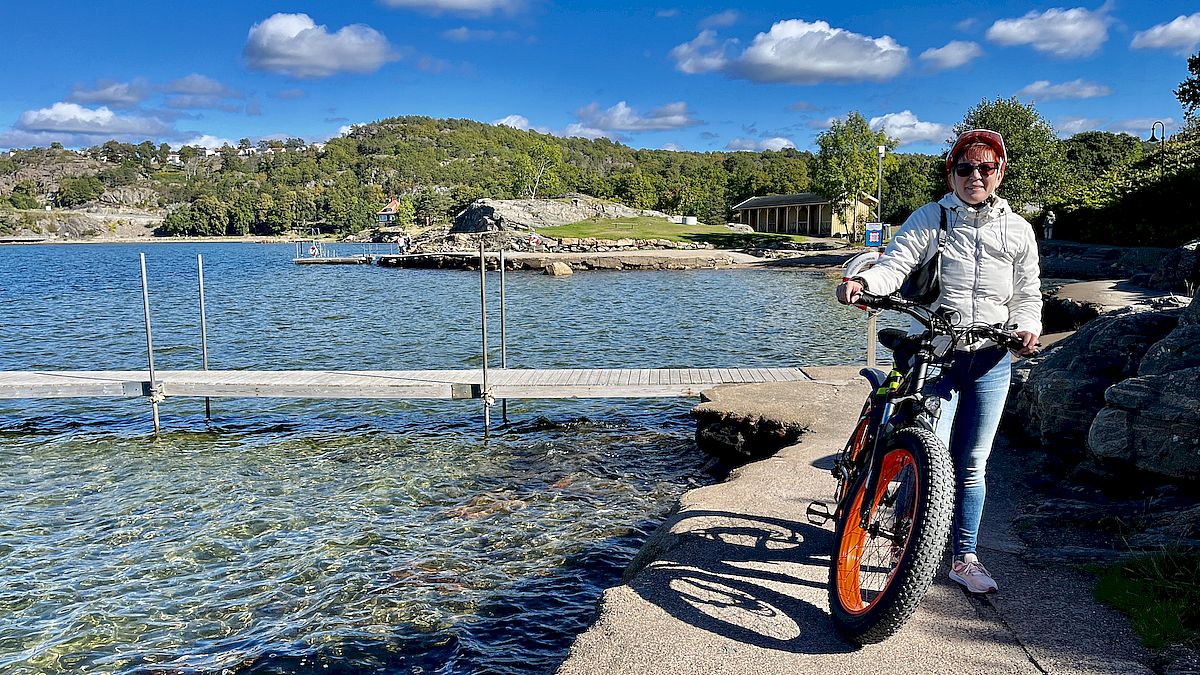
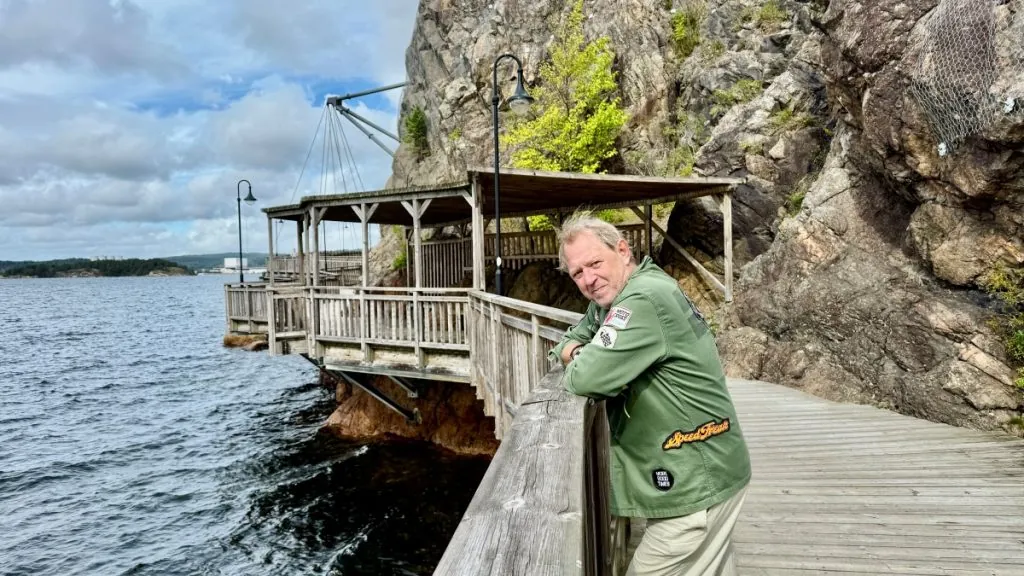
The promenade follows the Byfjord from central Uddevalla out towards Gustafsberg. In parts it runs on wooden trestles that cling to the rocks just above the water. The sea is always next to you, and along the way you pass both small swimming areas and places for winter swimming. We were content to look. September is September after all.
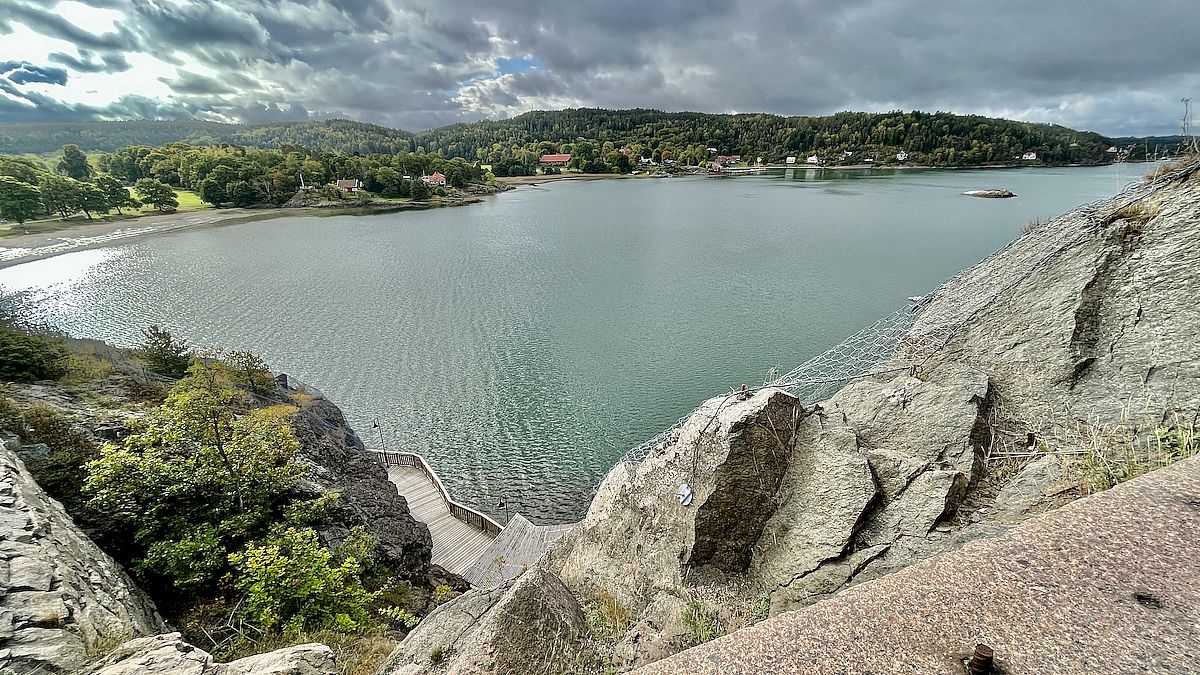
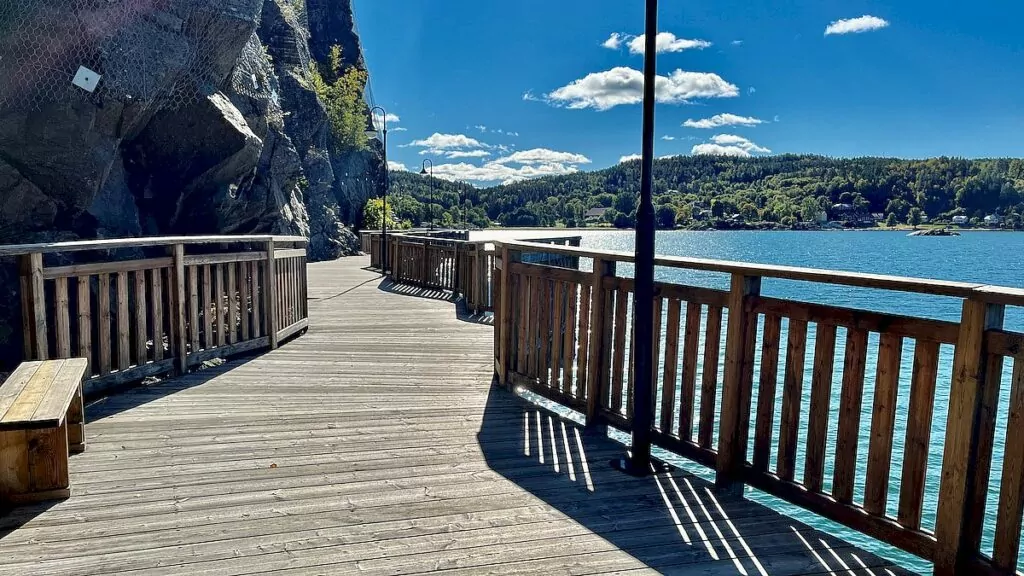
And that's what we like about the Strandpromenaden. It's not just a nine-kilometer walk from A to B. Sea, swimming, art, cliffs and views follow each other and mean there's always a reason to stop.
AND SUDDENLY EVERYTHING CHANGES
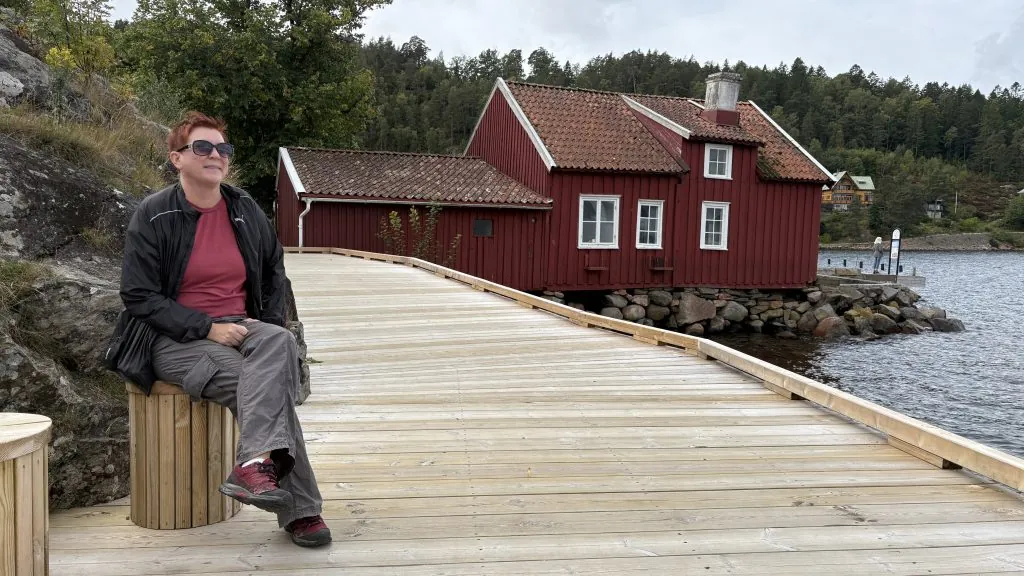
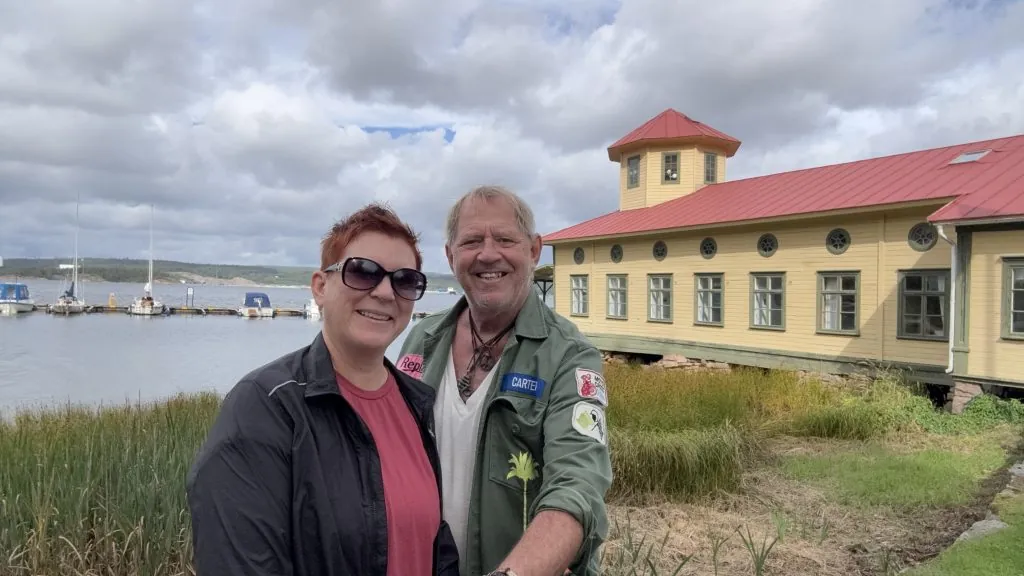
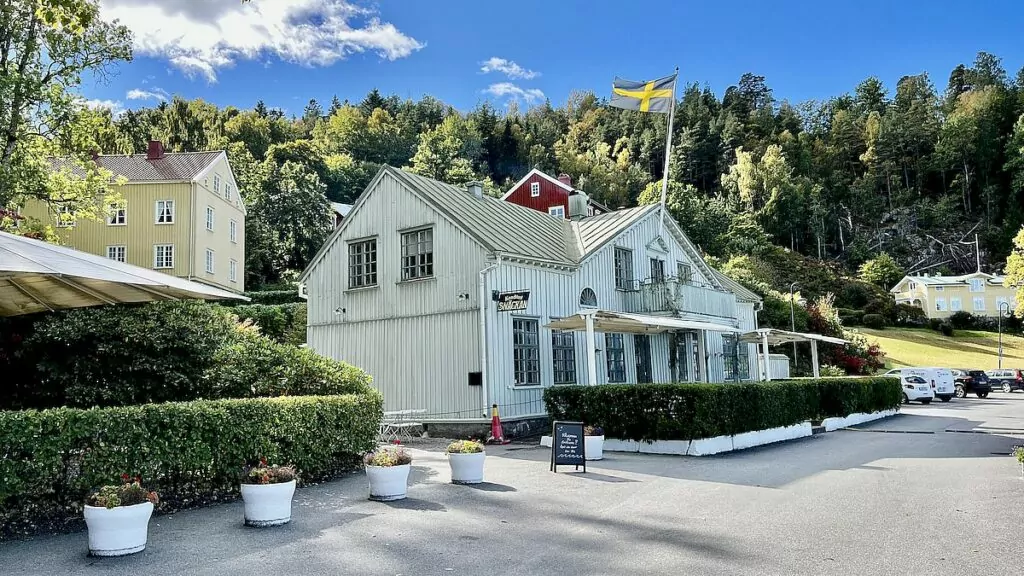
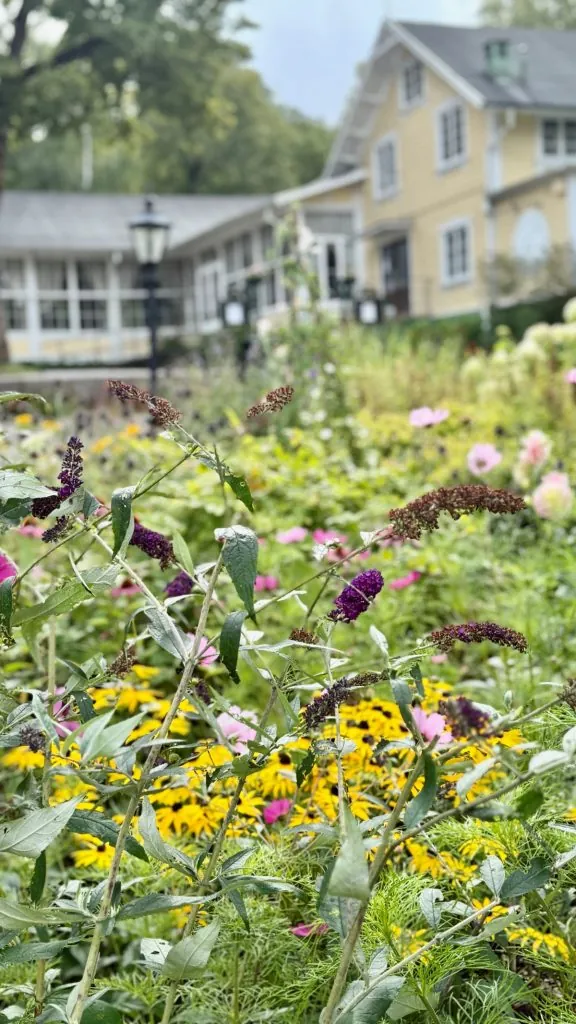
The closer we get to Gustafsberg, the more the environment begins to change. The cliffs and the sea are still there, but suddenly the old wooden houses appear. Finally we stand at the Varmbadhuset and the popular Café Snäckan, surrounded by beautiful buildings from a completely different era. This is where our walk ends.

But not our voyage of discovery.
Because we have just arrived at a place where people have come for over two hundred years to swim, drink from the well, walk and hopefully go home a little healthier than when they arrived.
Welcome to Gustafsberg.
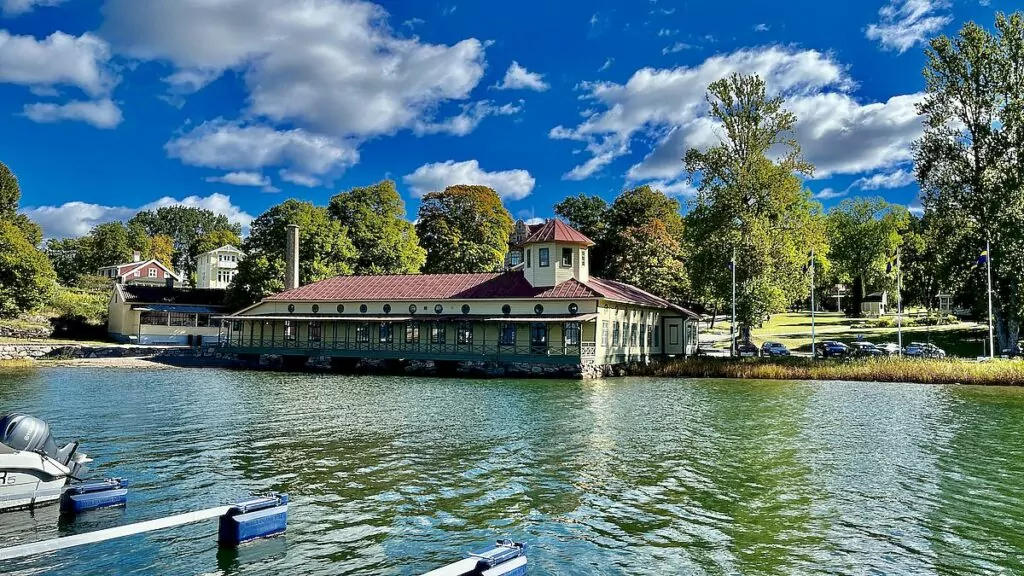
2. Discover Gustafsberg – Sweden's oldest seaside resort
When the Strandpromenaden ends, we suddenly find ourselves amidst beautiful old wooden houses, verandas and seaside resort environments. We had been here before, but when we came back in 2026 and really took the time to walk around, we began to understand what a strange little world Gustafsberg once was.
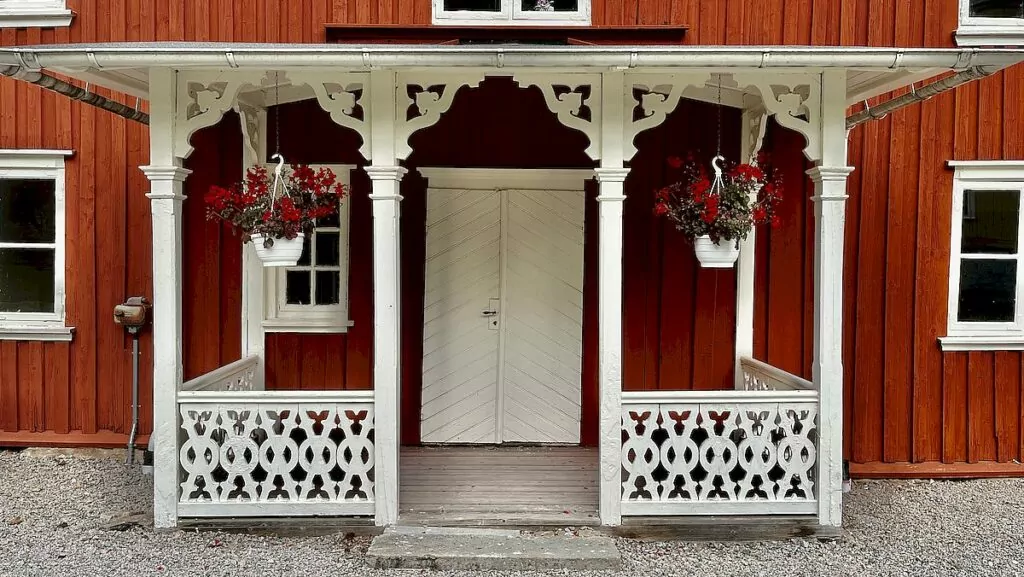
Because people didn't travel here primarily on vacation.
They came here to get healthy. As early as the 18th century, the mineral-rich water from the health spring was believed to be able to help with all sorts of ailments. Drinking from the well was fashionable and the water was prescribed in specific quantities – a glass every fifteen minutes or half an hour could be recommended depending on what the patient was suffering from. In the 1780s, drinking from the well was supplemented with salt baths and Gustafsberg is considered Sweden's first seaside resort.
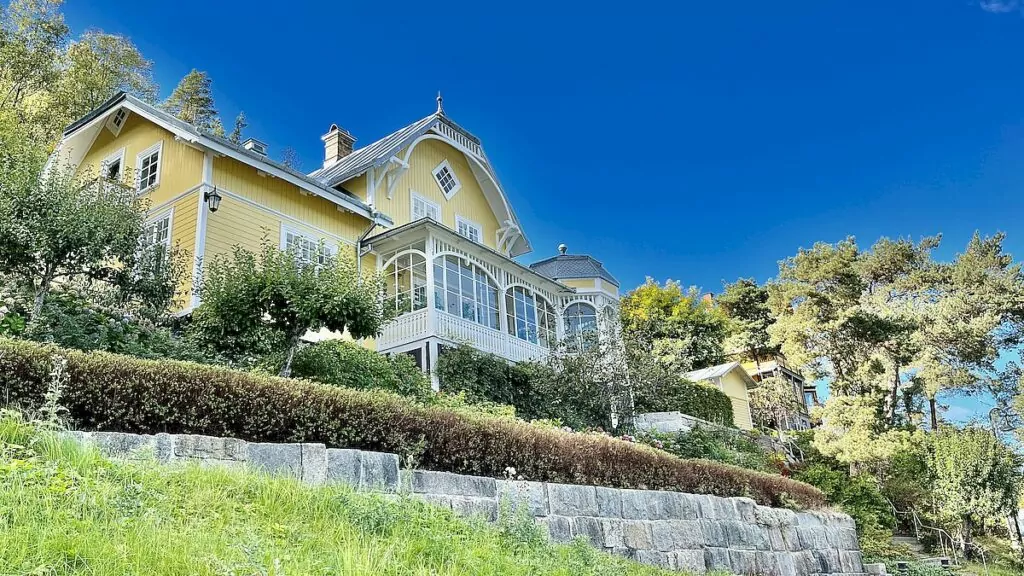
The big breakthrough came in 1804. King Gustav IV Adolf and Queen Fredrika took their sickly son, Crown Prince Gustav, here to swim. The boy perked up. It was just the kind of advertising campaign Gustafsberg needed. People started flocking here. In the 1830s, Gustafsberg was the seaside resort to be, and among the guests were names like Fredrika Bremer, Esaias Tegnér and Lars Johan Hierta. Until the mid-19th century, the place was considered Sweden's most luxurious seaside resort.
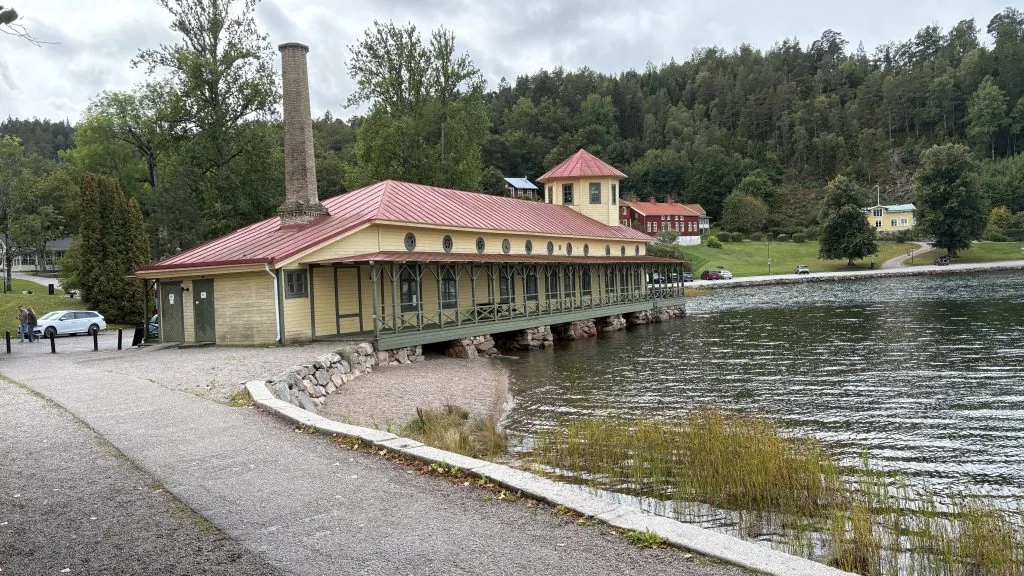
DRINK WELL – AND HOPE FOR THE BEST
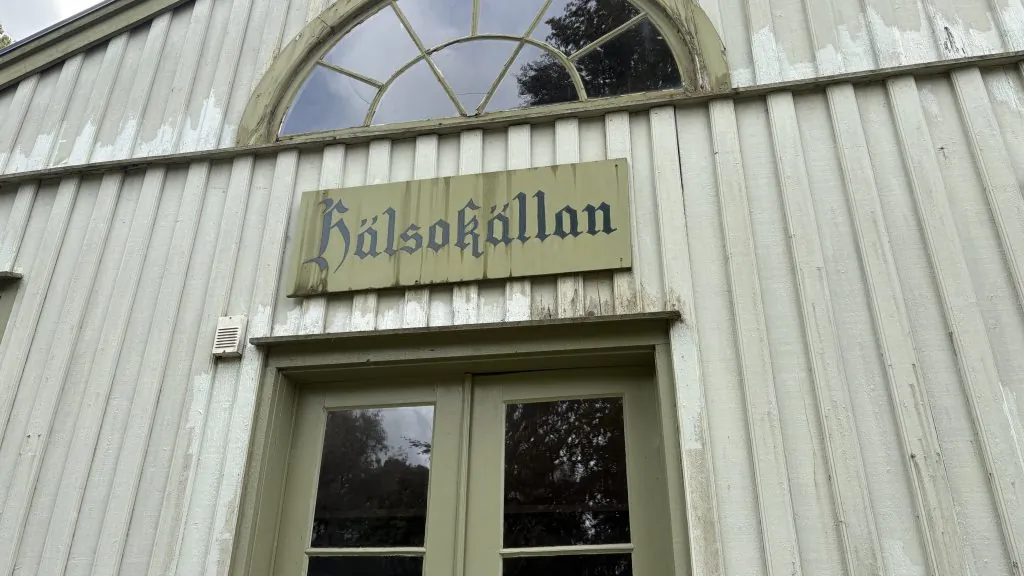
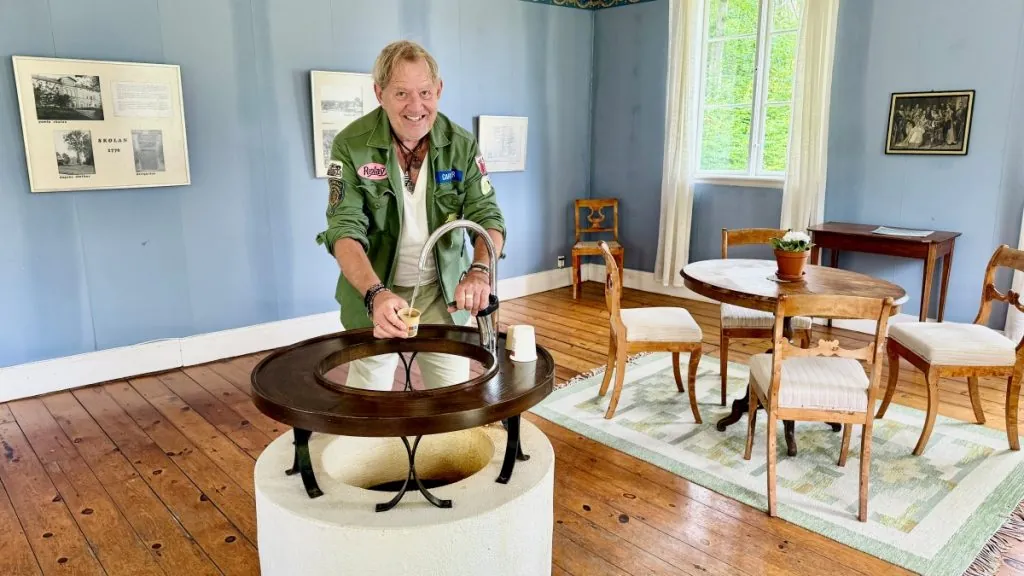
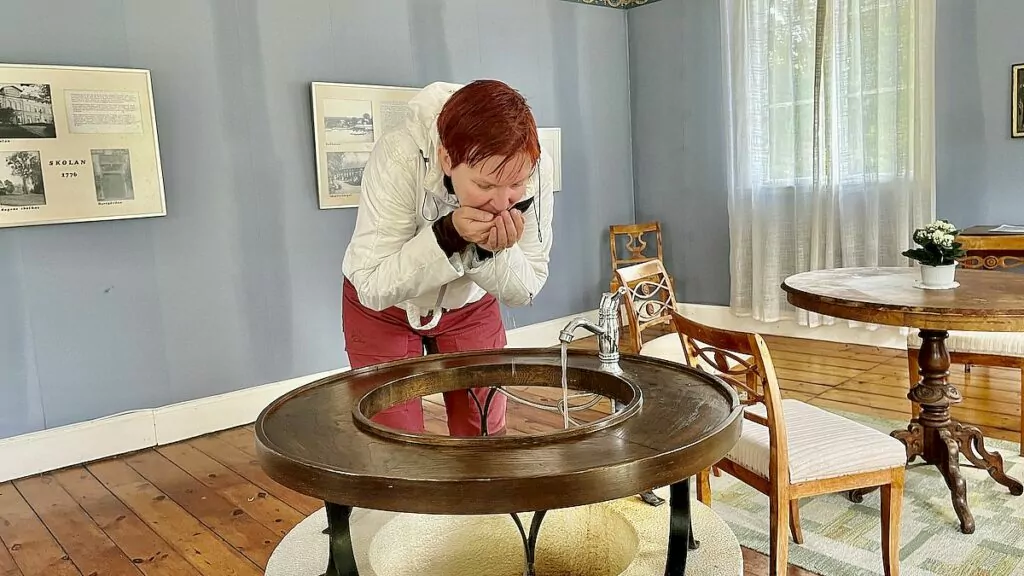
We went into the small pavilion with the health spring ourselves, just like we did when we were here in 2022. The pavilion is always open and here you can still try the water that was once drunk as medicine.
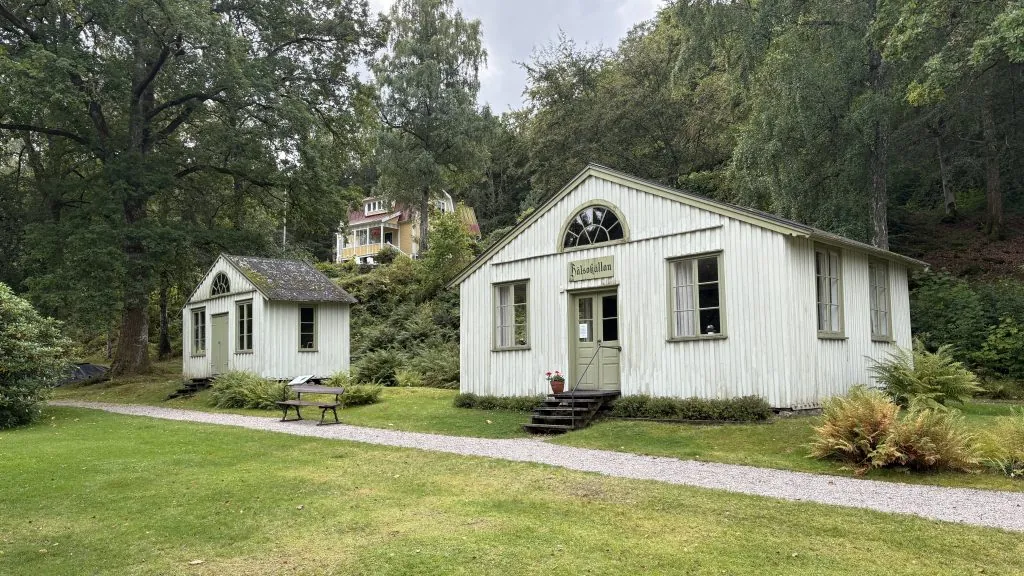
And of course you have to taste it. There is something very special about standing in the same place and drinking from the same spring as the bathers did over two hundred years ago.
At Gustafsberg you can literally taste history. In the 19th century, guests paid for four weeks of drinking from the well. The water was medicine, the treatment had to be followed, and a stay at Gustafsberg was seriously intended to improve health.
Today it is easy to smile at some of the old notions. But when we walk around here we also realize that the whole concept was perhaps not so crazy. Fresh air, walks, rest, swimming, nature, socializing. Remove some of the medical promises and add a pedometer and we almost have a modern health retreat.
A SMALL WORLD BY THE SEA
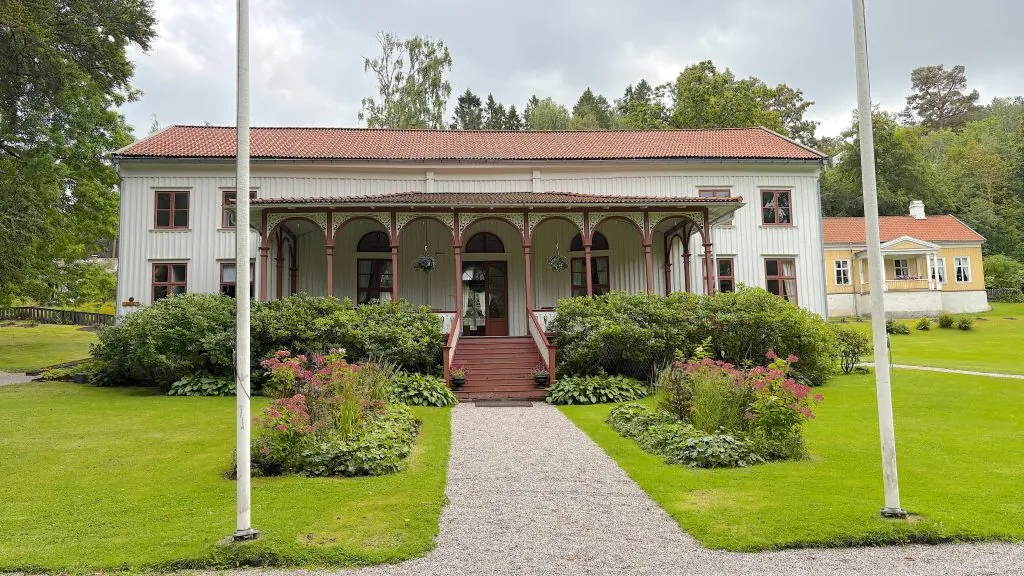
The beautiful houses around us are not just backdrops. Several were built as guesthouses when the seaside resort grew and were given names like The Castle, the Two and the Shell – names that still survive. Today, there are 26 listed buildings in the area.
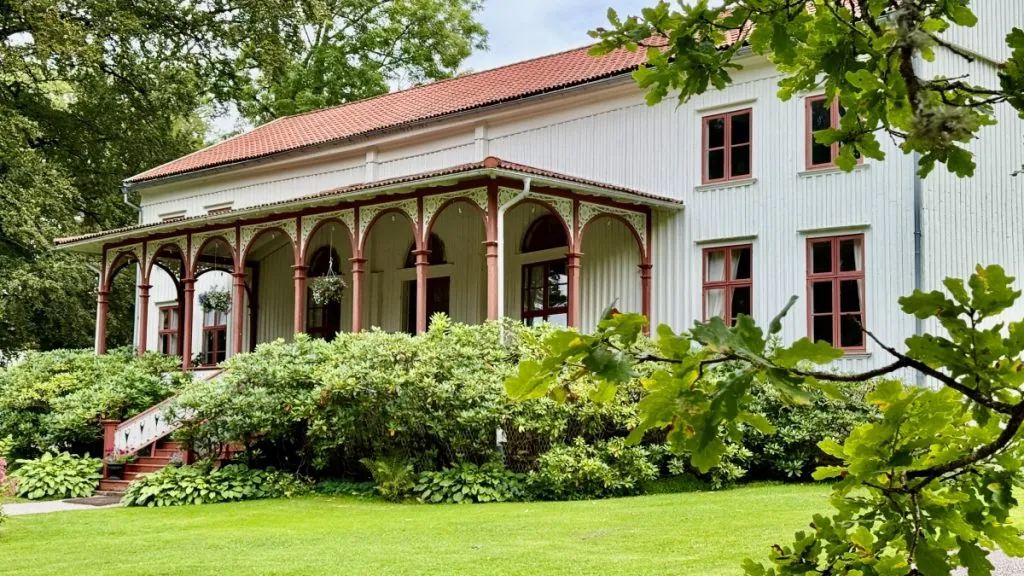
Sweden's first boarding school was also located here. The background was a foundation that Anders Knape Hanson and his wife Catharina created for gifted boys from Bohuslän who needed help with their homes and schooling. When Gustav III approved the foundation in 1774, the area changed its name from Baggetofta to Gustafsberg.
It creates quite a fascinating mix. Schoolboys would wander around here while royalty and wealthy bathers would come to cure themselves. Bathers would work long days, guests would drink from the well and take their baths, and in the evenings there would be music, theatre and balls in the Society Salon. We walk around the same houses almost two hundred years later with cameras in our hands.
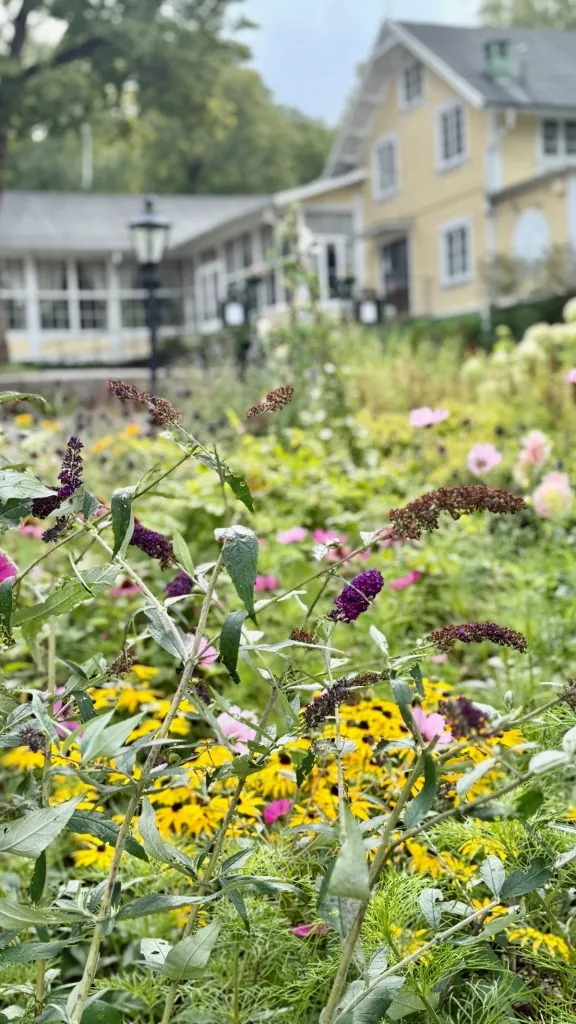
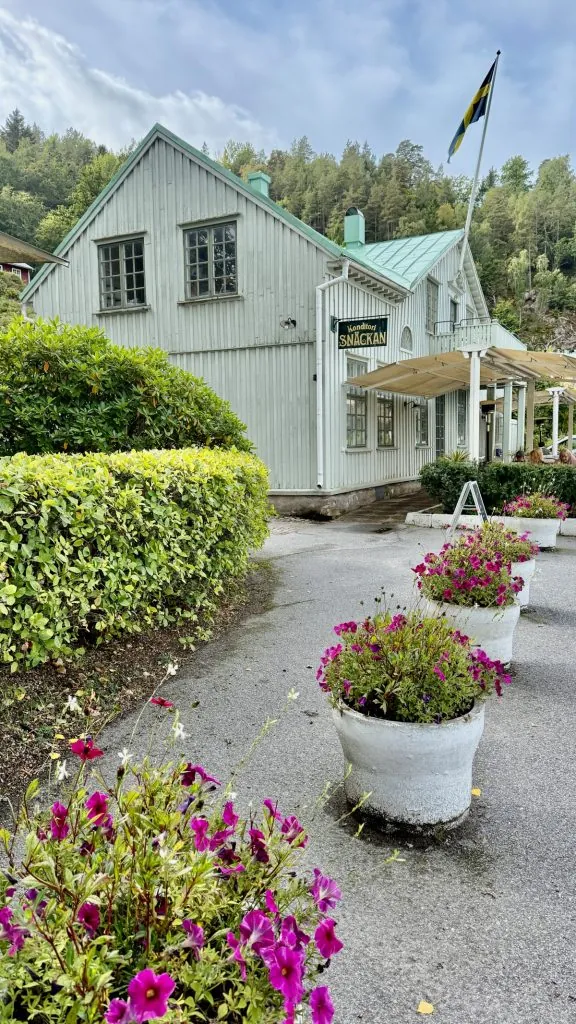
They are still standing.
And that's perhaps what we like most about Gustafsberg. History doesn't need to be imagined. You walk right in the middle of it. But there was another important part of spa life. You had to get moving. And from here you can still do that on a walk with a name that is much bigger than the route itself: Around the world.
3. Walk Around the World – a 5.5-kilometer health cure
After all the talk about drinking from the well, swimming and visiting Gustafsberg, there's really only one thing left to do. Go out and walk. It is also completely in line with the advice of doctors from more than two hundred years ago. Gustafsberg's first spa doctor, Dr. Marin, prescribed strengthening walks as part of a stay at the spa as early as 1810. Today, there is a hiking trail here Around the world, a 5.5 kilometer walk through nature around Gustafsberg.
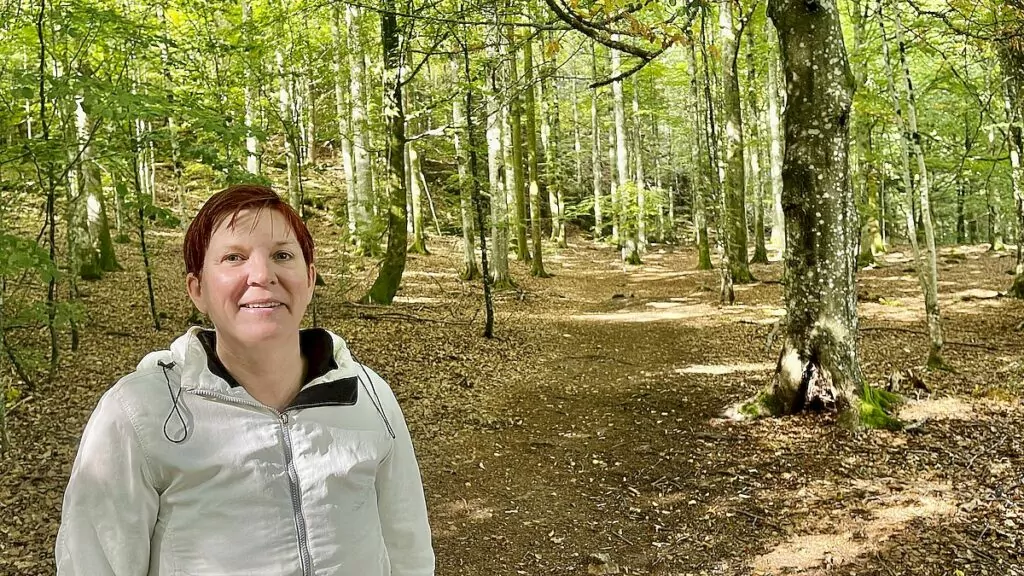
The name is almost as good as the walk. Archbishop Anton Niklas Sundberg and his wife Klara spent their summers here between 1855 and 1899, taking a walk every evening that they called Around the world. It went through the park, past the Society House and further around Lilla Bodele.
BODELEÅN – NATURE TAKES OVER
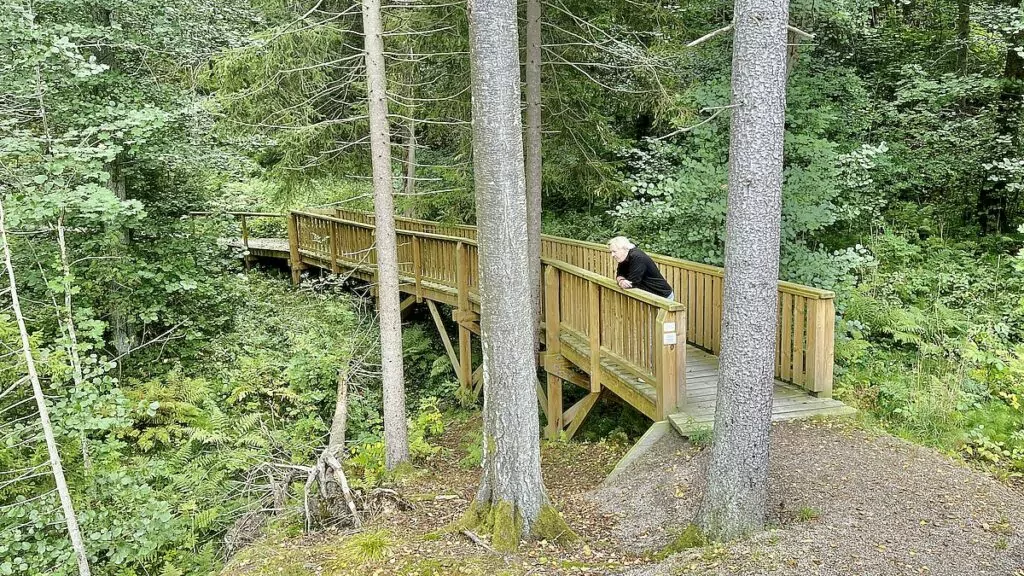
We decided to make our own version a little over a hundred years later. It won't be long before the beautiful houses on Gustafsberg disappear behind us and nature takes over. At Bodeleån it becomes green, leafy and considerably wilder than down at the seaside resort.
We stopped here with the cameras. It's the kind of place that might not make anyone travel 500 kilometers to Uddevalla – but it makes the walk itself better. And after all the royalty, spa doctors and socialite life, it's actually quite nice to have some ordinary forest.
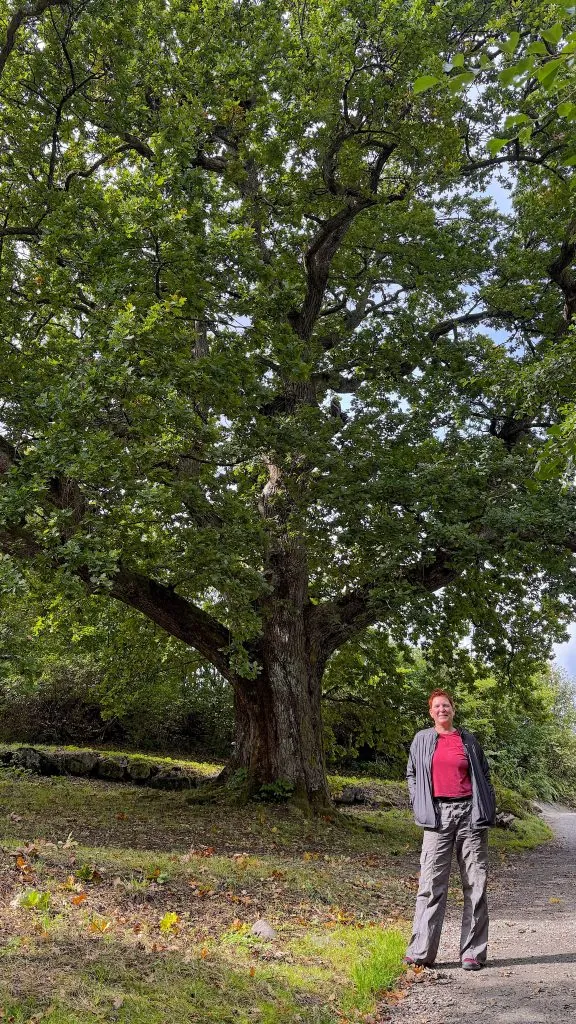
AN OAK TREE THAT WAS ALREADY OLD WHEN GUSTAFSBERG BECAME A SEASIDE RESORT
Then comes Gustafsbergseken. It is difficult to just walk past. According to the information on site, the oak is about 600–700 years old and measures 575 centimeters around the trunk. This means that the tree stood here long before anyone started selling well water as medicine or thinking about creating Sweden's first seaside resort. We photographed it of course, because people show respect for the elderly, especially when they are 700 years old.
KNAPES' VIEW – HERE'S WHERE YOUR LEGS GET PAID
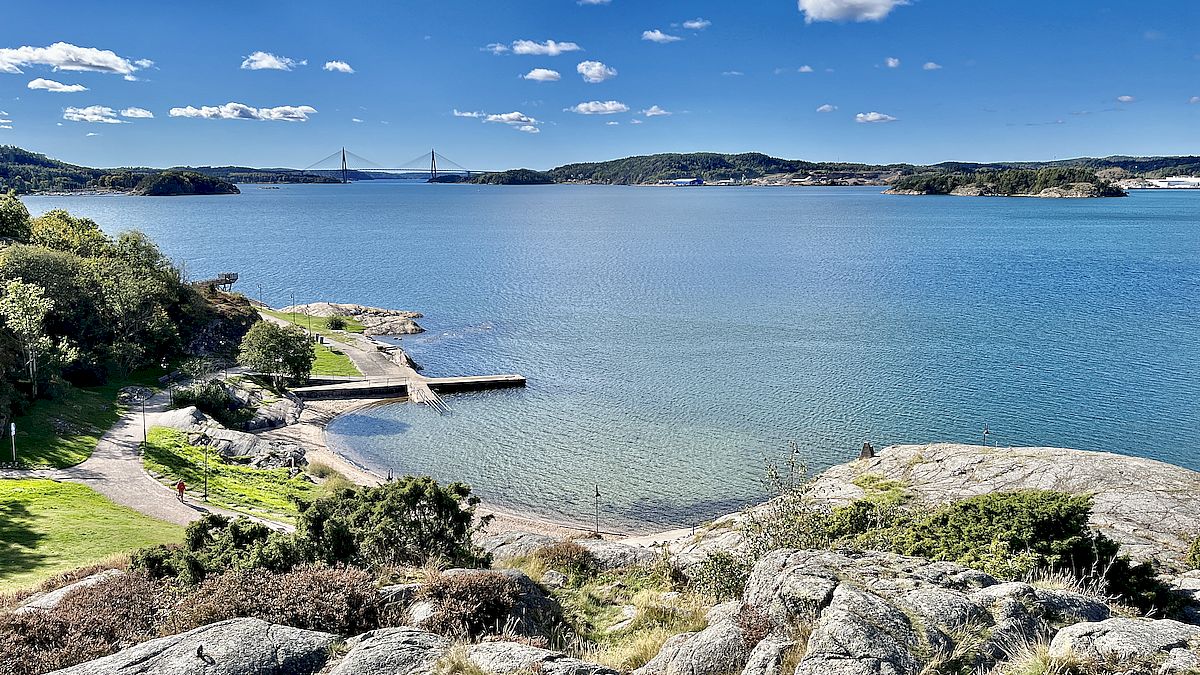
The next reward is Knape's View, where the landscape opens up and we get a view of the byfjord, the harbor and towards Uddevallabron. This is one of the places where we actually want the reader to stop, not just take the picture and walk away. After the Strandpromenaden, Gustafsberg and a bit of Jorden runt we suddenly start to see the whole area from above. The sea that has been next to us during the walk is now down there. It's the same journey – just from a new floor.
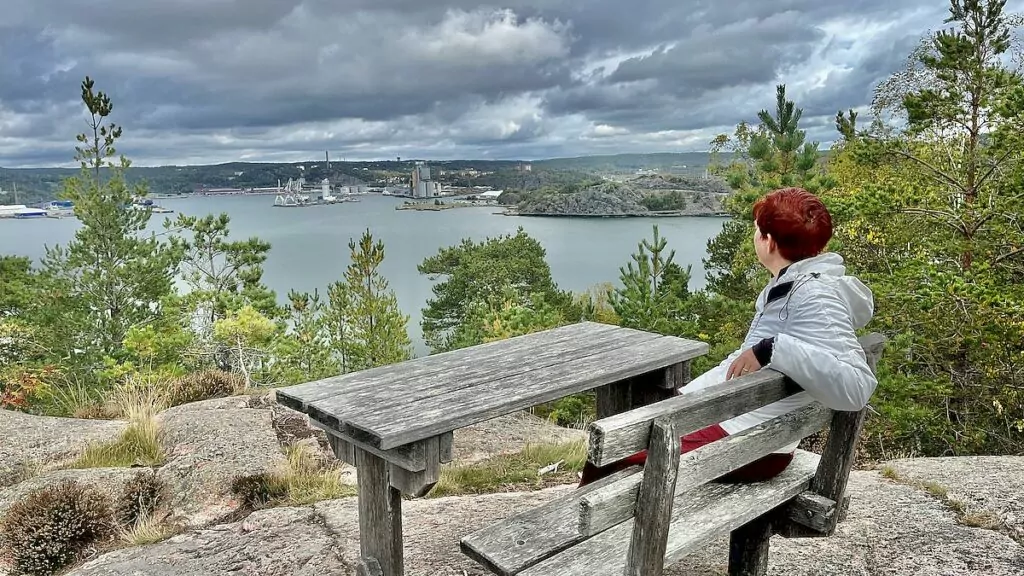
AND THEN THERE WAS THAT PIRATE CAVE...
There is one more stop along the Around the World tour that we actually discussed whether to look up. The large Pirate Cave. The boys who attended the boarding school at Gustafsberg used to play among the caves in the area. Today, the largest of them has been highlighted as a stop along the hike.
We stood in the morning and considered the matter, then we looked at the forest, Well. We had the Bodeleån River, a 600–700 year old oak tree and Knape's view on the memory card. Going out to look for a cave where schoolboys played over a hundred years ago had to be the limit.
We must leave something behind for the next generation of travel journalists, and maybe that's exactly how Gustafsberg was meant to be experienced. Drink water. Bathe. Breathe fresh air. Go for a long walk. More than two hundred years later, it's still hard to argue against the treatment.
4. Follow the Bäverån through central Uddevalla
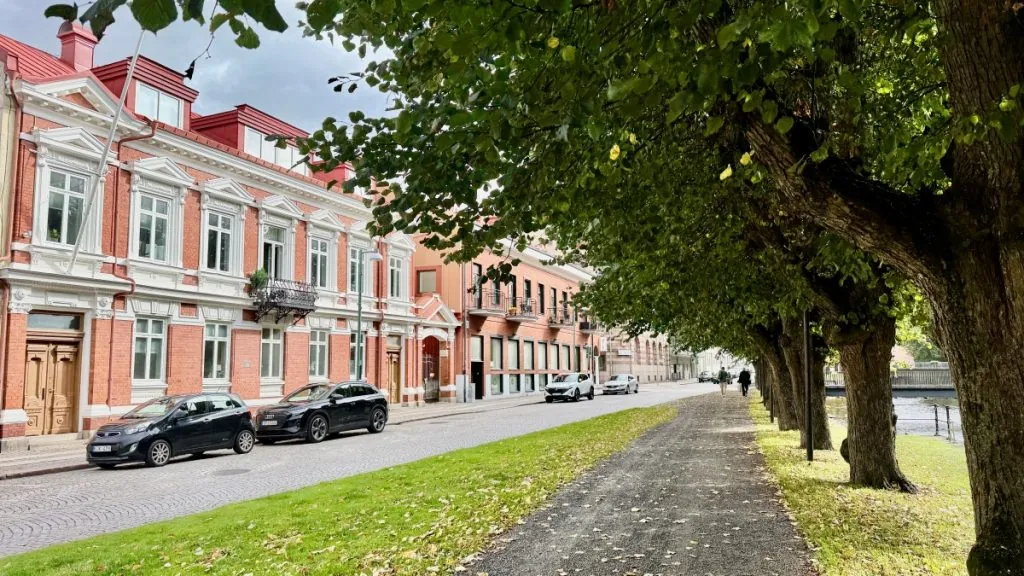
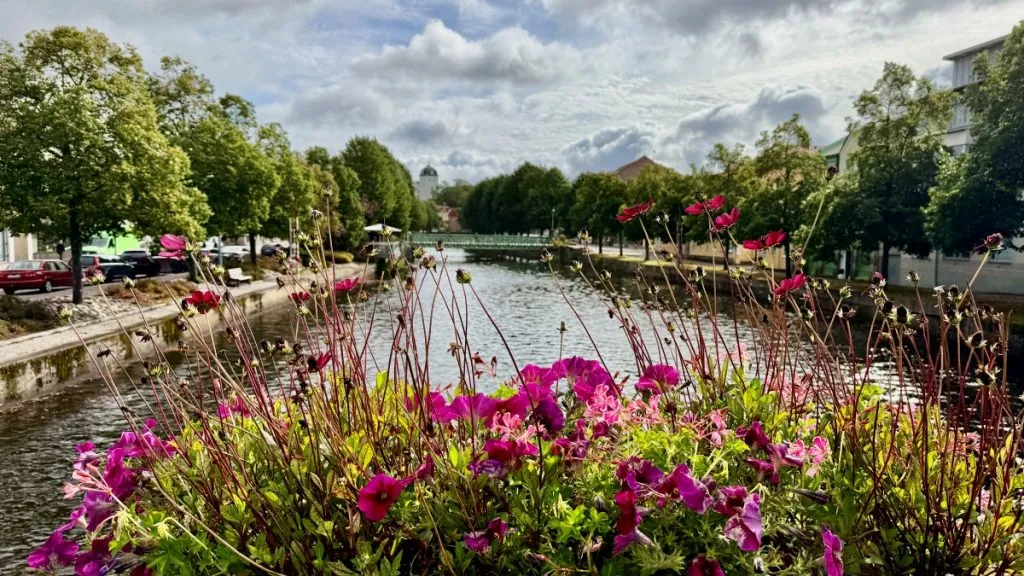
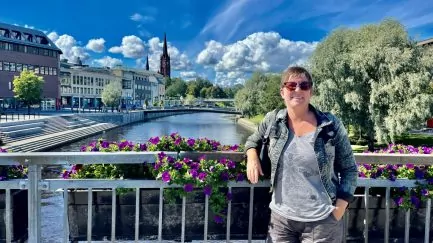
There is something special about cities where a stream or river runs right through the center. It's like you get two cities in one – one along the streets and one along the water. In Uddevalla it's called Bäveån, and as we walked along it, we realized pretty quickly that this is one of the best ways to discover the city center.
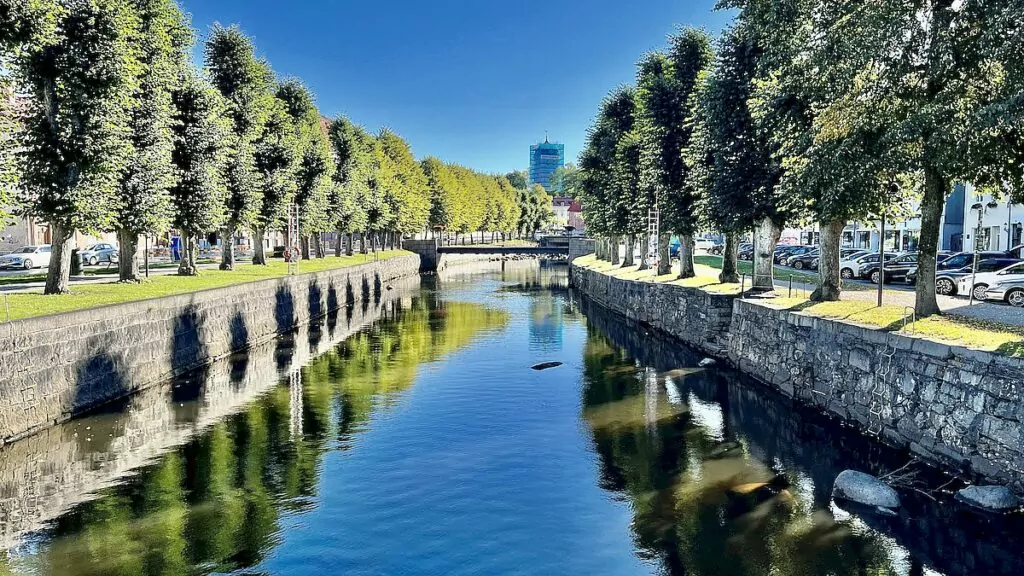
We started down by the water and barely made it to the first bridge before we stopped. In front of us were two absolutely enormous anchors. I tried to imagine the size of the ships that once needed anchors of this caliber and couldn't quite get the proportions right. There is also a memorial site here for sailors who died during the wars, marked by two old black anchors.
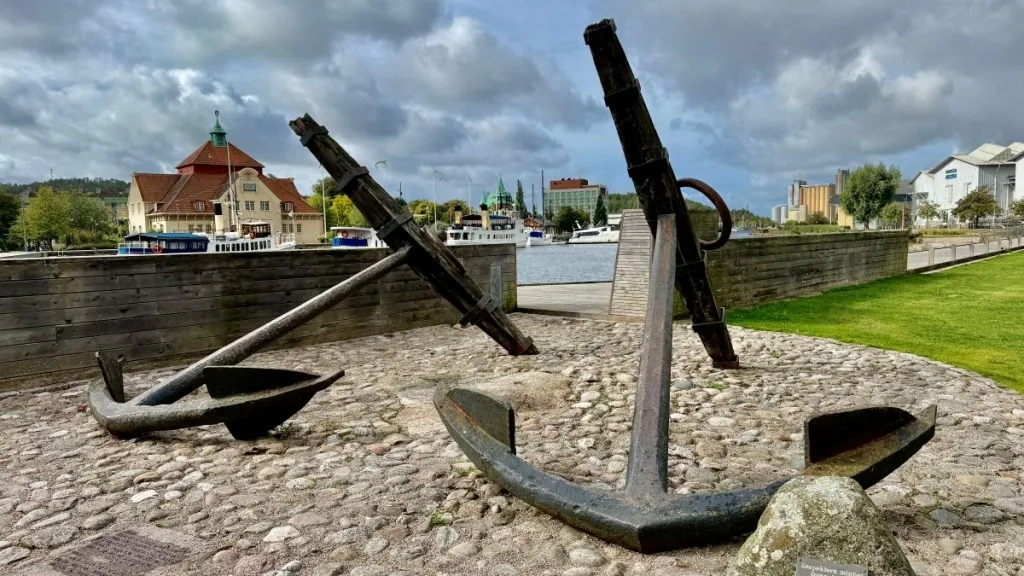
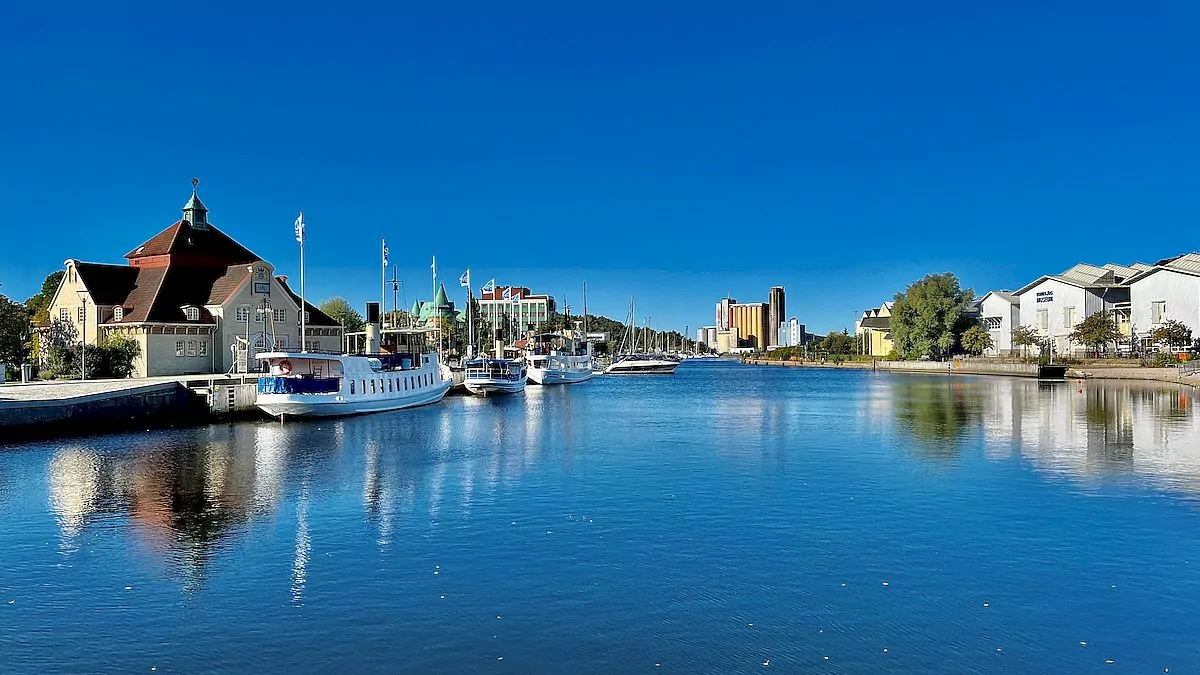
On the other side of the Bäveån River, Uddevalla's three white archipelago boats were lined up – Gustafsberg II, Sunningen and Byfjorden. The two oldest are from 1898 and 1911 and still have their characteristic steamboat chimneys. Peter was lost there. He loves boats like that and immediately began to fantasize about the time when men walked around in white shirts, vests, jackets and hats while women wore long dresses. Back then, the people were as beautiful as the boats.
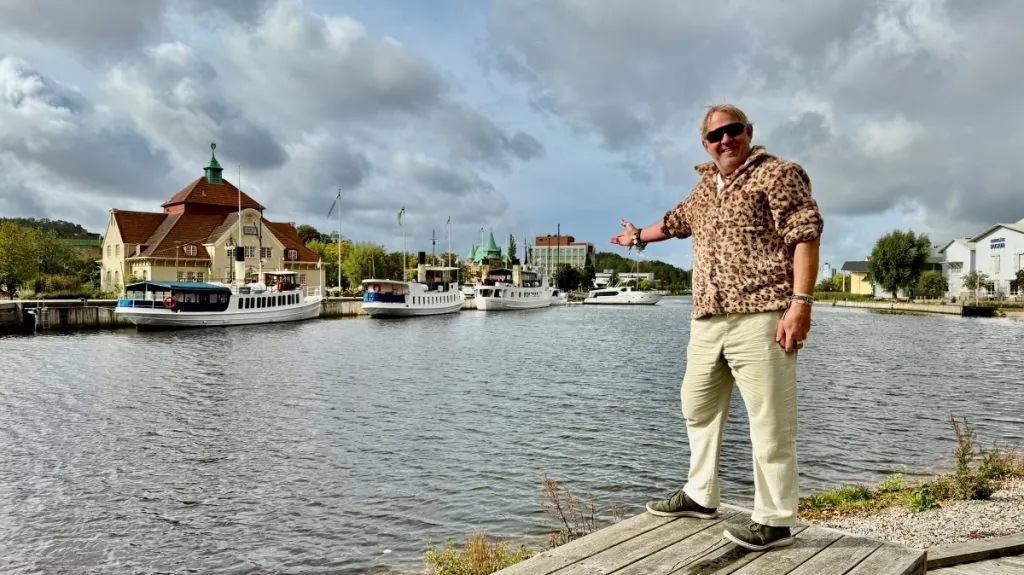
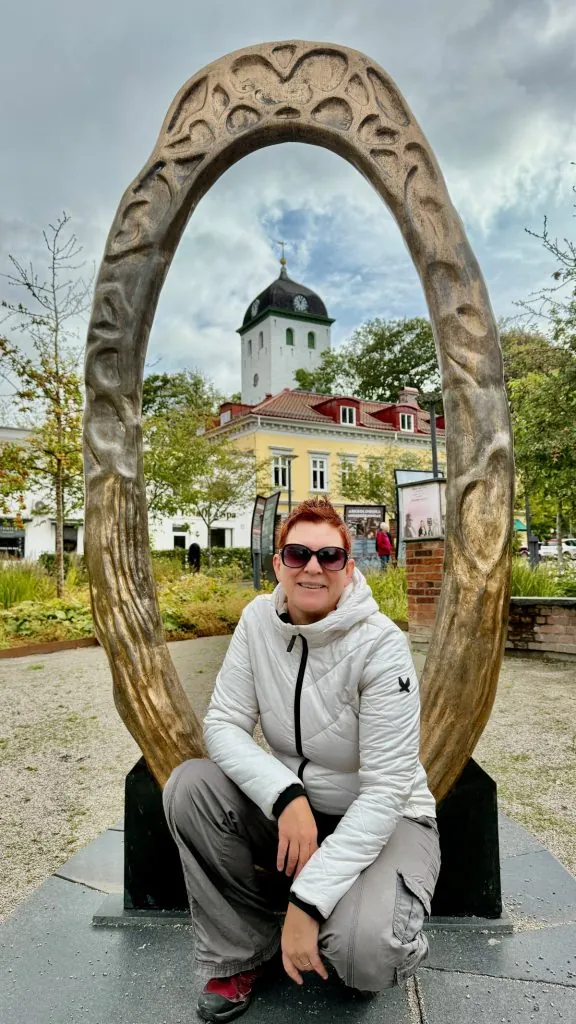
The clock tower is Uddevalla's own lighthouse.
A little further up we caught sight of the bell tower against the sky. At first we didn't see any churches nearby and it almost made the tower feel like its own little landmark in the middle of the city. That sticks with us much better than just another address or intersection.
Peter's advice: If it gets foggy in Uddevalla – or a little too foggy after a visit to a pub – aim for the clock tower. It works almost like a lighthouse. Suddenly you at least know where you are somewhere.
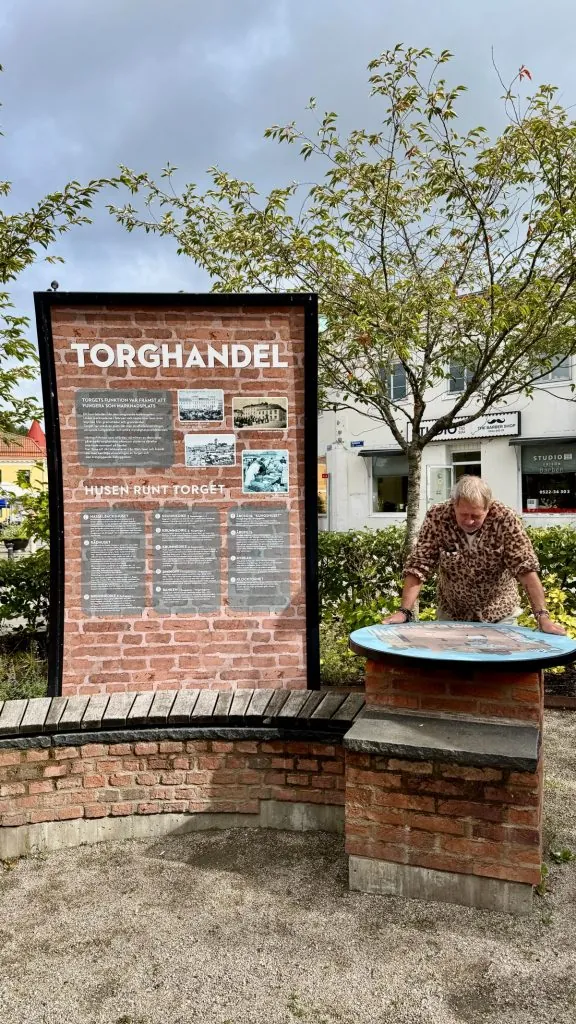
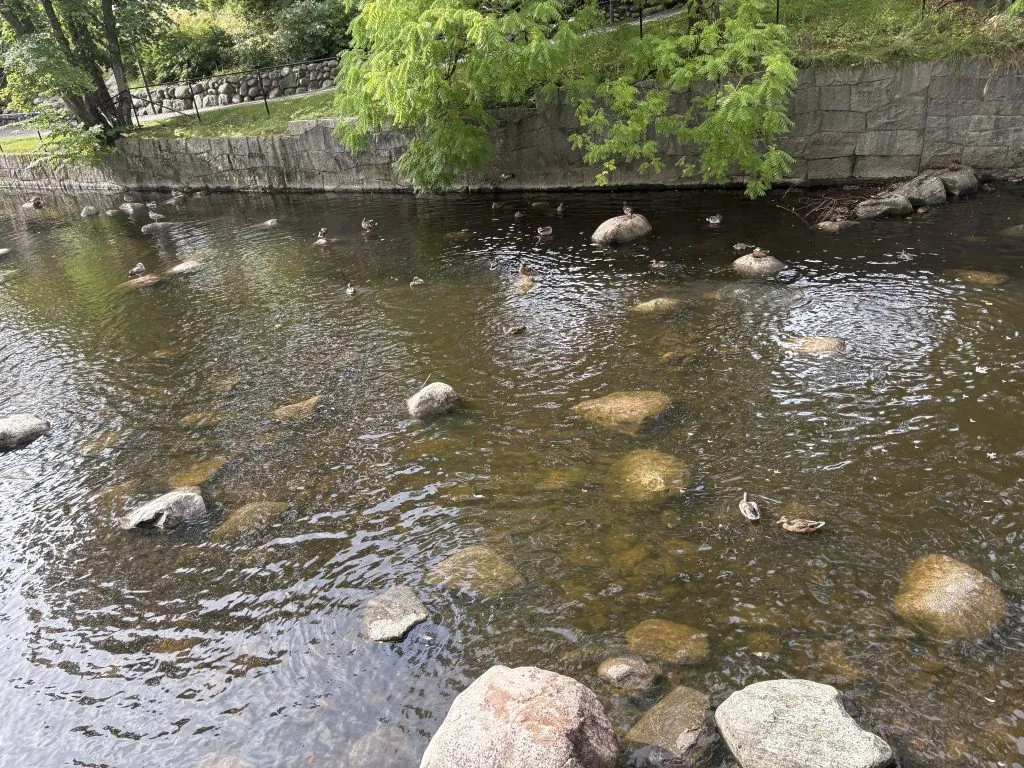
We continued along the river and soon there was a lot of bird life. Every stone sticking out of the water seemed to be an attractive plot of land and there was a loud discussion about who actually had the right of possession. Who doesn't want to sit nicely when people are standing and taking pictures?
And then came the little rapids
We passed the church and continued until the Bäveån suddenly changed personality. In the middle of the town came a small rapid where the water rippled and roared between the stones. We stood and listened, and just then the church bells began to ring. It was one of those moments that you can't plan. The water, the bells and the town around them melted together and for a few seconds Peter almost wanted to go back to the church.
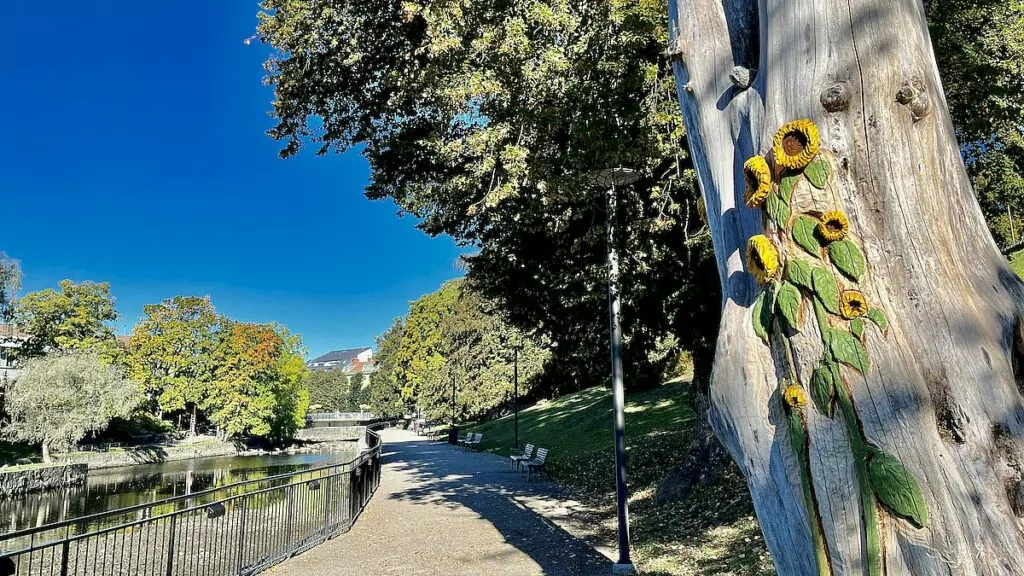
Then Helena cried out: We haven't set up the app for the parking! The spiritual experience was over. We picked up the pace back along the Bäveån River, passed the pensioners playing boules at the bus terminal, and arrived at the camper about fifteen minutes after we left it. There it was already sitting on the windshield.
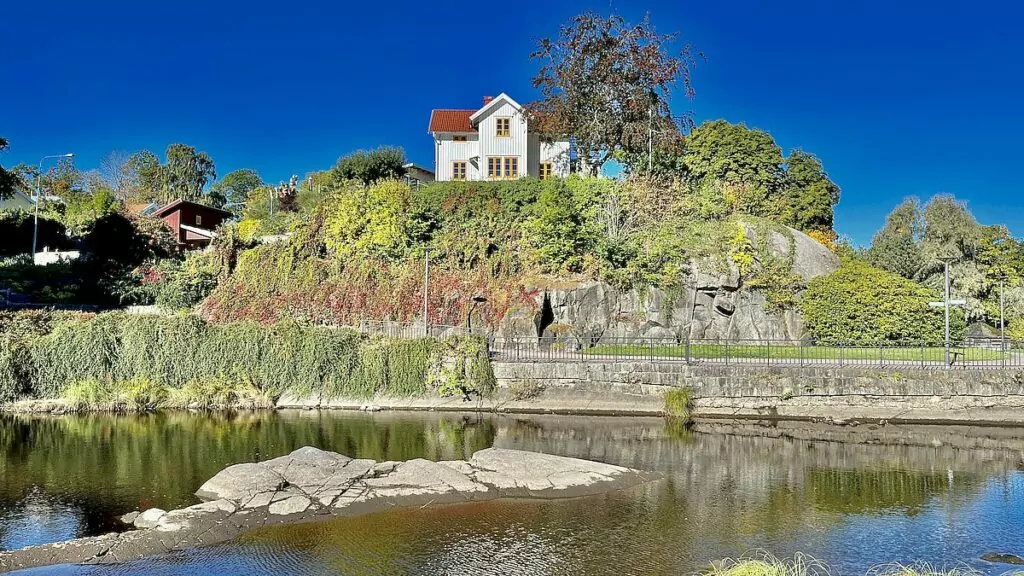
400 kronor. So we had traveled to Uddevalla to photograph, write and tell our readers why they should come here – and Uddevalla had managed to send the invoice in fifteen minutes. We moved the camper, left the yellow note behind and continued the day in a good mood. There is not much else to do. Shit happens, and the Bäveån River? It was still there, just as beautiful as before the parking fine.
5. Discover the Shell Banks – The Seabed That Ended Up on Land
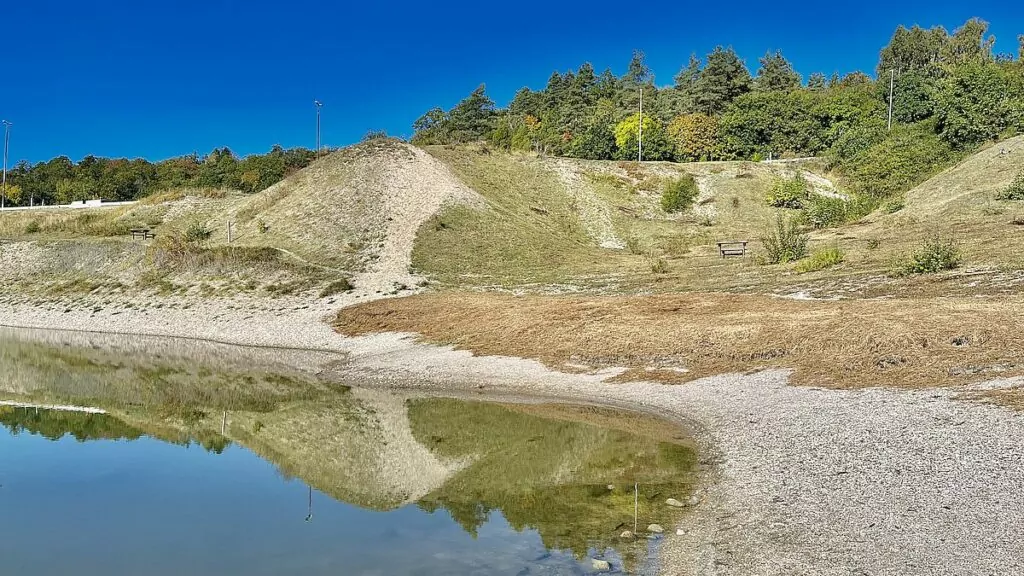
It's hard to understand what you're really walking around when you come to Skalbankarna in Uddevalla. Today we see hills, grass, trees and a small pond. But about 11,000 years ago we would have had to swim here – the place was under a cold and incredibly rich sea.
We are very glad we made it here, because this is not just another nature reserve to check off. Uddevalla has the world's most powerful shell banks and in some places the layers of shells have become up to 20 meters thick. These are the remains of a sea life so rich that even Carl von Linné, when he came here in the 18th century, was amazed at the amount of life that must have once existed here.
AN OCEAN FULL OF LIFE
As the ice sheet retreated, meltwater flowed through the then Uddevalla Strait, while salty, nutrient-rich seawater was pushed in the opposite direction. The result was a near-perfect environment for plankton, mussels, snails, barnacles, crustaceans and fish. When the animals died, the shells accumulated in enormous layers on the seabed for hundreds of years.
And it's only when you start reading what the scientists have actually found that your imagination takes off. In the shell banks, fossils have been found for 103 different marine invertebrate species, but also remains of fish and much larger visitors. There have been seals and other seals here, but also beluga whales, humpback whales and killer whales.Think about that for a moment.
We are standing in Uddevalla looking out over a green hill. Just over 10,000 years ago, a Humpback whales swim past here. That's what makes Skalbankarna so amazing. It's not a museum where someone has collected history and put it behind glass. We are standing in the middle of the old seabed.
THE SEAFLOOR LANDED
As the heavy ice sheet disappeared, the land slowly began to rise. The sea receded and the shell banks eventually ended up well above today's sea level. Today they are about 55–75 meters above sea level – despite the fact that everything around us was once formed under water.
Humans later did their best to use the strange white hills. Shells were dug up and used for roads, railways and chicken feed, among other things. So much was lost that what remains today is protected as a nature reserve.
There are also traces of some of Bohuslän's very first people on the heights around the old strait. Here, around 11,000-year-old settlements have been found, including flint tools and arrowheads. These people literally lived on the shores of the sea that we are now trying to imagine.
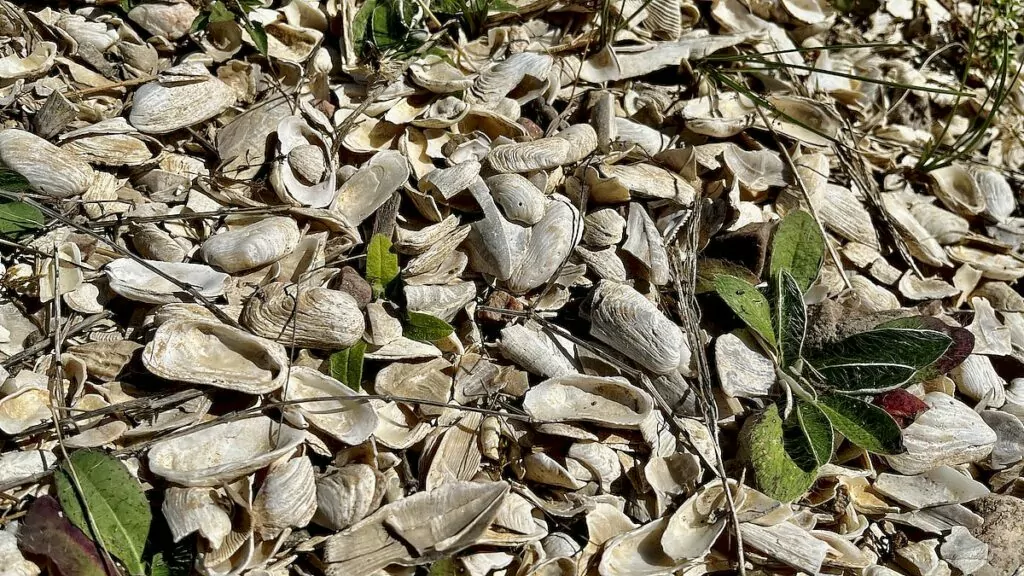
WALK AROUND THE 11,000-YEAR-OLD SEAFLOOR
We think you should leave the car and actually walk here. From the Skalbanksmuseet there is a marked loop of about two kilometers through the reserve. The museum is only open during parts of the summer, but the Skalbankarna themselves and the hiking trail can be visited all year round.
It's not a spectacular place in the usual Instagram way. No huge cliff rises in front of us and no viewing platform tells us exactly where to take a photo. The power is instead in our heads when we understand what we are actually doing. Barnacles. Mussels. Fish. Seals. Beluga whales. Humpback whales. Killer whales, and then we 11,000 years later.
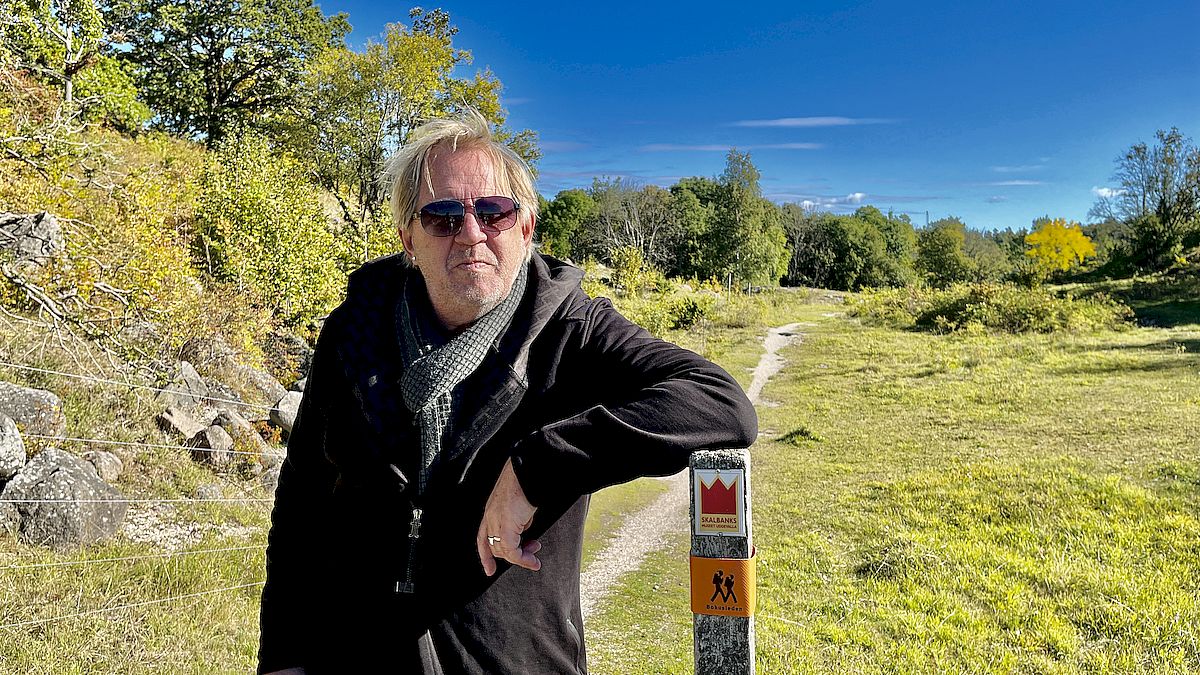
6. Meet Ture Malmgren – The Man Who Built His Own Castle
There are people who are content with building a house. Ture Malmgren was not one of them. When we started reading about the man behind some of Uddevalla's most remarkable buildings, we quickly realized that it's hard to separate the man from the sights. Ture Malmgren was born in 1851, founded the newspaper Bohusläningen in 1878, worked as a printer, was politically involved, and clearly had much bigger plans than just publishing tomorrow's newspaper.
FIRST WE BUILD A HOUSE
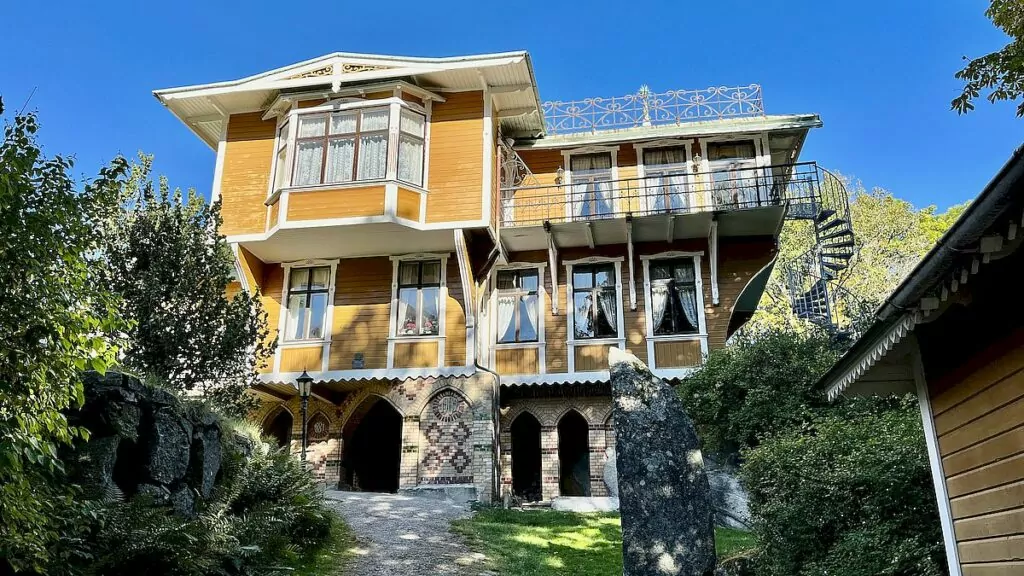
In 1887, Ture began building Villa Elfkullen on a hill by the Bäveån River. Originally intended as a summer villa, the house was later expanded and became a permanent residence for Ture and his wife Hilma. And it is already clear that the man did not directly order the standard model from the catalog.
Here, different styles are mixed, including Art Nouveau and a Chinese-inspired tower. A local historical description also tells of maple chests and a safe blasted into the rock. When we stood in front of Villa Elfkullen, it was easy to understand that the man who lived here didn't think quite like everyone else. But an imaginative house apparently wasn't enough.
THEN WE BUILD A CASTLE
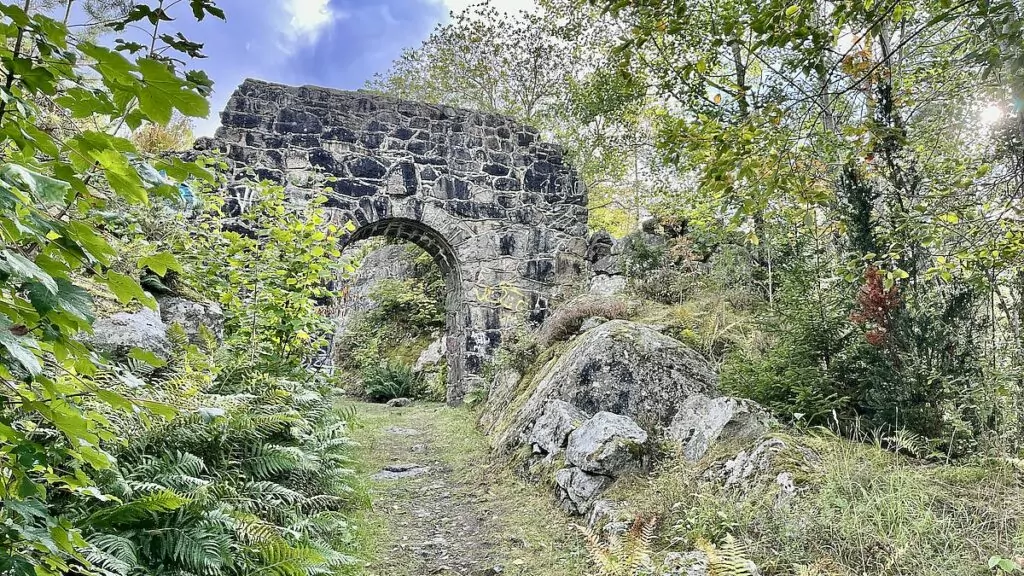
In 1899, Ture Malmgren began building his own knight's castle on the mountain above. Inspired by the Middle Ages and the romance of knighthood, construction continued until 1912 without actually being completely finished. The castle had around 40 rooms and several towers, and grand banquets were held here.
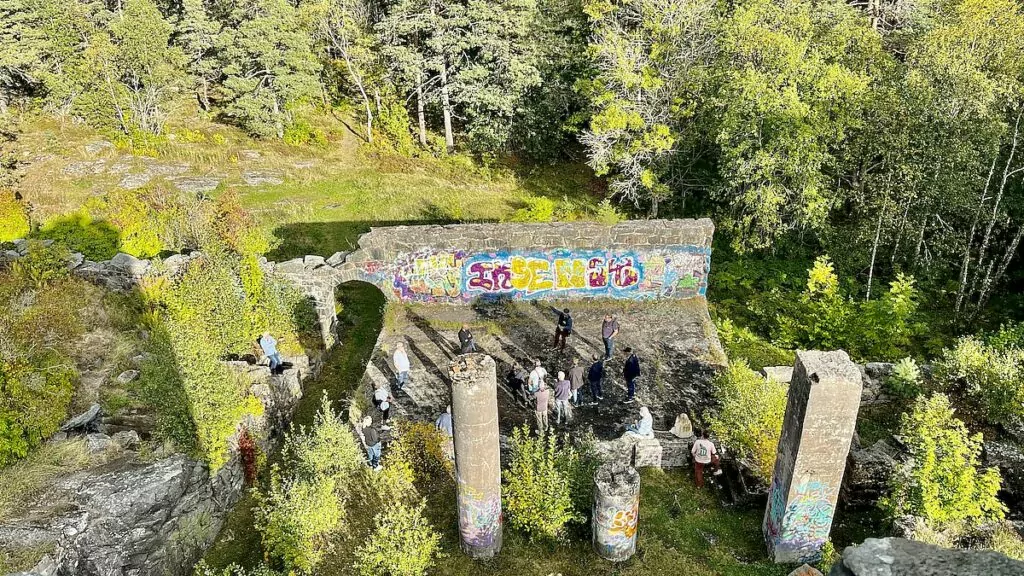
In our separate article about Tureborgen, we have delved much deeper into what it looked like. There was a knight's hall, a room in Bedouin style, a bowling alley and a music room with three pianos. The walls were adorned with art and among the artists was Anders Zorn.
SECRET PATHS – NOW IT STARTS TO GET FUN
Of course, stories grew up around Tureborgen. One of the most persistent ones says that there was a secret tunnel all the way between the castle and Villa Elfkullen. However, it seems to be just a legend. The Tureborgen Society, on the other hand, describes shorter secret passages inside the castle itself, including a hidden entrance that was reportedly opened by pressing a twig in the wooden panel.
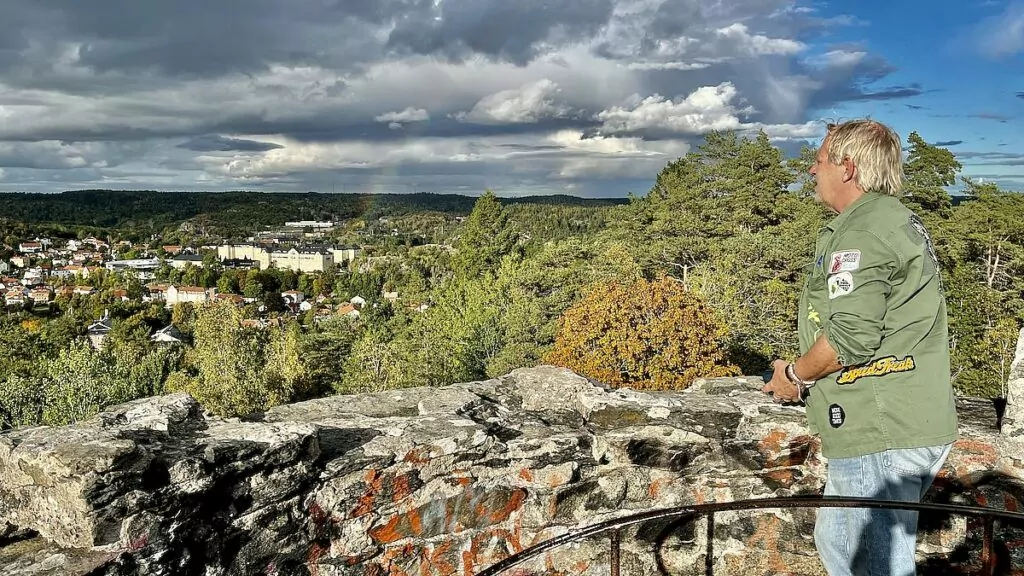
And here we are almost starting to get a little jealous. Own newspaper. Villa with Chinese tower. Lönnfack. Secret passages. Riddarborg. Ture Malmgren seems to have lived as if someone had forgotten to tell him that reality had certain limitations.
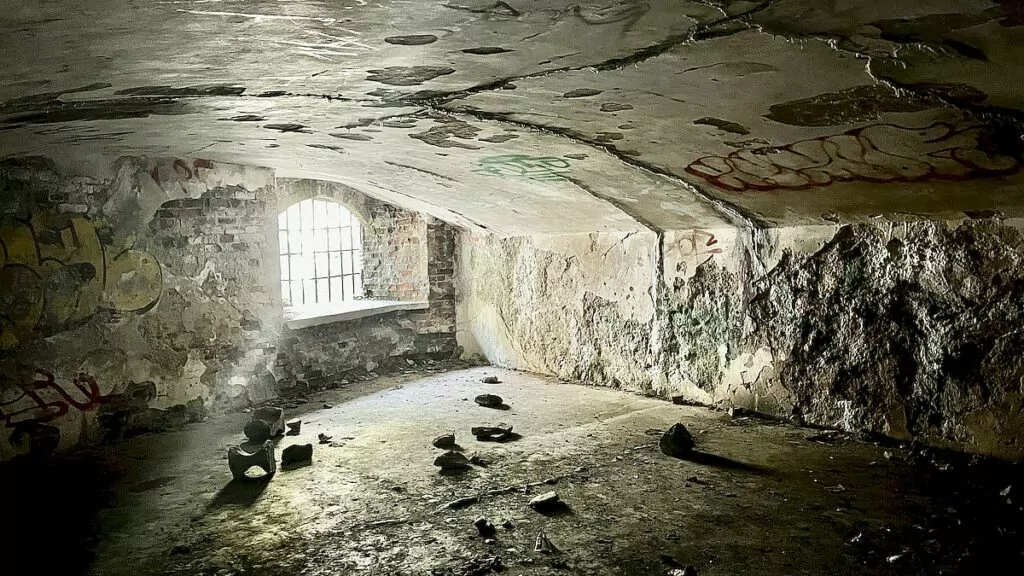
WE WENT UP TO THE CASTLE
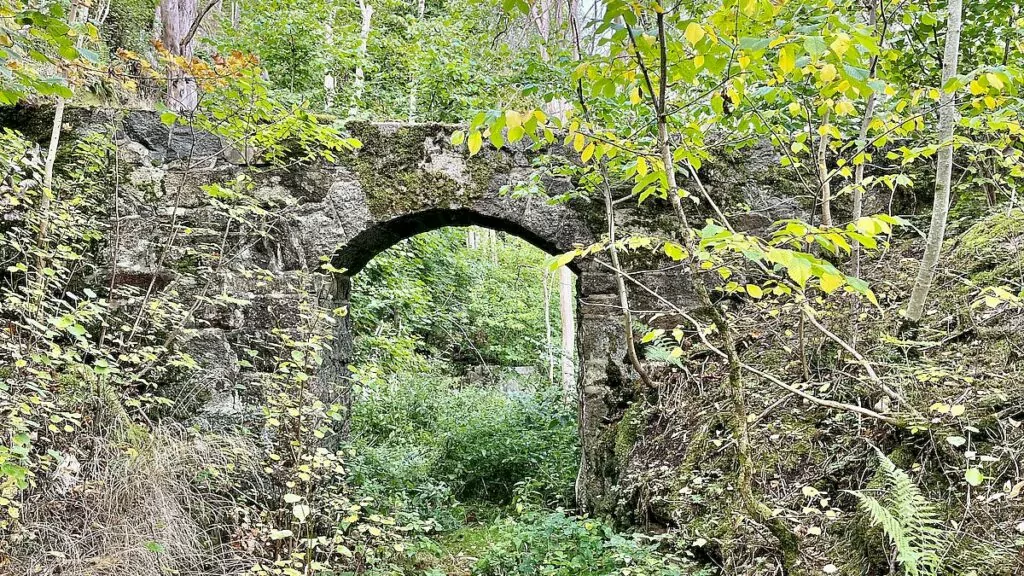
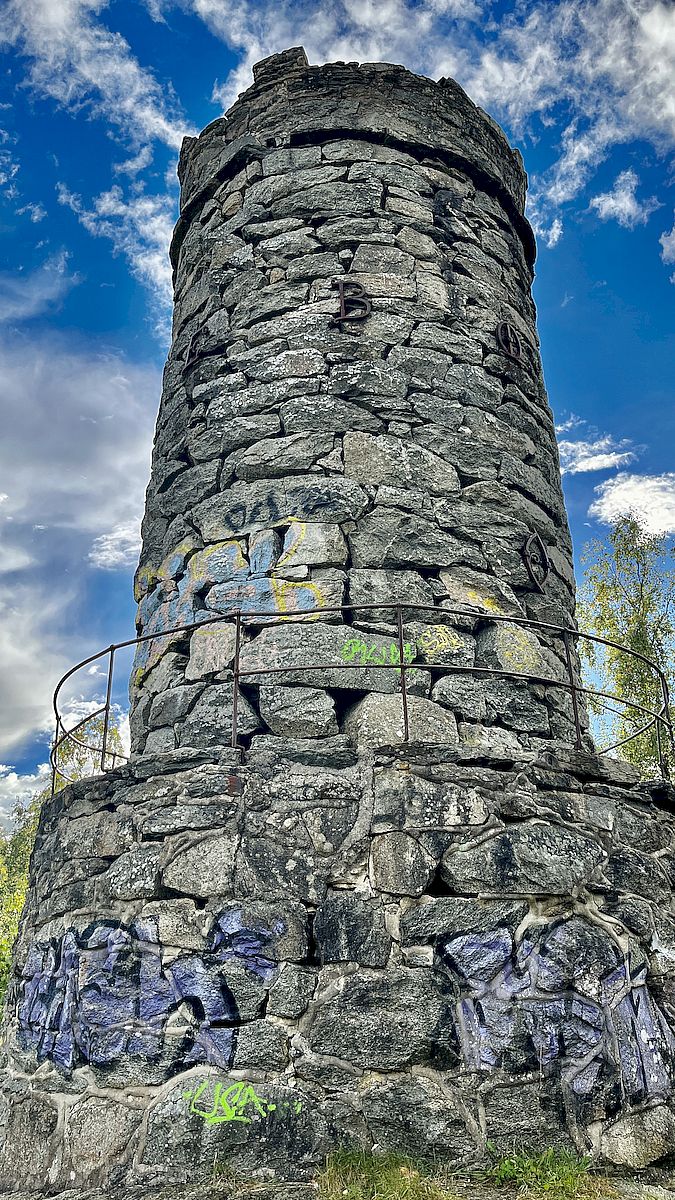
We made our way up to Tureborgen ourselves. When we got there, the last road was closed, so we took a short detour before parking and continuing on foot up the mountain. What was once a huge fantasy building is now a ruin with only foundation walls, basement spaces and a tower left. Our old article also tells about that wrong-way driving on the way up.
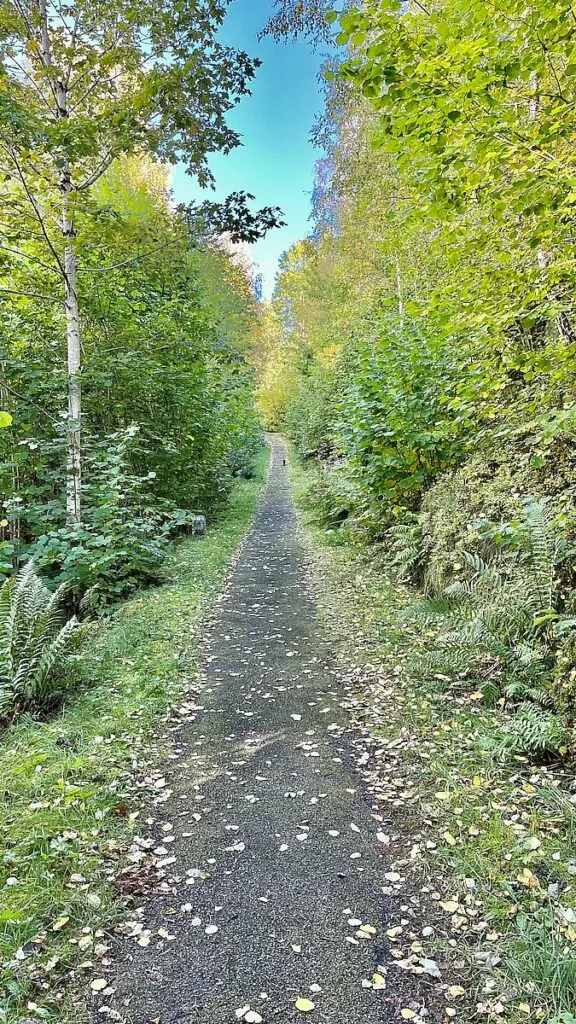
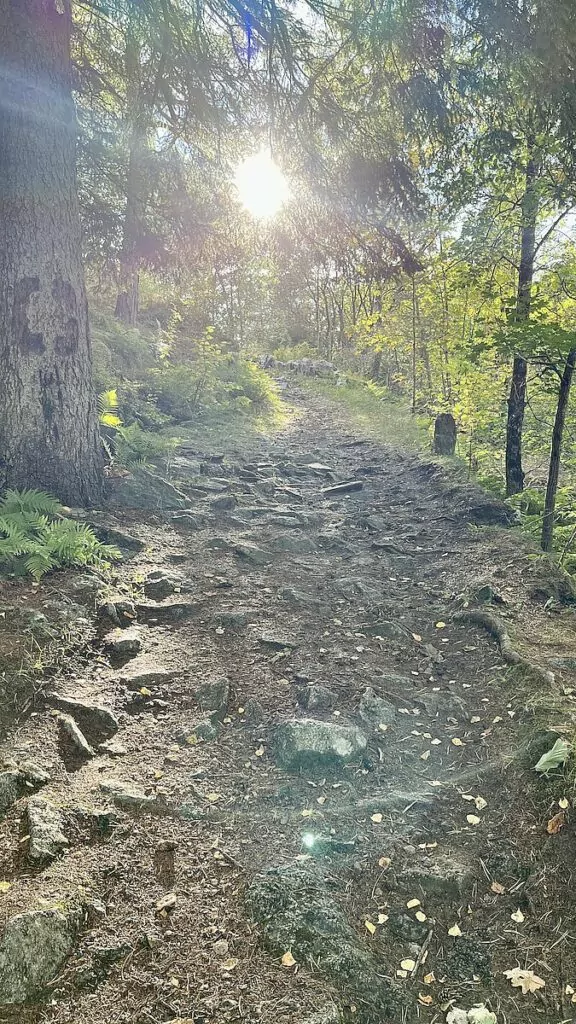
The castle was destroyed by fire in 1950, almost thirty years after Ture's death. But the ruin remained – and also did something that few private construction projects succeed in. It gave its name to an entire district: Tureborg.
We also looked for the remains of The mountain hut, the hunting lodge that Ture had built nearby. Today, only the foundations and remains of the walls remain, and when we were there, there were significantly more stinging nettles than knights.
IT IS TURKEY WE REMEMBER
The strange thing is that the more we read about Ture Malmgren, the less the story is about an old ruin. It's about a man who had ideas and actually implemented them. He started a newspaper, got involved in politics, built a strange home and then decided that he also needed a knight's castle on the mountain above.
We don't need to understand him. It's pretty much enough to be happy that Uddevalla had him. If you want to follow Ture all the way up the mountain and see what remains of his insane construction project, we have done just that. There, our separate guide to Tureborgen over the story.
7. Step into the Bohuslän Museum – where love crosses borders
Bohuslän Museum is located right next to the Bäveån River and has free admission, so it's easy to just walk in. We did – and perhaps thought that we would primarily learn more about coastal life, fishing and the history of Uddevalla. We did, but it was a completely different story that made us stay the longest.
Bohuslän has been a borderland for much of its history. Here, people have fought, traded and smuggled across the border between Sweden and Norway. But borders can also cause problems for something much more pleasant. Love?
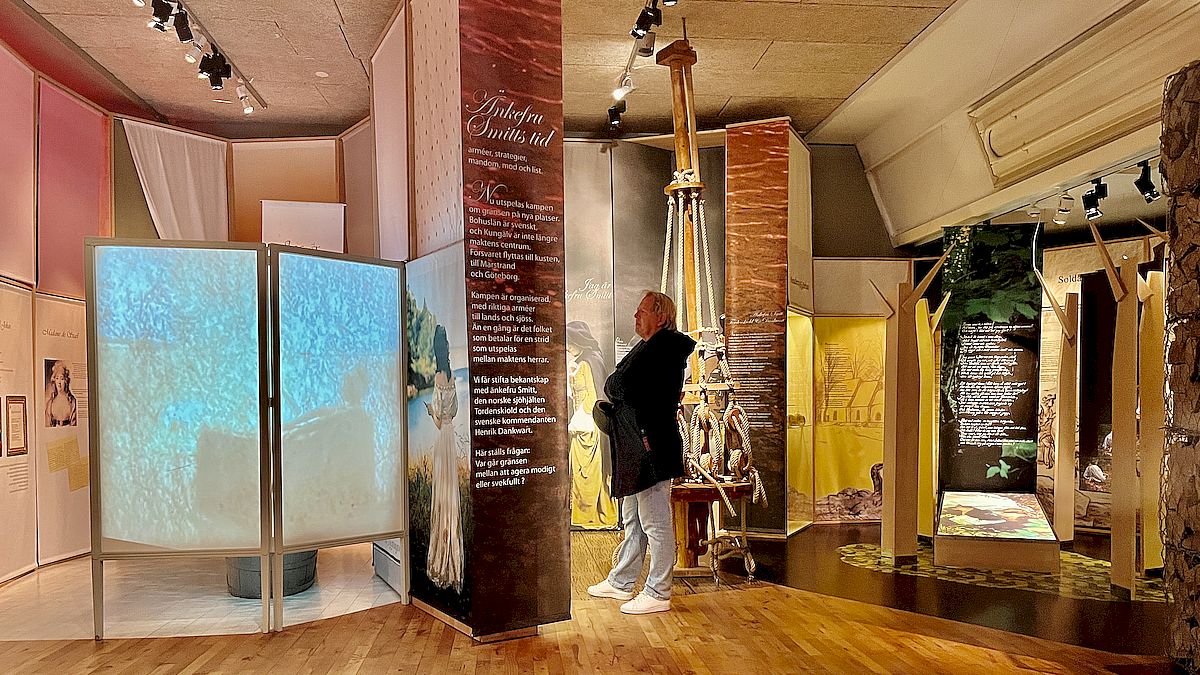
ESTHER AND HANS HAD A PROBLEM
During World War II, Norwegian Esther and Swedish Hans fell in love, but the border between the countries separated them. They obviously weren't going to let a little world war get in the way of their wedding plans, so they found a solution that kept us hooked to the story.
They got married in the middle of the river. Esther stood on the Norwegian side and Hans on the Swedish side. When the wedding was complete, Esther was married to a Swedish man and could legally cross the border into her new homeland. It's stories like these that make a museum suddenly stop feeling like a museum. War and national borders are huge historical concepts, but here everything is reduced to two people who just wanted to be together and thought about solving the problem.
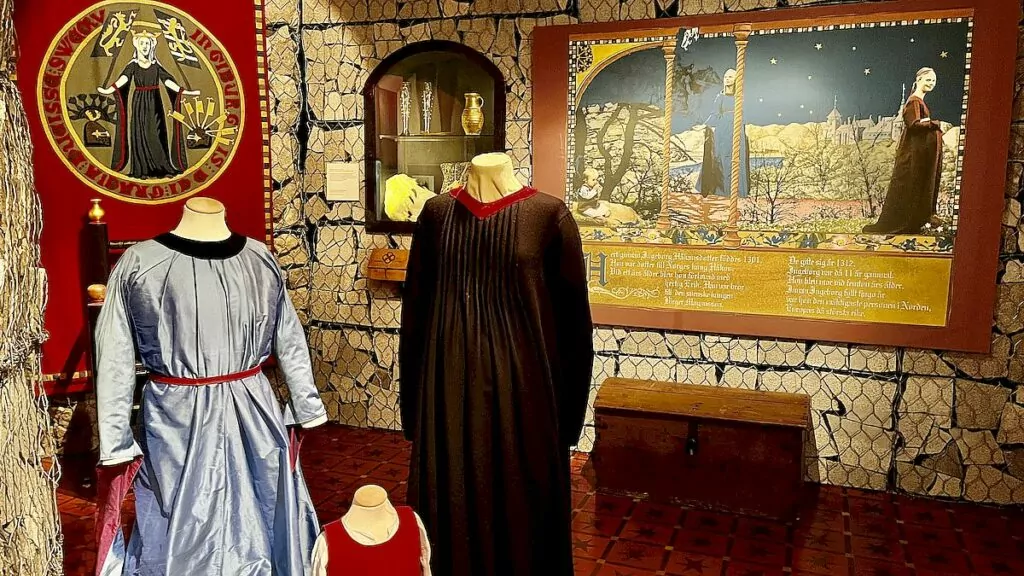
THE HOUSE IN SWEDEN – THE OUTHOUSE IN NORWAY
In another part of the exhibition we encountered the history of the Travellers and another example of how strange a national border can become when it ends up in the middle of people's everyday lives. Vilhelm Korsgård had his house in Sweden – while the outhouse was in Norway. It is almost impossible not to start thinking about the practicalities. If you forget the hammer in the outhouse, you suddenly have an international matter.
And that's exactly why we like this part of the museum. History isn't just about kings, wars and years. It's about people trying to make everyday life work despite someone having drawn a line across the map.
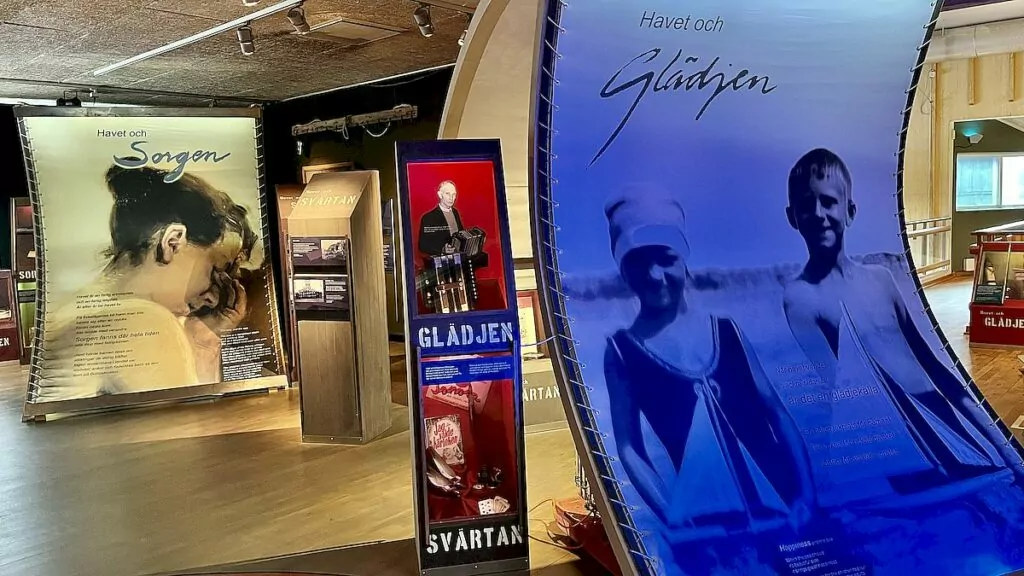
UDDEVALLA HAS RESTED MORE THAN ONCE
The museum also tells the story of Uddevalla itself, and it hasn't exactly been an unbroken success story. The town has suffered from wars, fires and economic ups and downs, and in the 19th century came what is described as the three accidents: the city burned, the great herring season ended and unemployment hit.
When you then leave the museum and encounter today's Uddevalla by the Bäveån River, the city actually becomes a little more understandable. We have already followed the water through the center and seen the traces of shipping. Here we get the people and the history behind much of what we have seen.
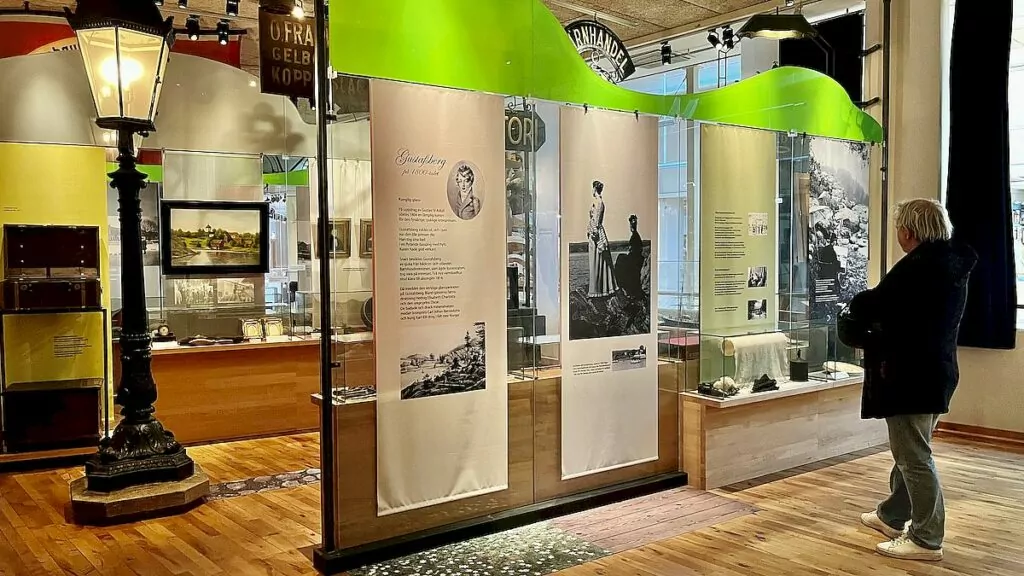
AND SO WE HAVE TO SMELL THE BOATS
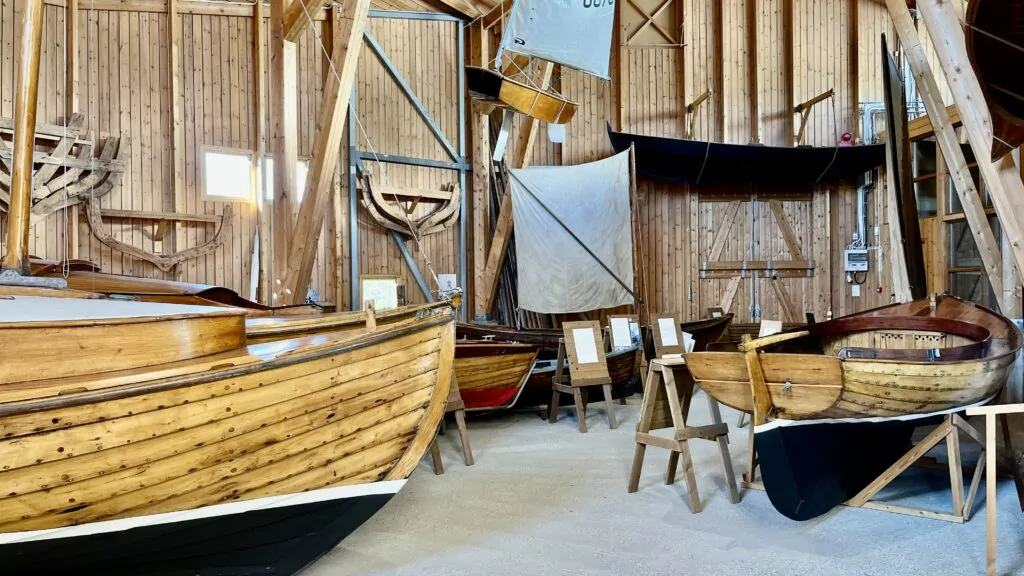
Bohuslän Museum also has art, temporary exhibitions and a boat hall with traditional utility and leisure boats from Bohuslän. When we visited the museum, we were of course captivated by the beautiful old boats – but Helena noticed something that may not be at the top of the museum's own presentation.
It smelled wonderful. Wooden boats have a very unique scent. Tar, wood and old craftsmanship mean that the boathouse is experienced almost as much with the nose as with the eyes. Perhaps that is precisely why we remember Bohuslän's museum, not because we managed to read every single sign, but because we left with a love story from a river, an outbuilding in the wrong country and the smell of old boats in our noses.
8. Visit The Luck That Became the Misfortunes in Ljungskile
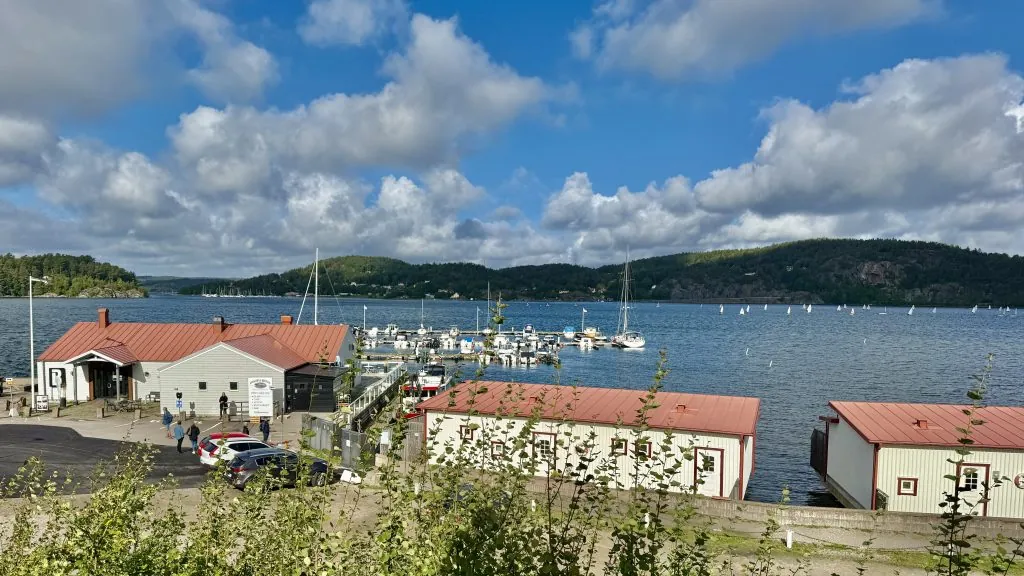
We actually had all the conditions to enjoy Lyckorna. We rolled slowly down towards the harbor and the further down we got, the more beautiful it became. Nice old houses, red roofs, piers, lots of small boats and sails out on the water. It was exactly that Bohuslän idyll that makes us want to park the camper, take out the cameras and stay for a while.
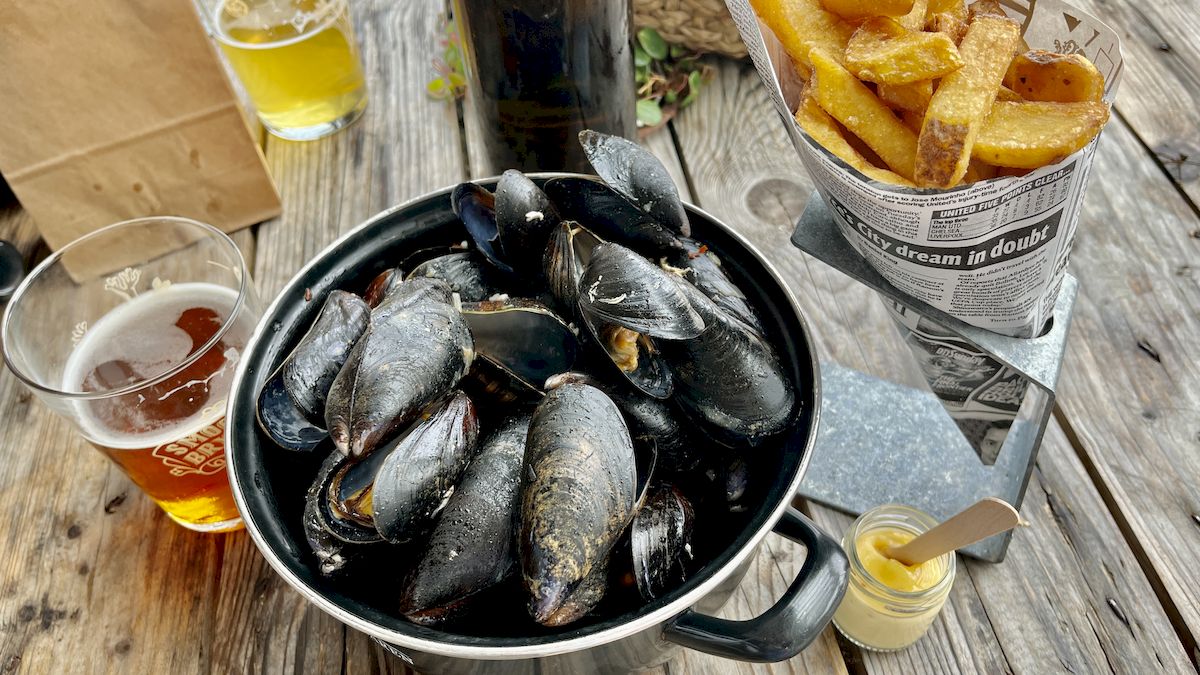
When we saw The Mussel Bar down by the harbor we looked at each other and decided pretty quickly. Here we would eat mussels. It's something of a favorite of ours, but we only managed about 20 meters.
THE ILLEGAL YELLOW SIGN
There it was. A small yellow sign with a caravan crossed out in red, a motorhome crossed out in red and the text ”Parking prohibited”. The message was crystal clear! We have the wrong type of car. We drive a 3.5 ton camper van and have parked in cities all over Europe, but here at the port in Lyckorna it stopped. This was also the second damn yellow problem of the day. First a yellow parking ticket in Uddevalla and now this yellow sign, the same day we were out to photograph and write about the destinations.
And it wasn't actually an overnight stay we were looking for. We wanted to park the camper for a while, walk around Lyckorna, take pictures of the harbor and have lunch at Musselbaren. Somewhere along the way, we The Happinesses to the Misfortunes, and we drove on from the oled accident.
9. Stay at Hafsten – and make your holiday an adventure
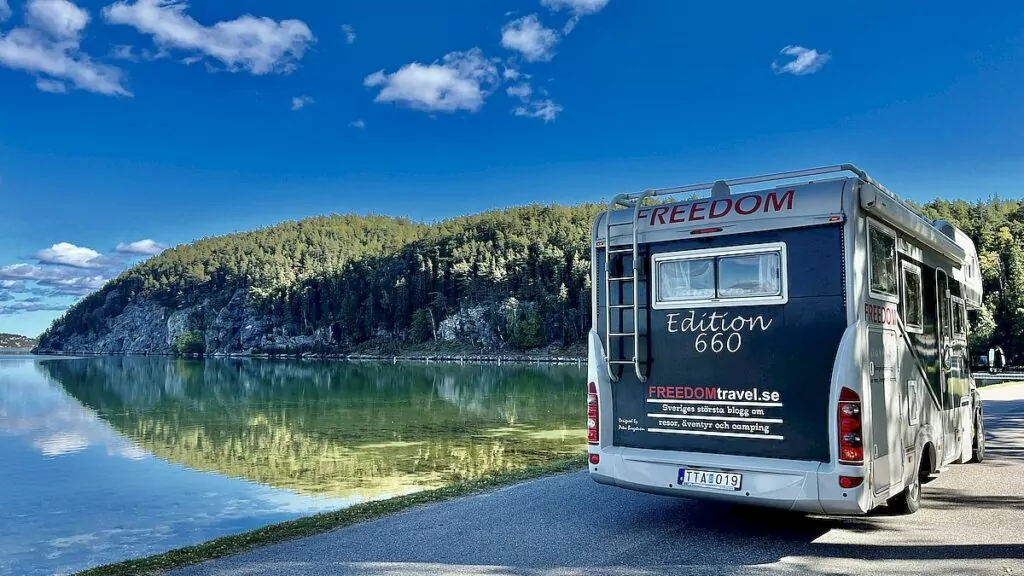
We arrived at Hafsten Resort & Camping with the FREEDOM camper van and were given a spot with a view of the sea. The idea was to stay for a couple of days and discover more of the area around Uddevalla. We ended up taking a hot tub bath, hiking, cycling on a food tour and sending Peter through the air at 90 kilometers per hour. That's pretty much how we think a campsite should work.
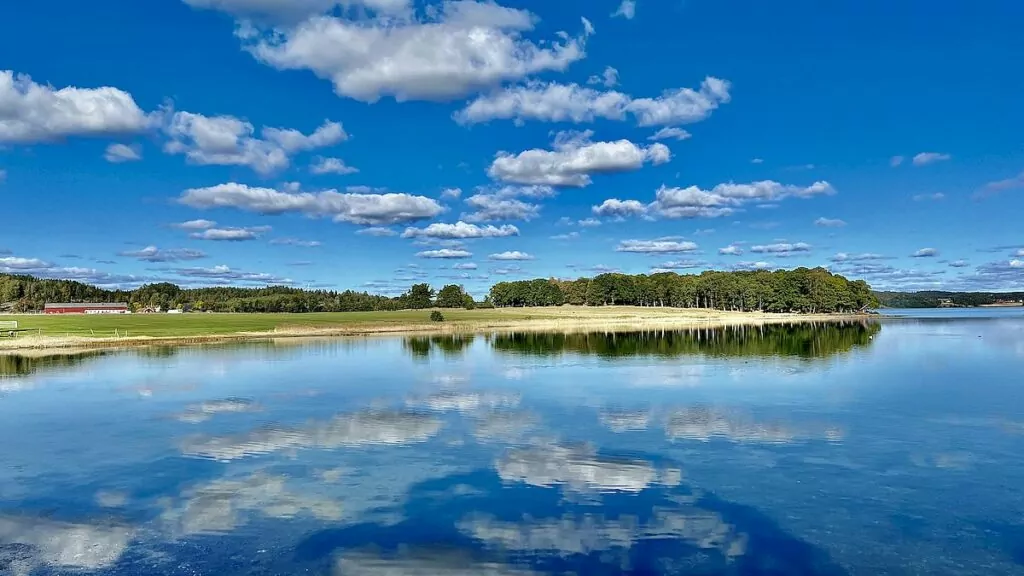
Hafsten is located on the coast at Bokenäset, about twenty kilometers from central Uddevalla, and is much more than a place to park your camper. There is a beach, a pool, restaurants and lots of activities, but above all, nature is right on your doorstep. We really just had to decide which direction to start.
START WITH THE HOT TUB – IT CAN ONLY GO OUT THEN
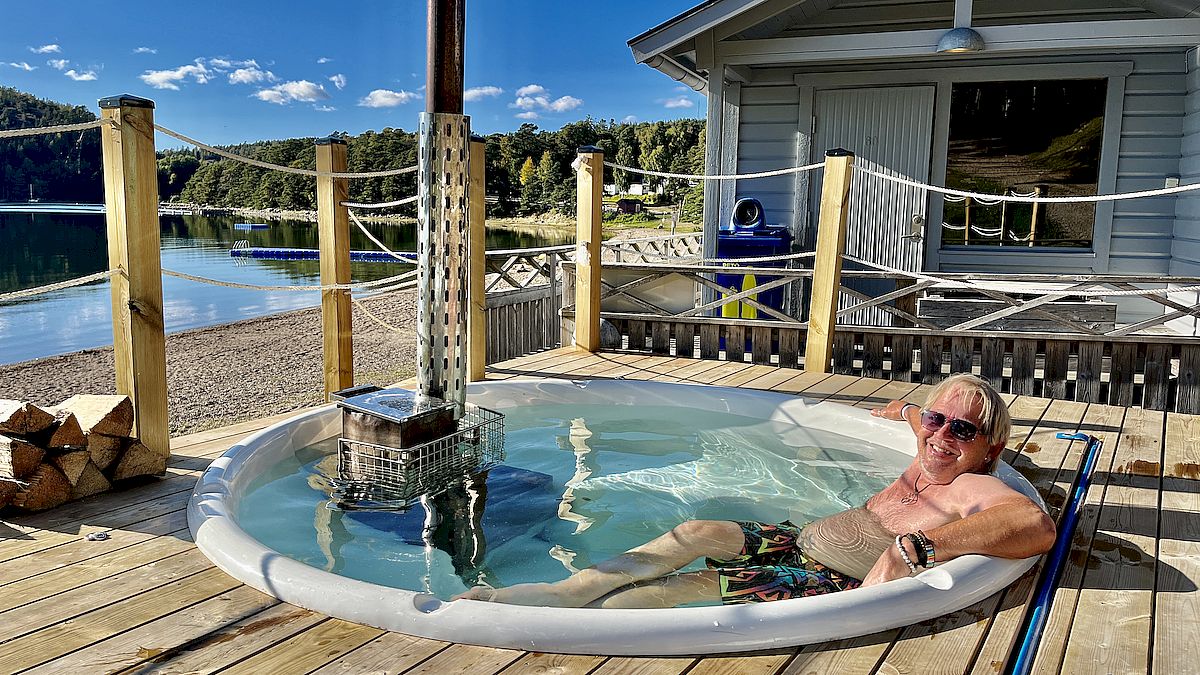
The first evening we had booked a hot tub and sauna. We were here at the end of September and had expected a rather rough autumn day, but instead we sat in warm water under bright sunshine. After a while we climbed onto the wooden deck and sunbathed, before Helena finished with a dip in the considerably cooler sea.
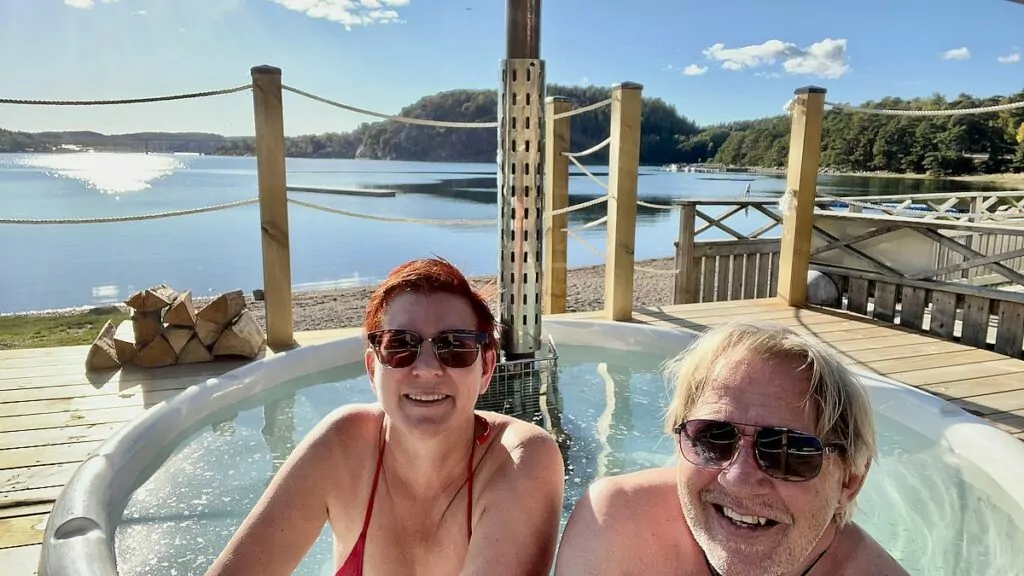
This is our kind of camping luxury. No crystal chandeliers or someone folding the towel into a swan, but being able to sit in a hot tub with the ocean in front of you and knowing that your camper is just a short distance away.
PETER TOOK THE FAST WAY DOWN
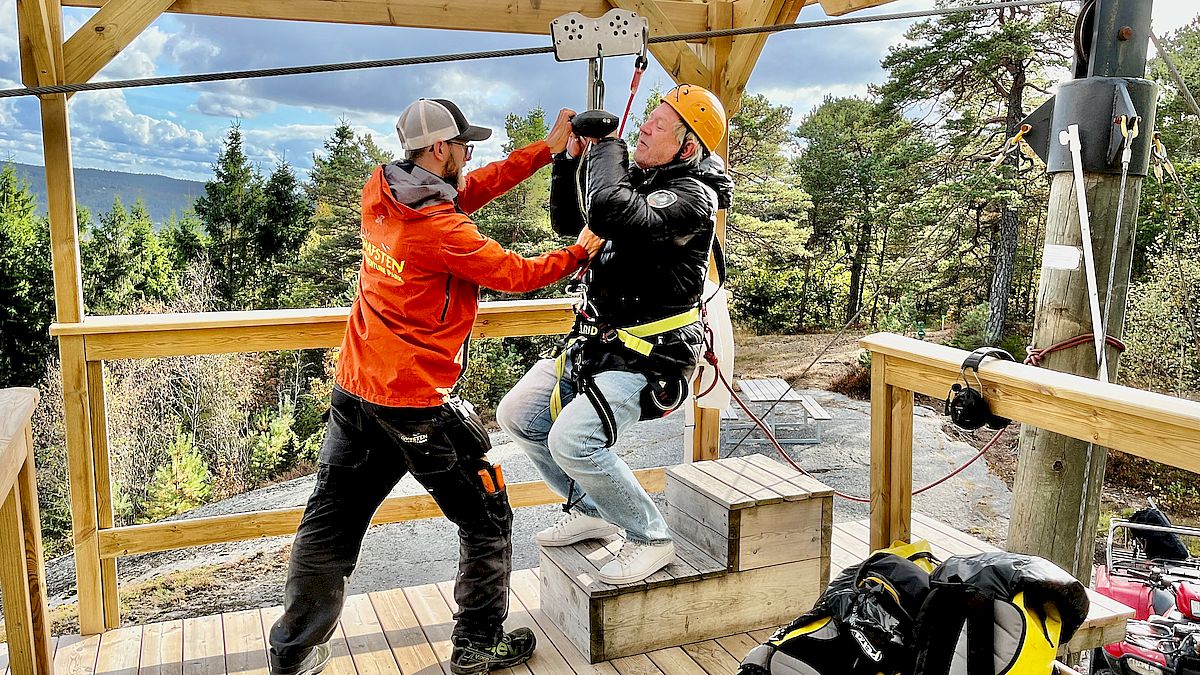
The next problem was that Hafsten has activities that make it difficult for Peter to behave like a normal camping guest. FlyingFox is a zipline where you throw yourself over the landscape, and when we were here it was listed as 900 meters with a 90 meter drop and a top speed of 90 km/h. Peter of course had to try it.
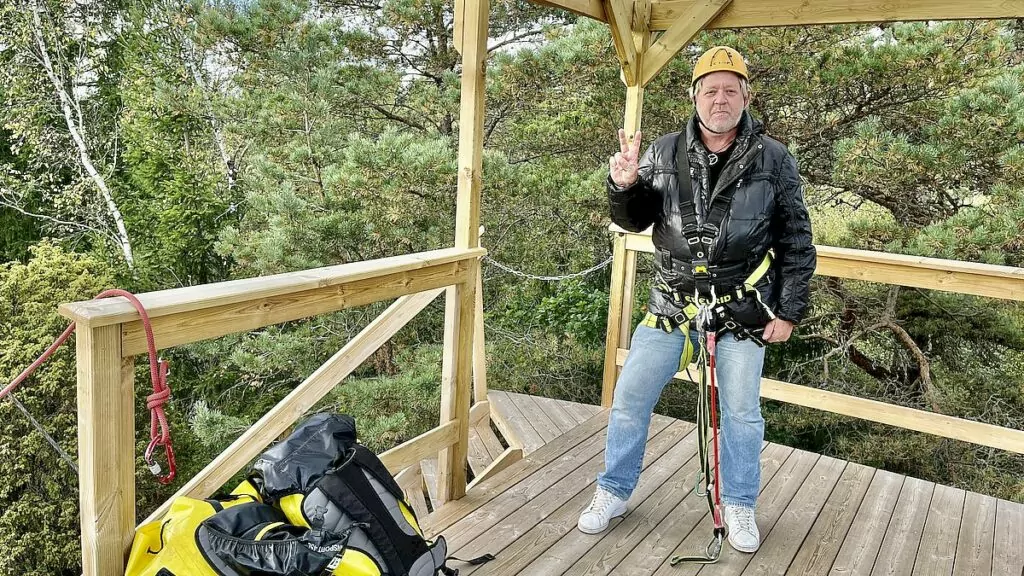
Helena also thought about the matter, but in the end concluded that photography and filming were at least as important a journalistic assignment. She therefore stood there safely while Peter disappeared into thin air and returned very satisfied. In a good marriage, both parties don't have to be stupid at the same time.
WE TOOK THE SLOW ROAD UP
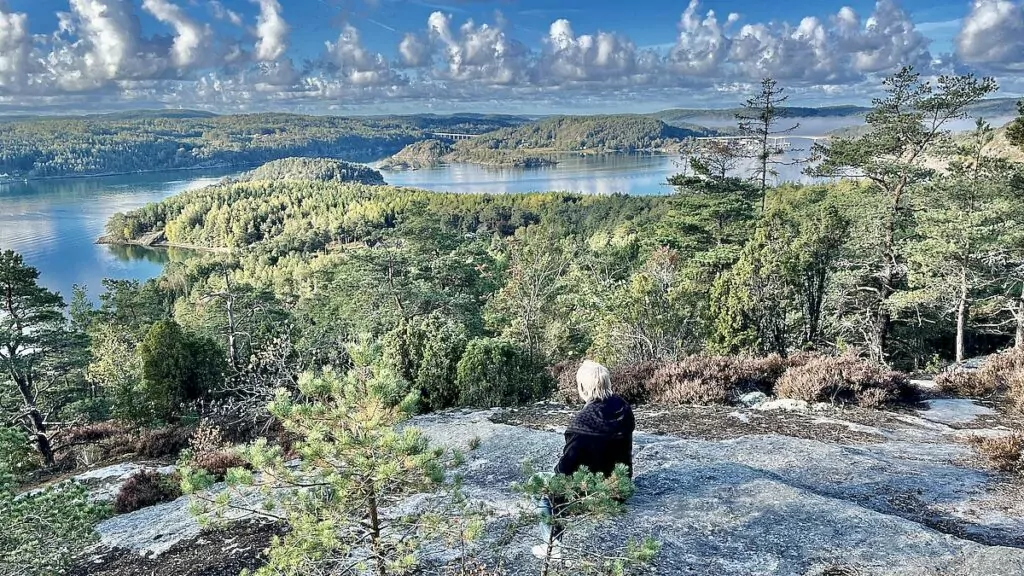
We also made it to Hafstenstoppen, 119 meters above sea level. The hike from the campsite is relatively short and we could choose between an easier and a steeper route. The reward came up on the cliffs with a view of Uddevalla and the outer archipelago.
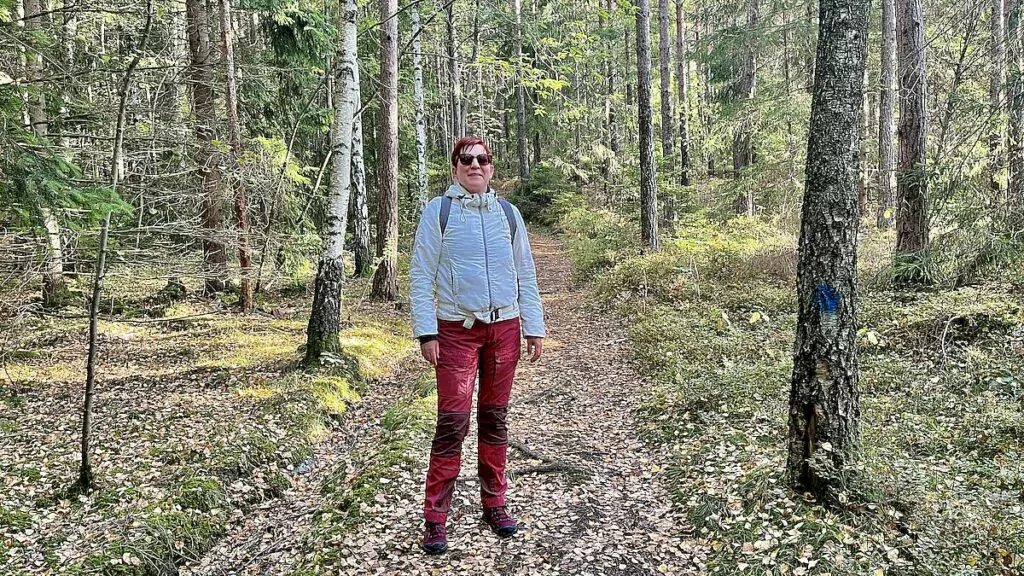
That's the contrast we like with Hafsten. One moment someone is flying through the air on a wire, the next we are walking together through the forest and stopping on a cliff to look out over Bohuslän.
TAKE THE BIKE TO DINNER
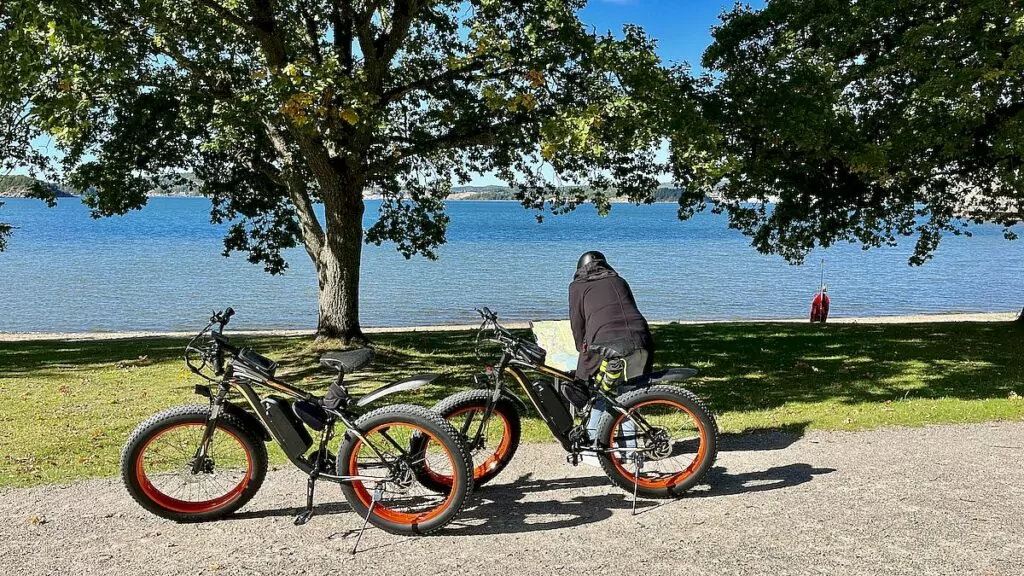
One of our best excursions started right from the campsite. We got on our bikes and pedaled across Bokenäset to Destination Bokenäset, where bathrobes seemed to be some kind of unofficial dress code and the pace dropped around the same time we parked the bikes.
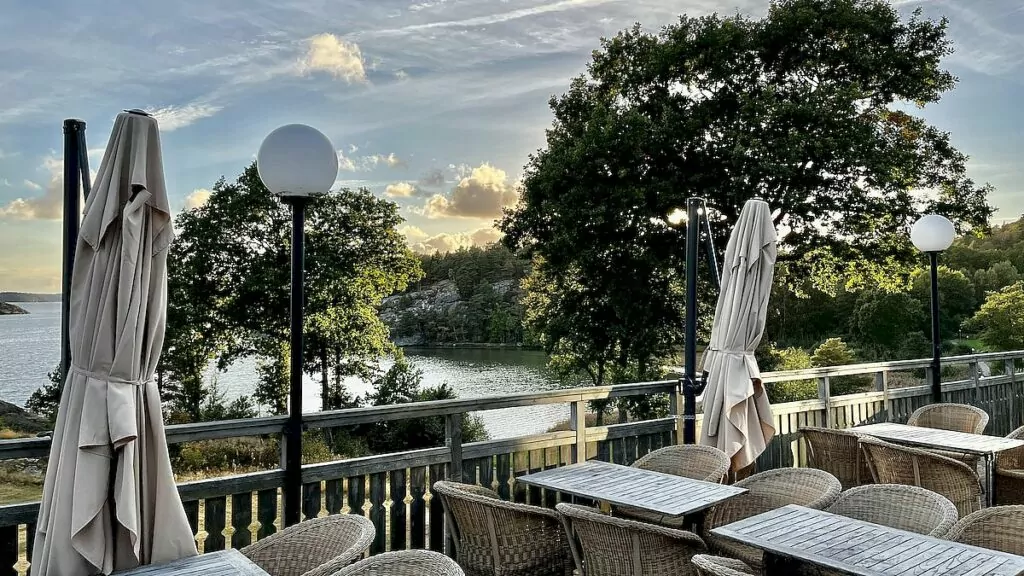
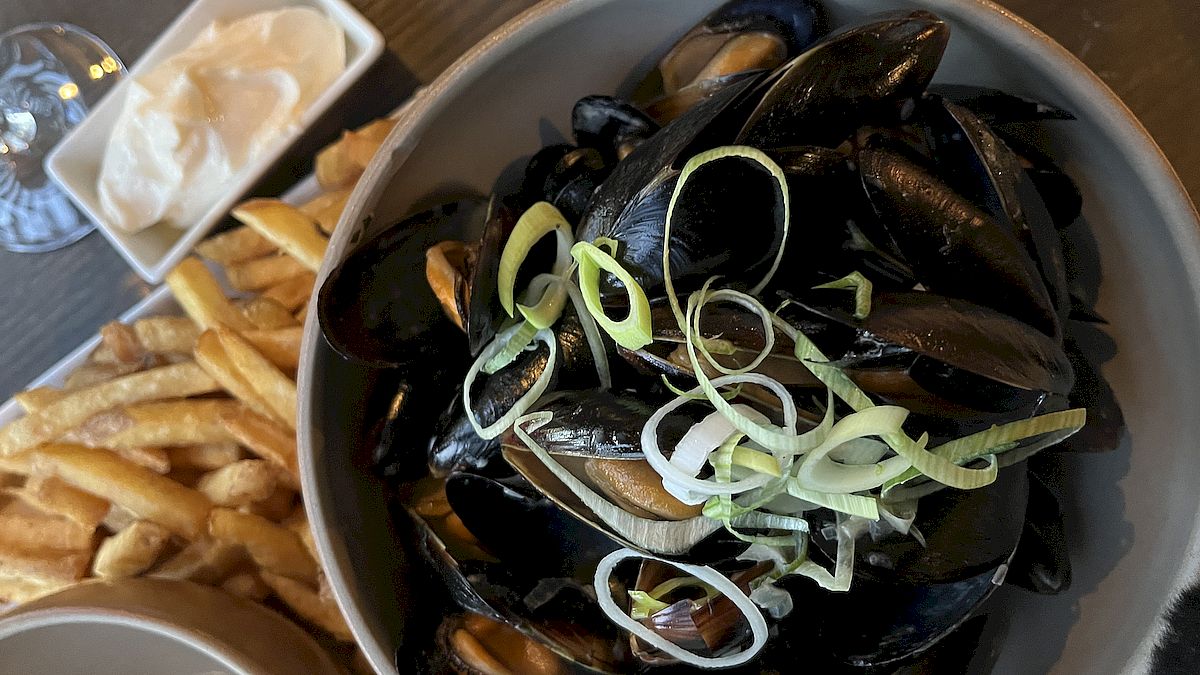
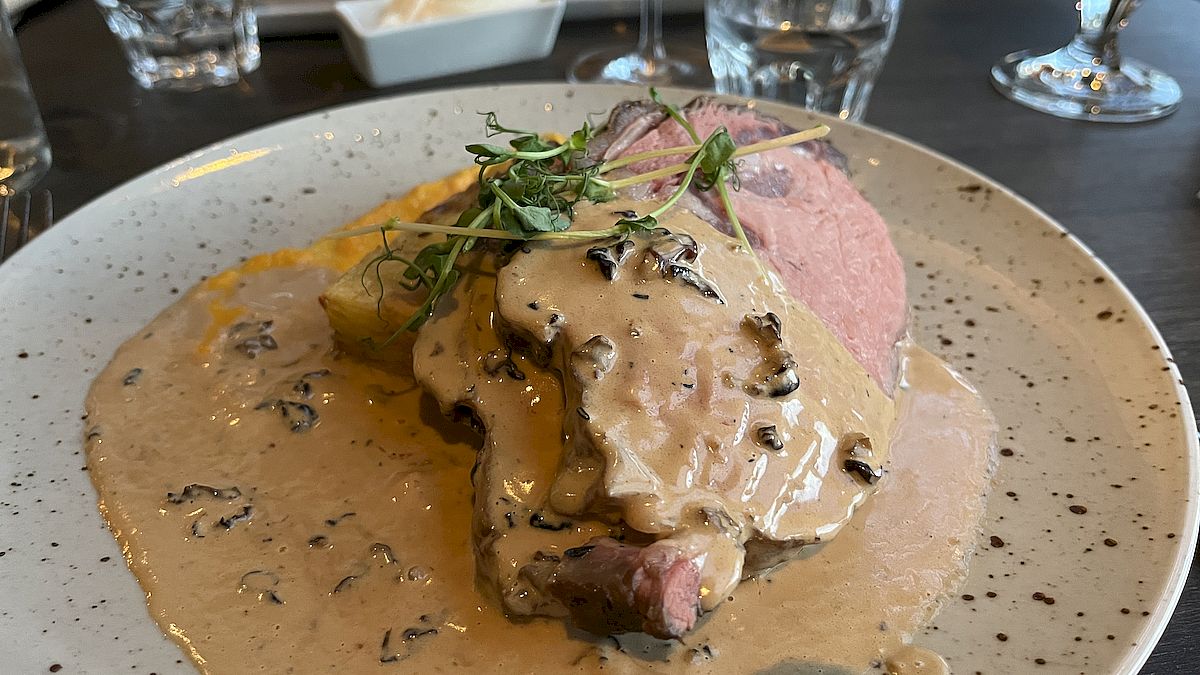
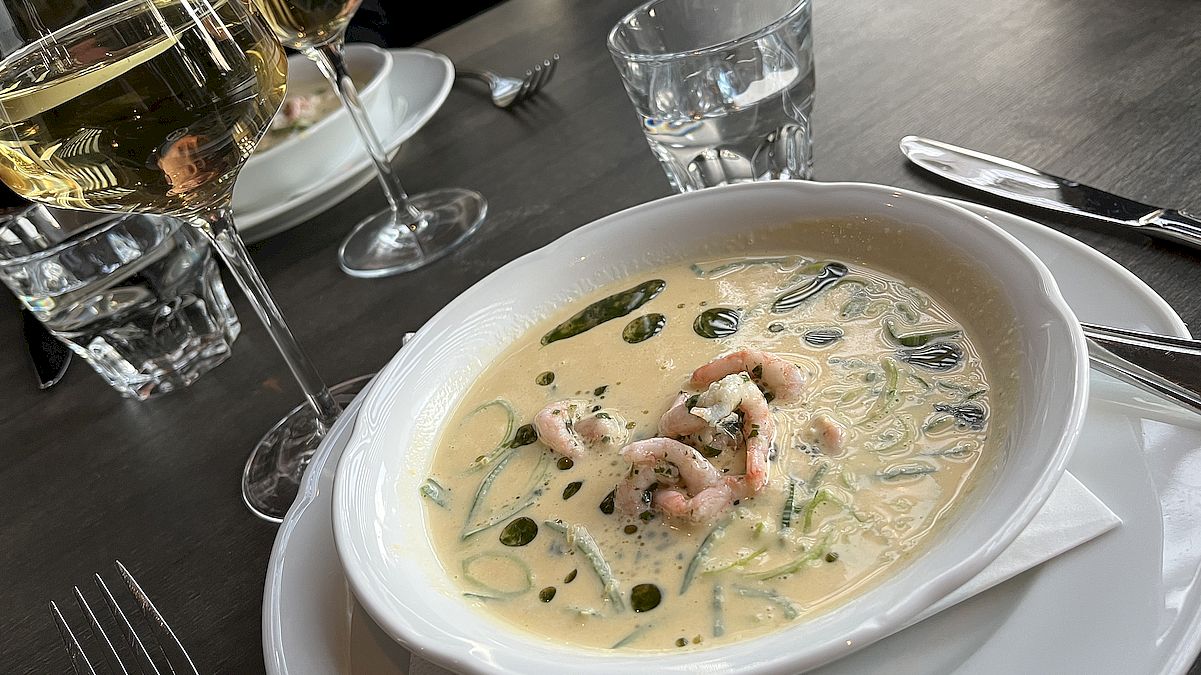
The destination was the Västersalt restaurant by the water. We both started with pumpkin soup with shrimp before moving on to mussels for one and sirloin steak with morel sauce for the other. It was one of those outings where the road, the food, and the place together become greater than any of the parts individually.
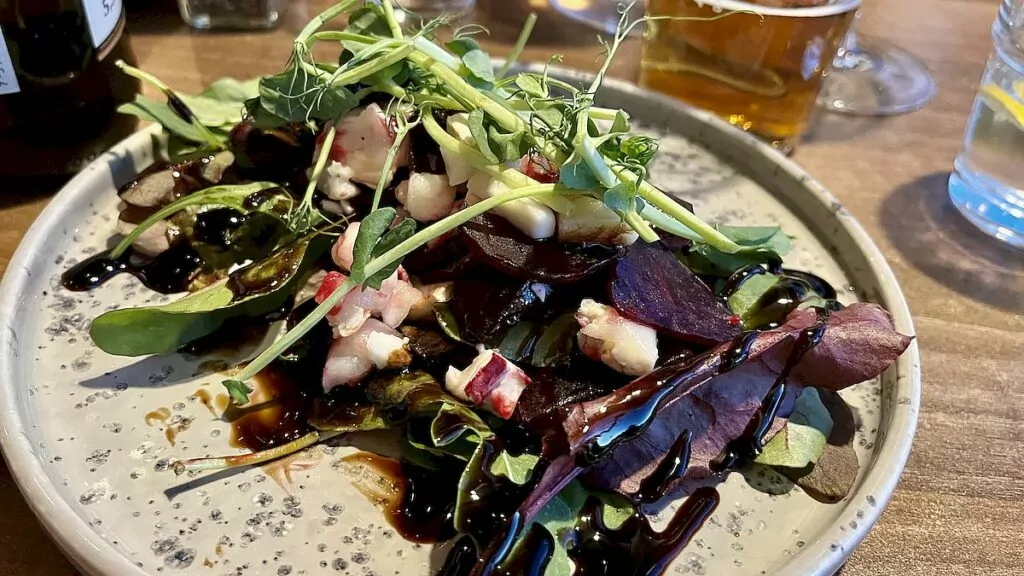
We also ate well at home at Hafsten. At restaurant Corallen, Peter was pleasantly surprised by a Skagen canapé followed by salmon and shellfish soup, while Helena ate oven-roasted beetroot with chèvre and breaded plaice.
HAFSTEN BECAME OUR BASE
It's easy to write about Hafsten as a long list of pools, beaches, high-altitude courses, adventure golf, paddle tennis, spas and everything else that's here. But after our two days, it's not the list we remember.
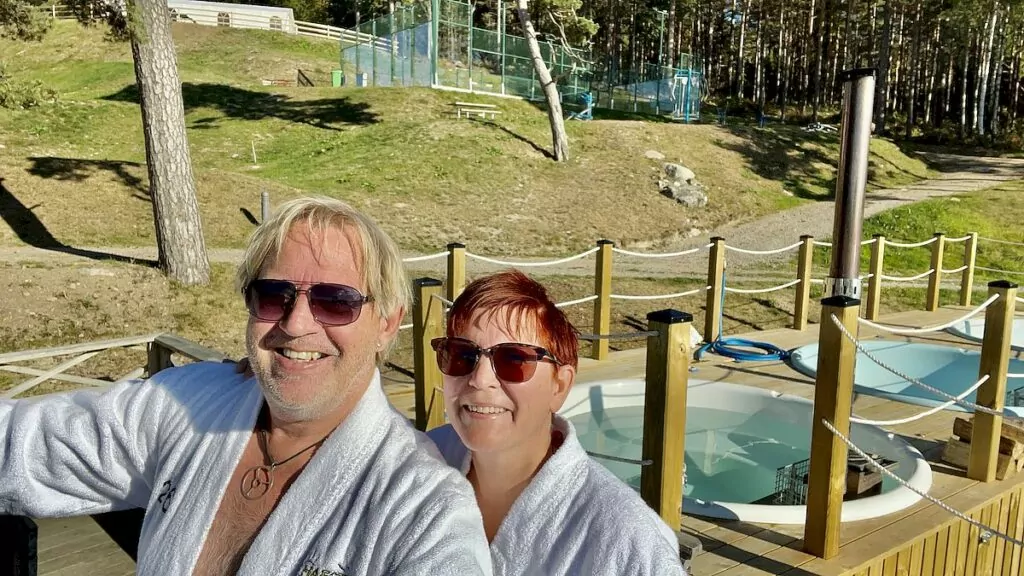
We remember the sea outside the camper. The warm water in the hot tub. Helena's cold dip. The view from Hafstenstoppen. Peter flying through the air. The bikes on the way to a good dinner. We came here with the camper to stay, and we ended up barely getting home. That's probably our best rating on Hafsten.
READ MORE: Hafsten Resort & Camping in Uddevalla – camping luxury
Uddevalla in 2 days - complete itinerary day by day
Two days gives you time to experience both central Uddevalla, the sea and some of the places that are a bit outside the center. Here is the itinerary we would choose ourselves – with walks, history, nature and enough time to actually have time to look around.
Day 1 – Bäveån, the boardwalk and Gustafsberg
- Morning: Start in central Uddevalla and follow Bäveån through the city. Look at the old archipelago boats, the clock tower, the church and the small rapids. And start the parking app before you go. We've already paid for that lesson.
- Morning: Visits Bohuslän Museum by the Bäveån River. Here you will get the background to Bohuslän and Uddevalla – and maybe, just like us, you will get hooked on the people behind the story.
- Lunch: Have lunch in central Uddevalla before continuing towards the sea.
- Afternoon: Go The seafront promenade to Gustafsberg. Take your time along the Byfjord and finish among the old wooden houses at Sweden's oldest seaside resort. Feel free to try the water from the health spring.
- Evening: Stay at Gustafsberg or return to the city center for dinner. If you still have the energy to run, you can start exploring. Around the world, but we would rather save the longer hike than rush through it.
Day 2 – Skalbankar, Hafsten and Bohuslän nature
- Morning: Start at The shell banks and walk the marked trail through the ancient seabed. It's only when you know that whales and seals once swam where you stand that the place becomes truly powerful.
- Morning: Drive on towards Hafsten and hike up to Hafstenstoppen. The hike is short enough to fit into the day, but the view makes it worth the detour.
- Lunch: Eat at Hafsten or continue out to Bokenäset. If you have bikes with you, you can do as we did and make the journey to the food part of the excursion.
- Afternoon: Spend a few hours at Hafsten. Beach, nature and activities allow you to choose your own pace – from a leisurely walk to much more fast-paced adventures.
- Evening: Finish by the sea with dinner. If you're staying at Hafsten, our version is even better: sauna, hot tub and then not very many meters home.
Our advice: Don't try to collect Uddevalla like Pokémon. Two days is plenty, but you can leave some places for next time. It worked for us – we needed to discover Uddevalla twice ourselves. 😄
Best time to visit UddevallaJune-October
Where can you stay in Uddevalla?
Where to stay in Uddevalla depends primarily on how you want to experience the city. If you want to be able to walk to the city center and Bäveån, a central hotel is the easiest, while the area towards Gustafsberg is better suited if you want the sea, the Beach Promenade and quieter surroundings. With a camper or caravan, however, we would like to stay a little outside the city center.
LIVE CENTRALLY – CLOSE TO THE BÄVEÄN RIVER AND THE CITY
Quality Hotel Carlia Uddevalla is located in the heart of Uddevalla and is a great option if you want to explore the city centre on foot. The hotel also has a spa, restaurants and a rooftop bar, so it is an option for those who want to combine sightseeing with a bit more comfortable city life.
LIVE BY THE SEA AND THE BEACH PROMENADE
Bohusgården Hotell & Konferens is located south of the city center, close to Byfjorden and the Strandpromenaden. It has a spa, restaurant and sea views, and the hotel states that it takes about 15 minutes to walk into the city center. For us, the location is especially interesting because you can almost start one of Uddevalla's best experiences outside your door.
If you want to get even closer to history, there is also Gustafsbergs Badhotell och Vandrarhem out on Gustafsberg. Then you will stay in the middle of the environment that we talked about earlier in the guide – among the old houses at Sweden's oldest seaside resort.
STAY AT HAFSTEN – OUR CHOICE WITH A MOTORHOME
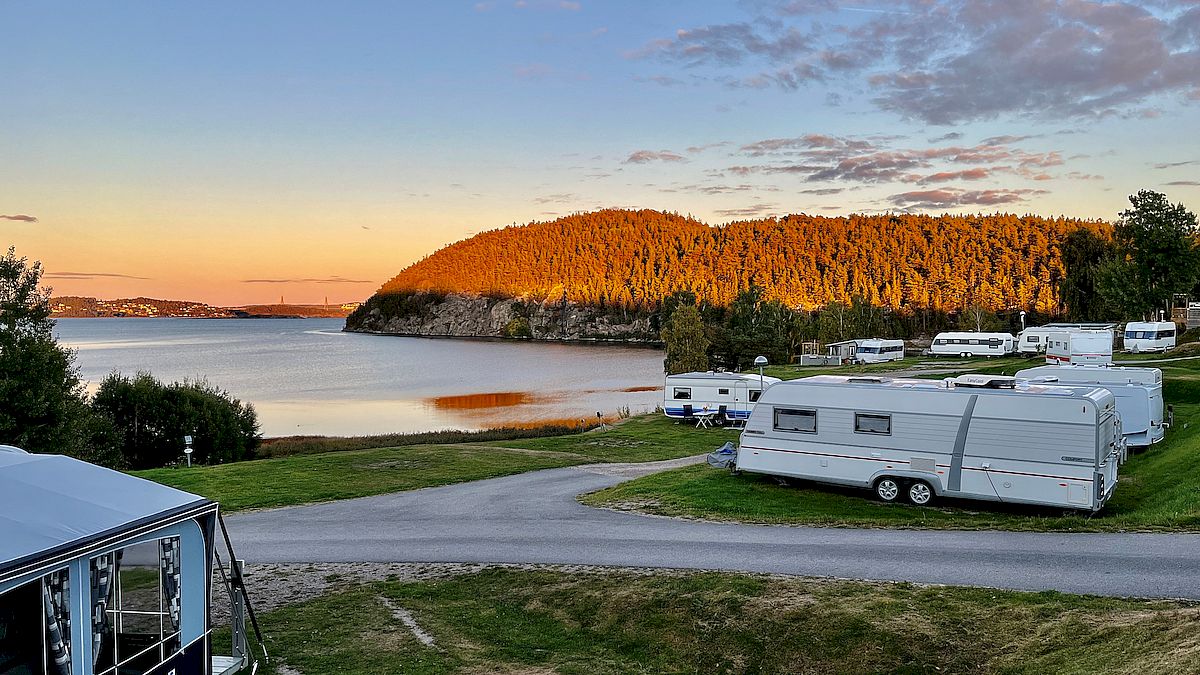
We know Hafsten Resort much better because we have stayed here ourselves with FREEDOM. We got a place with a view of the sea and used the campsite as a base for hiking, cycling, hot tub and excursions on Bokenäset. Hafsten also has cottages for those who do not come with their own accommodation, and the resort is also open outside the summer season.
Our choice: For our first weekend without a camper, we had chosen city center or the area along the Beach Promenade. With a camper van, we choose Hafsten – not because it is closest to the center, but because the accommodation becomes part of the Uddevalla experience itself.
By motorhome in Uddevalla – our experiences
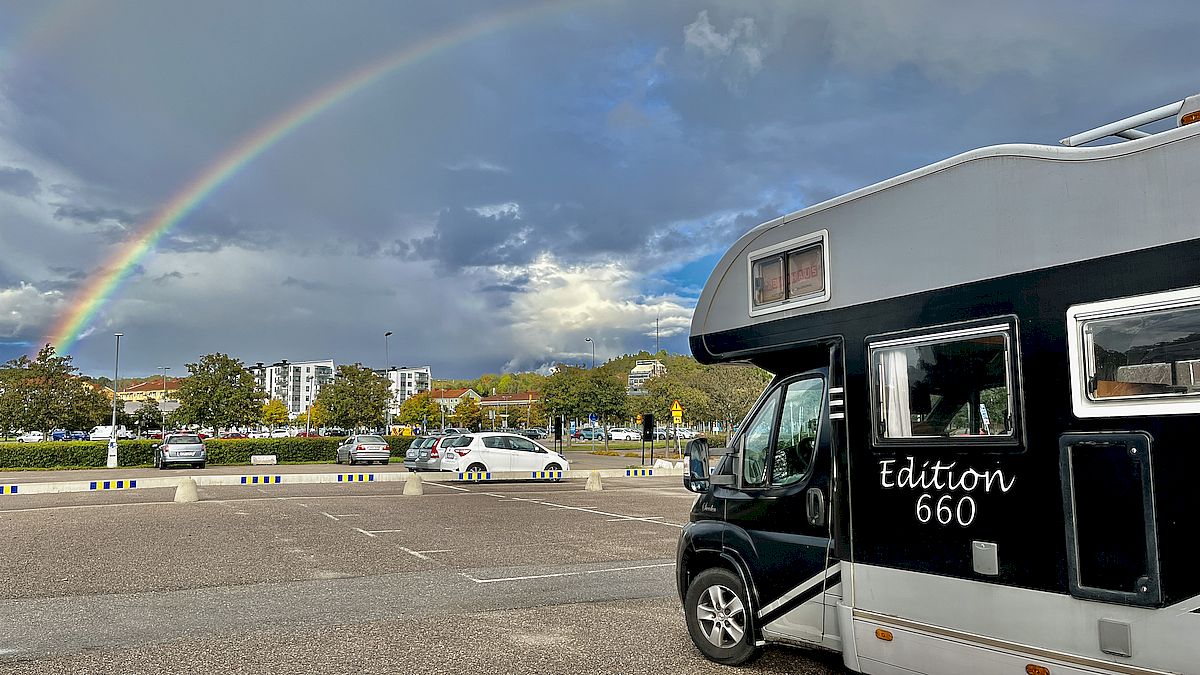
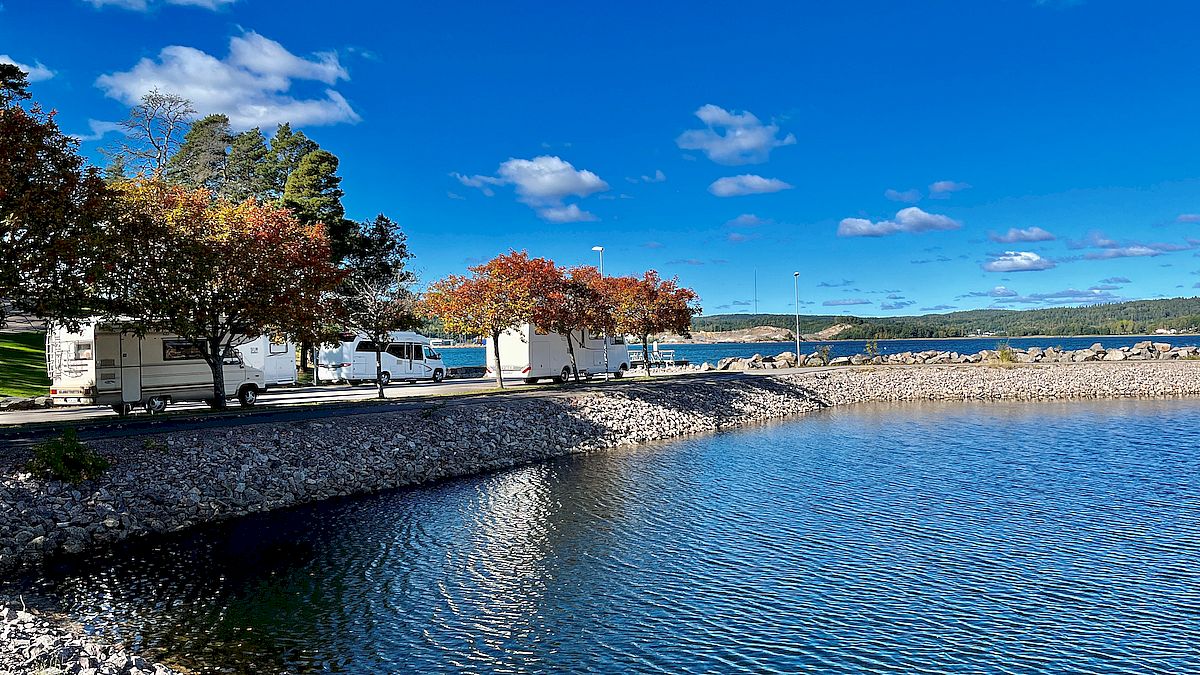
Uddevalla is easy to explore by campervan, but our last day in the city taught us that it's wise to check the parking a little extra before jumping out with the camera. We first managed to forget to start the parking app in the city centre and received a yellow 400 kronor fine. Later that day we were greeted by an equally yellow sign at the harbour in Lyckorna prohibiting parking for campervans and caravans.
So we can't say that Uddevalla gave us a free lesson in RV parking. However, the city did give us a pretty memorable one. Our advice is simple: check the signage where you intend to park and start the parking app before you start photographing Bäveån. The last piece of advice cost us 400 kronor to produce.
LIVE WITH A MOTORHOME AT HAFSTEN
Do you want to stay a few days? Hafsten Resort & Camping our own choice. We stayed here with FREEDOM and had a nice campsite with a view of the sea, electricity and water at the site and other services nearby. From here we could hike, cycle and discover Bokenäset while the accommodation itself became part of the trip.
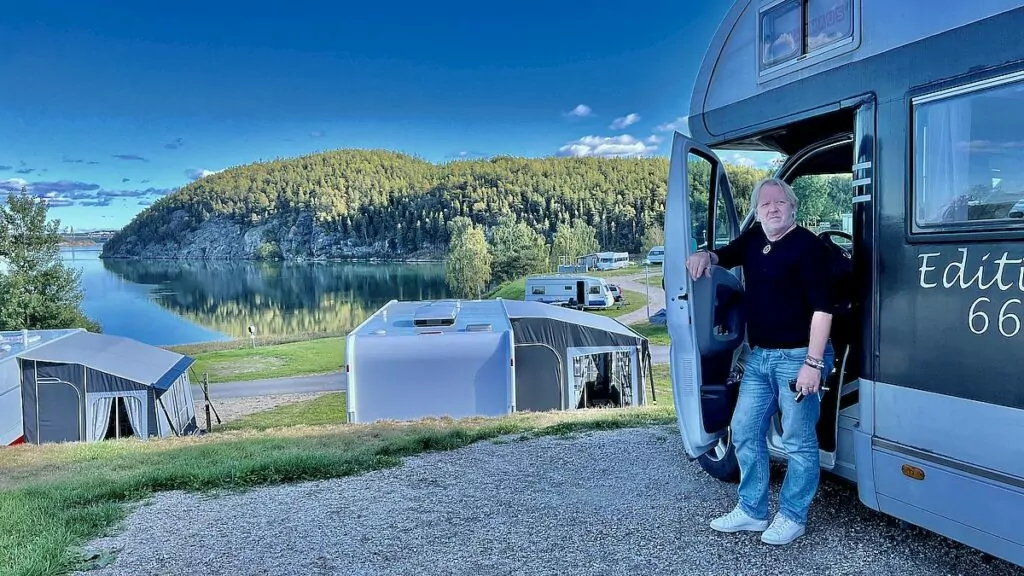
Hafsten is about 20 km from central Uddevalla, so it's not the place we would choose if our only goal was to walk out the door and stand right by the Bäveån River. But for a few days in the area, we almost think the distance is an advantage – you get the sea, nature and camping life and can make excursions into the city.
CAN YOU FREECAMP WITH A MOTORHOME IN UDDEVALLA?
The right of public access does not automatically mean that you can park or spend the night with your camper anywhere. The camper must be parked where motor vehicles are permitted to be driven and parked, and local parking regulations and signage always apply. In nature, it is also extra important not to drive onto land where motorized traffic is not permitted.
Our experience: It's better to look for a place where you clearly know that the camper can be parked than to try to interpret signs creatively. We have already done the field study in Uddevalla.
Two bright yellow signs later, we now feel almost qualified as parking consultants.
Shit happens. 😂
More city guides nearby
Are you planning a trip to the west coast? Here are more guides to places and cities we've visited.
- Things to do in Tjörn
- Things to do in Smögen
- Things to do in King's Landing
- Things to do in Hunnebostrand
- Things to do in Lysekil
- Things to do in Grebbestad
Things to do in Uddevalla - on film
FAQ frequently asked questions about Uddevalla
WHAT CAN'T BE MISSED IN UDDEVALLA?
The beach promenade out towards Gustafsberg is our top recommendation for a first visit. You get Byfjorden, cliffs, art and sea along the way and end at Sweden's oldest seaside resort. If you have more time, we would also prioritize Skalbankarna, Jorden runt and Bohusläns Museum.
HOW LONG IS THE BEACH PROMENADE IN UDDEVALLA?
The entire Strandpromenaden is about nine kilometers, but you don't have to walk the entire distance to have a great experience. We especially like the part from central Uddevalla out towards Gustafsberg, where the walk goes on wooden trestles along the cliffs above Byfjorden. We have both cycled and walked here – and discovered significantly more when we walked.
WHAT IS THE MOST DIFFERENT THING YOU CAN SEE IN UDDEVALLA?
We choose Skalbankarna. It may not look like Uddevalla's most spectacular attraction at first glance, but here you are walking on the remains of a seabed that was formed around 11,000 years ago. When you realize that belugas, humpback whales and killer whales, among others, could once swim where you are now standing, the place becomes something completely different.
IS UDDEVALLA WORTH VISIT?
Yes, and we actually appreciated Uddevalla more when we returned and gave the city more time. The combination of the sea, Bäveån, Gustafsberg, hikes and unusual places like Skalbankarna means that there is significantly more to discover than we first thought. Uddevalla was a city we needed to visit twice to truly understand.
WHERE CAN YOU STAY WITH A MOTORHOME IN UDDEVALLA?
We have stayed in a camper at Hafsten Resort & Camping, about 20 km from central Uddevalla, and enjoyed it very much. There we had the sea outside the camper and could combine the accommodation with hiking, cycling and other activities. If you park inside Uddevalla, however, you should read the signs and remember the parking app – That experience cost us 400 kronor.
Want to extend your trip? Combine with a weekend in Smögen or King's Harbour
Planning more trips? Don't miss our guides to Lysekil and Tjörn




 English (UK)
  Svenska
Maria/emjis.se says:
Wow, you found a lot to see! Recognise the black house...😉. Bokenäset and Ljungskile we have been but not thought that it belongs to Uddevalla!
Many nice views! Glad it was successful!
24 September 2022 - 9:37
Helena says:
Yes, of course we found a lot worth seeing and nice, both in the centre of Uddevalla and in the surroundings! Great that you found Ljungskile and Bokenäset! 🙂
25 September 2022 - 8:09
BP says:
Following a blogger who lives in Uddevalla. She is also totally in love with the city, especially the beach walks and the possibility of winter swimming. I also liked the promenade and the lovely horse.
24 September 2022 - 19:48
Helena says:
What fun! The promenade is really incredibly nice, especially with the wooden bridge along the mountain!!! And yes, we also liked the horse! 🙂
25 September 2022 - 8:10