

Writer: Helena Bergström
What is it like travelling by motorhome in France? We've travelled here several times, and now we're back for another long trip. If you're curious about taking your motorhome to France, but maybe you're not used to it, we'll answer any questions you might have!
 Tweet
Tweet Share
Share Share
Share Pin
Pin Share
Share Share
ShareThis article contains affiliate links. This means we may earn a commission if you book through our links - at no extra cost to you.
Table of contents
What are the entry rules for visiting France?
To enter France, you need a valid passport or national ID card. You probably won't need to show either at the border, but you are still required to carry a valid travel document, and there may be situations where you need to present this. When travelling by vehicle, you should also bring the registration certificate.

How to travel to France?
You can travel from Sweden to France in a number of ways. By car/caravan, it may be suitable to go via Denmark and take the ferry Rödby-Puttgarden, or to take a ferry from Sweden to Germany, such as Malmö-Travemünde, Trelleborg-Travemünde, Trelleborg-Rostock or Gothenburg-Kiel. We have listed all ferries from Sweden to Europe here.
After that, you can continue by any route you like. Either you make your way down quickly via motorways, or you take the opportunity to make stops in, for example Germany and Belgium on the road.

What are the roads like in France?
Travelling by motorhome in France is generally easy and French roads are often of good quality. Note that in the countryside there are roads that are narrow, winding and steep. Some stretches, among the smaller roads, may have height, width or weight restrictions.
If you use GPS, you can often get help choosing a suitable route by car. Motorways, some of which are toll roads, can help you get there quickly. If you are not in a hurry, you can choose to avoid both toll roads and motorways. This will be a cheaper and more beautiful way to travel, but perhaps slightly slower.

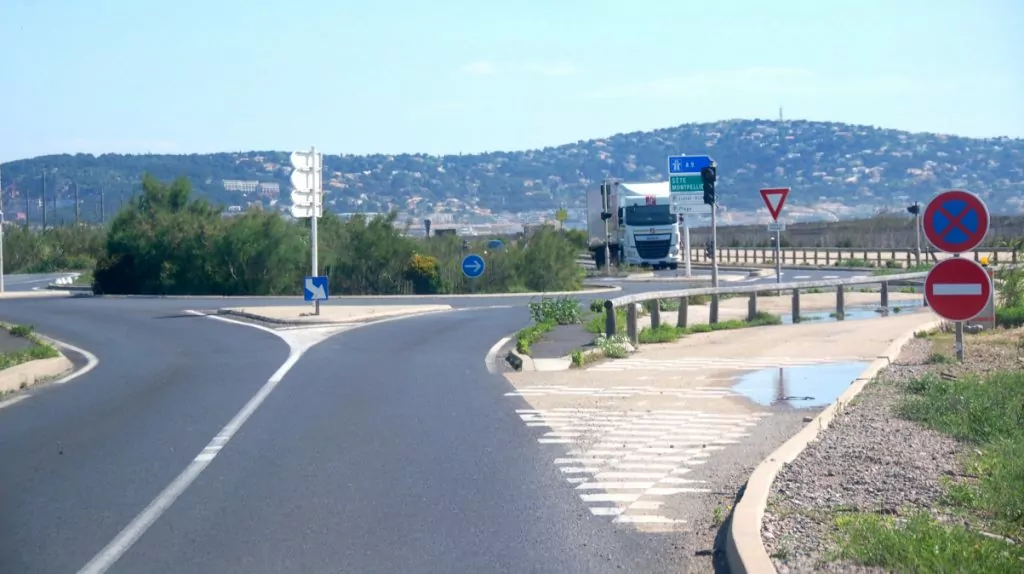
Another thing we have noticed after many trips through France is the amount of roundabouts. The French seem to love roundabouts, and on some stretches it feels like the next one starts before you have even left the last one.
Do you pay motorway tolls?
Many motorways in France, but not all, are toll roads. These roads can be a good choice if you want to get there quickly. If you're not in a hurry, and you want to avoid tolls, you can ask your GPS to avoid toll roads. This will result in a cheaper journey and usually more beautiful views. Toll roads are signposted "Péage".

How is the traffic?
We find that traffic on French roads runs smoothly, and that most people drive in a relatively calm and relaxed manner. However, you may need to be extra observant around big cities and during holiday periods, when traffic is much heavier and more intense than in Sweden.
What are the speed limits for motorhomes in France?
The usual speed limits for cars and motorhomes up to 3.5 tonnes are 130 km/h on motorways, 110 km/h on expressways and 80 km/h on roads. When there is precipitation (rain), speeds are reduced to 11o on motorways and 100 km/h on expressways.
Motorhomes with a total weight of more than 3.5 tonnes are subject to different speed limits. These are a maximum of 110 km/h on motorways, 100 km/h on motorways and 80 km/h on roads.
Also note that speed limits are significantly reduced when travelling through towns and villages.

What are the driving licence rules for motorhomes in France?
Your Swedish driving licence is valid in France just like at home. It may be useful to know that in Sweden we have a transitional rule which means that if you obtained a Swedish driving licence before 1 July 1996, which has not been revoked, you may drive motorhomes over 3.5 tonnes provided that they are classed as a passenger car class II and not as a lorry.
You have the same competences throughout the EEA, but it can be difficult for individual police officers in other countries to keep track of Swedish transitional rules. To be on the safe side in case of any doubts, you can download an equivalence table to bring along in your preferred language, from Transport Agency website.

What happens when you drive a motorhome weighing over 3.5 tonnes in France?
You can of course drive a heavier motorhome in France, although there may be occasional small stretches of road where you are not allowed to drive heavier vehicles. Here's what to keep in mind:
- Have a driving licence with the right qualifications (B licence in some cases or C1)
- Follow speed limits for heavier vehicles (110 on motorways, 100 on expressways and 80 on roads)
- Note higher road tolls when driving a heavier vehicle.
- Attach Angle Mort stickers to your campervan. Blind spot stickers are also required on foreign-registered vehicles over 3.5 tonnes, and can be purchased in various shops both in the UK and abroad.

Are there environmental rules to follow when driving a motorhome in France?
In many places in France, both in cities and villages, an environmental sticker is required. This sticker can only be ordered online and should be ordered directly from the French authorities here. Please note that it can take up to six weeks to receive the sticker, so you should order it well in advance.
Zones requiring an environmental sticker are labelled with a red round ring on a white background and the text "Zone". When the zone ends, it is labelled "Zone fin".
Do you need to carry anything special in your motorhome when travelling in France?
In addition to the stickers mentioned above (environmental sticker and Angle Morts sticker), you will also need the following items in your campervan:
- Registration certificate for the motorhome
- Warning triangle
- Reflective vest
- If you have a rear bike rack: a reflective warning sign
- Recommended: Spare lamps, First aid kit, breathalyser

How much does it cost to refuel?
It is difficult to say what it costs to refuel because it depends on where and what you refuel, and because prices change. During this trip, we have found that prices are relatively similar to those in Sweden. Good to know is that diesel is called "gazole" and LPG is called "GPL"
How to fill/refuel LPG?
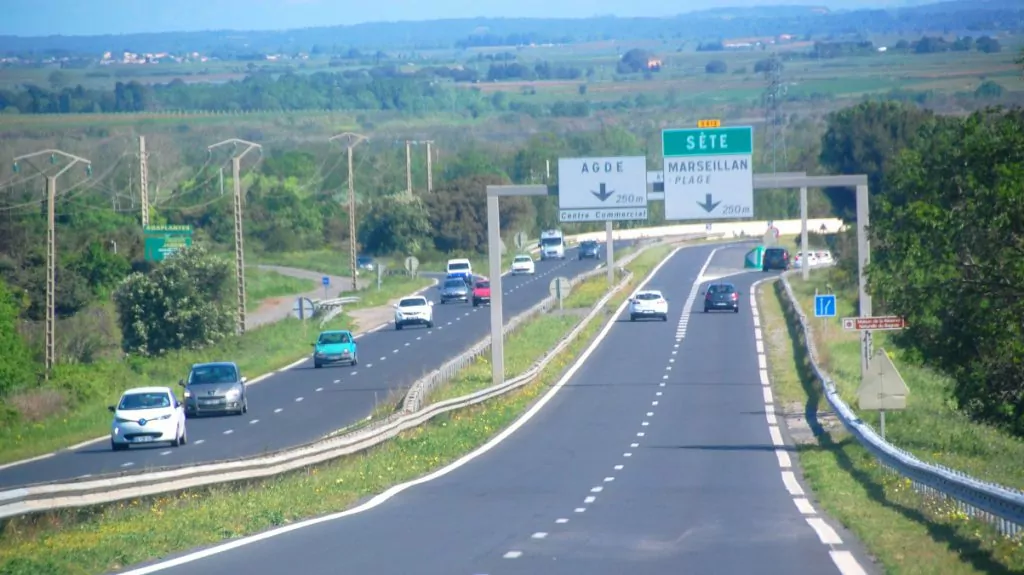
Changing standard Swedish LPG cylinders abroad can be difficult, as LPG systems are different. The best way may be to install a fixed tank for LPG/gasoil, which can be filled in many places around Europe.
If you don't have a fixed tank and are only travelling in France for a short period, or don't need much LPG, one option is to travel with full LPG cylinders, which you calculate can last for the whole period.
Where can you empty tanks and fill water?
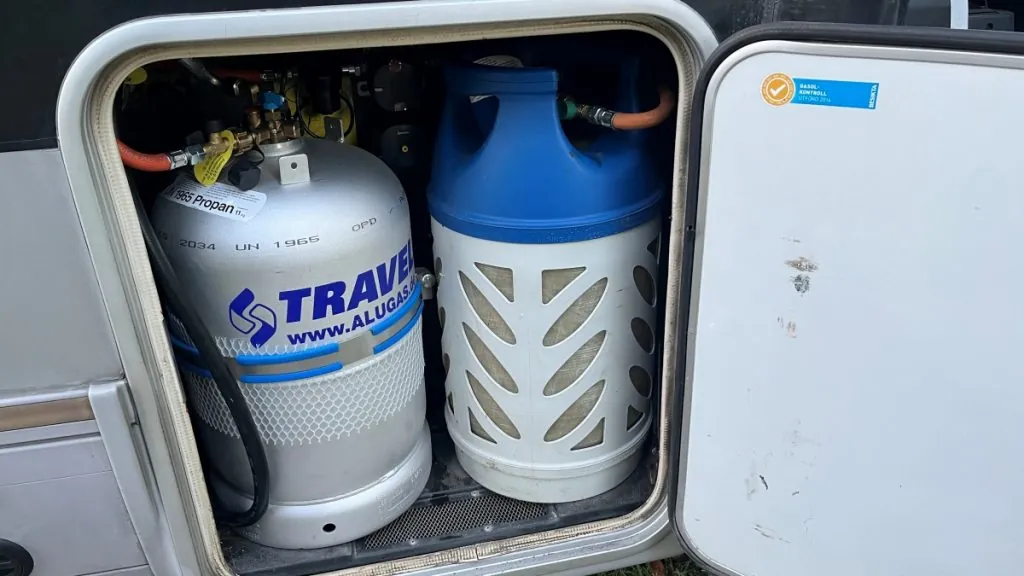
Travelling by motorhome in France is easy and there are plenty of places to empty grey and black water tanks and fill up with fresh water. In addition to campsites and many caravan parks, there are also 'stations' with vending machines here and there. You can find these, for example, via the app Park4Night.

Can you go camping with a motorhome in France?
The rules for free camping in France can be somewhat restrictive, and we find it difficult to be clear about what actually applies in different situations. Some websites state that you need the landowner's permission to fricamp, which in practice is of course difficult as you often don't know who owns the land.
However, our experience, after a few months on the road in this country, is that fricamping is very common in France and that French motorhomers themselves do this to a large extent. In the countryside, it is very easy to find nice places, for example using the app Park4Night. In larger cities and tourist centres, there may be more bans on overnight stays, as indicated by signs or barriers limiting the height.
If you are going free camping, it is of course advisable to behave respectfully: follow signs, park where you won't be disturbed, respect nature, don't litter, don't spread your belongings outside the vehicle.

How do car parks work in France?
When it comes to caravan parks, France is a fantastic country. There are plenty of car parks in France - from simple pitches with no services to pitches with all the services you can imagine. Sometimes all services are included in the daily fee, and other times you pay a lower daily fee and pay separately for services such as water and electricity.
There is also something called France Passion, which is suitable for those who want to stay in French vineyards. You pay an annual fee and then have access to a wide range of vineyards where you can stay free of charge with your motorhome.
You can often pay by card, but it's always a good idea to have some cash with you just in case. For separate services, you may sometimes need to pay with tokens (which can be bought with a card), but you may also need to pay with coins, in the form of euros. You can use these apps to find parking spaces:
- CamperContact
- Camping-Car Park
- Park4Night

What are the campsites like in France?
Not only are there plenty of pitches in France, but also plenty of campsites. In other words, motorhome travellers feel welcome in France! Campsites can range from small and cosy to large with lots of activities for children and adults.
Many times you can come spontaneously, but in high season you may need to book in advance, especially in popular places. If you get ACSI Card (now digital), you can get a discount on certain campsites during low and mid season.

What are the costs of pitches and campsites in France?
It is difficult to give a general answer on the price of pitches and campsites, as it varies a lot, depending on the level of service, location, season and other factors. During this trip we paid around 15-25 euros/day for pitches and 20-35 euros/day for campsites, but please note that these prices apply during the pre- and mid-season (April-June). During the high season, prices usually go up slightly.

How to pay?
You can often pay by card in France, but it's good to have some cash as well. Bear in mind that you may want to choose a card without an exchange surcharge if you don't want to incur unnecessarily high costs while travelling.
The Northmill card is an example of a card that is completely free of charges both at home and abroad. Travel insurance is included and you become a customer in 3 minutes with BankID. Click here to access the registration of a Northmill card.
Can you manage in English?
We don't speak French, so yes, you can get by in English. We find that most people we meet in France speak either decent or good English, especially younger people and people working in the tourism sector.
We also meet people who don't speak English, such as elderly people in rural areas and some people who work in grocery stores and the like. Usually it's quite simple things you want to communicate, and then it works great to point to the desired fish in the fish counter, smile a little and maybe add a "bonjour" (hello), "merci beaucoup" (thank you very much) or "au revoir" (goodbye). You don't need to know French to travel in France!

What do you need to consider in terms of safety?
France is generally a safe and secure country to travel in, but it is always wise to check the current security situation when visiting another country. You can find up-to-date information via the Embassy's travel information on France or by downloading the "UD Resklar" app.
To protect yourself from theft and burglary, it is good to think about where you park your motorhome and to be careful with your valuables. You can also choose, for example, to get an alarm for your motorhome and good locks for your bicycles. Don't forget to check your travel insurance (home insurance) and motorhome insurance.

What is available in shops and restaurants?
The selection in the supermarkets is fantastic, with a wide range of cheeses, pâtés, seafood, pastries and other goodies. There are also plenty of pleasant restaurants, where you can often choose a 'plat du jour' (dish of the day) at a reasonable price during the day. Read more about shopping in French supermarkets here.

What do you want to see and do when travelling by motorhome in France?
France is a large and varied country with a lot to offer, whether you like nature, culture, history, food and drink or entertainment of all kinds. You'll find plenty of inspiration and travel tips on our France page:
You might also like:
 Visiting Rocamadour in France - a sacred pilgrimage site
 Millau Bridge in France - Europe's highest bridge
 Visiting La Couvertoirade in France - a fortified knightly town
 Things to do in Dijon - 16 tips for the mustard city in Burgundy
 Palais Idéal in France - a palace built by the postman Cheval
 Travelling by motorhome in Corsica - everything you need to know


 English (UK)
  Svenska
Madde says:
Very good tips. Would probably not dare to drive alone in another country, but gladly with a couple more. Now that we are getting a motorhome.
18 June 2025 - 6:22
Helena says:
Travelling abroad in a motorhome is actually quite easy, but doing it with a few other people is a great idea if you're feeling unsure!
28 July 2025 - 9:05
Christina says:
We live in the south of France and recognise a lot of the text, but I would like to point out a few things.
Regarding the route, we always drive the bridges through Denmark when we visit Sweden with our motorhome. It's a motorway all the way and you avoid ferry queues. If you have registered beforehand, you can just drive through the barrier at the toll stations.
Incidentally, we think that France is a dream country for motorhome tourists, as almost every small village has a parking space and signs for emptying motorhomes are frequently found along the roads.
This is something we lack in Sweden, where you can travel a long way without being able to empty the grey water tank in particular.
Breathalyser tests have not been required in France for a number of years.
Many good tips for excursions from you.
France has it all:
18 June 2025 - 9:18
Helena says:
Isn't France amazing!!! Thanks for your comment Christina! And you are right about the alcohol test, we are correcting this!
28 July 2025 - 9:10
eval8 says:
Don't feel we would have driven in other countries, if we had a motorhome.
18 June 2025 - 9:45
bmlarsreseblogg says:
Thanks for many good tips. We will probably try to explore southern France a bit on our way south this autumn but much depends on weather and when we will leave.
18 June 2025 - 14:45
BP says:
Great tips! Also wondered why you should have an alcohol test in the house picture. Yes, I understand why, but I did not even know that you as a private person can buy them. Then I saw Christina's interesting comment - no more alco-tests; -)
18 June 2025 - 19:20
Claes Heidenback says:
Many good tips and explanations. We have a lorry that is rated at 4 tonnes so we have stuck "Angles Mort" stickers on the car that we bought before the trip to France. However, we can see that we are quite alone in having these apart from lorries. Almost no other motorhomes have them on despite the fact that they are also reasonably over 3.5 tonnes. Are they really needed? The Freedom travel car does not have them on either I see in your pictures.
28 July 2025 - 8:29
Helena says:
Hi Claes! Our motorhome is registered to 3.5 tonnes and therefore we do not have this sticker. We have seen quite a few motorhomes with this sticker and I am sure that you should have it. I have no idea how carefully it is checked though.
28 July 2025 - 9:04
Claes Heidenback says:
Hi Helena, Thank you, I understand. However, I find it hard to understand that so many people manage under 3.5 tonnes in practice and thus the risk of overloading should be very high for many hb tourists in France.
But maybe it is not checked so carefully how much a HB weighs? We have travelled in motorhomes for 13 years in Europe and have never been checked by the police yet but we have also always been under the regulated weight limit. However, never under 3.5 tonnes at the time we had as big a motorhome as you have. We were in Sardinen 2018 after your tips from 2015 and now look forward to your possible return visit to Cala Gonone, because you are going there again, right? It is certainly a place we plan to return to!
29 July 2025 - 10:55
Helena says:
Yes, it can be difficult to go below 3.5 tonnes in practice. We didn't realise this when we bought the campervan and have tried to upsize it, but it's not possible with our model. We try to think about what we pack. For example, we did not bring bikes on this trip. But yes, it is difficult. However, as a rule, it helps many times to be regged to 3.5 tonnes. And yes, we want to return to Cala Gonone! 🙂 Glad to hear that you went there after our tips! 🙂
29 July 2025 - 15:10