



Writer: Helena Bergström
Updated: September 2026 | It's one thing to read about the Normandy landings and another to stand on the beach where history still lies out in the sea. We visited Arromanches-les-Bains during our motorhome trip through Normandy and were deeply moved by the place.
 Tweet
 Share
 Share
 Pin
 Share
 Share
Table of contents
Arromanches-les-Bains in Normandy
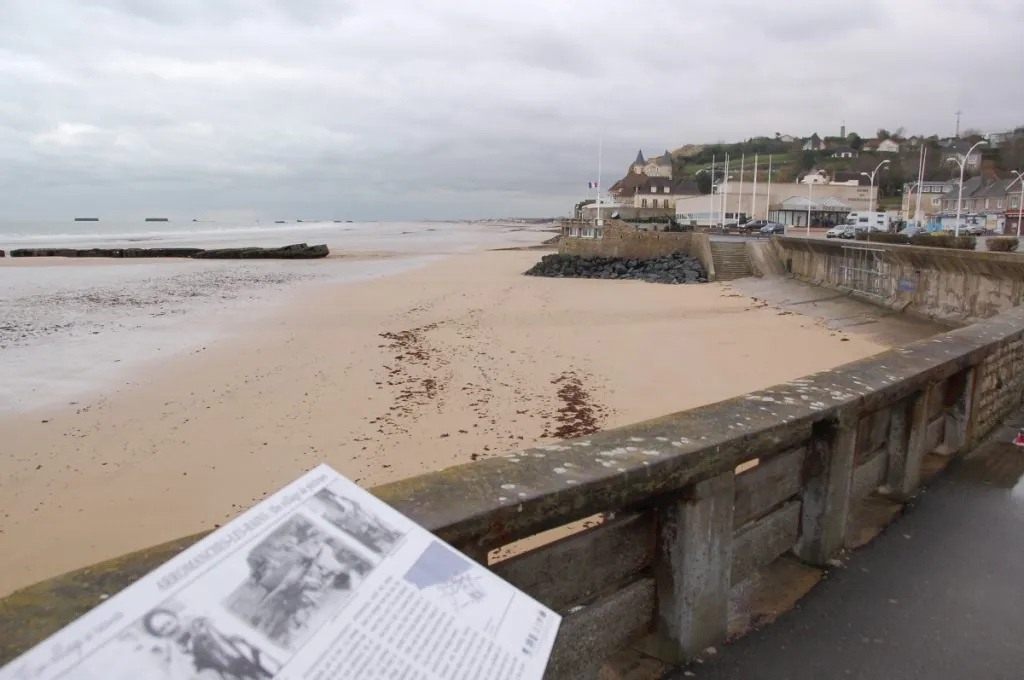
Arromanches-les-Bains is located on the Normandy coast in northern France. Today it is a small seaside resort with a sandy beach, restaurants and houses that climb up the surrounding cliffs.

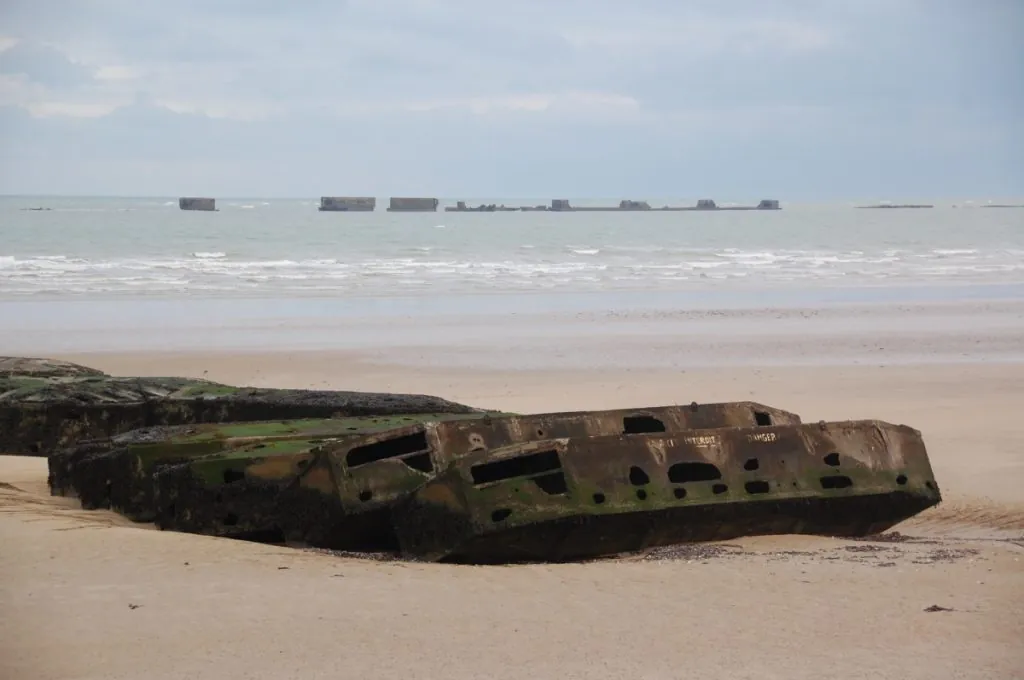
But Arromanches is above all known for the role it played during the Normandy landings in 1944. If you look out over the sea from the beach, you can still see large concrete structures out in the water. They are the remains of the enormous artificial harbor that the Allies built here after D-Day. For us, it was a special encounter with history.
The Normandy landings on June 6, 1944
The Allied landings in Normandy began on June 6, 1944. The operation was part of Operation Overlord, the grand plan to establish a bridgehead in France and then continue the liberation of occupied Western Europe.
The landings were carried out along five different parts of the Normandy coast, which were codenamed Utah, Omaha, Gold, Juno and Sword.
Arromanches is located in the area around Gold Beach, where mainly British forces landed. But getting the soldiers ashore was only the beginning. In order for the offensive to continue, enormous quantities of vehicles, ammunition, fuel, food and other equipment had to be transported across the English Channel. And then there was a problem: they needed a port.

Why did the Allies build a port in Arromanches?
The Allies could not count on quickly capturing and using any of the major ports along the French coast. The experience of the failed raid on Dieppe in 1942 had shown how difficult it was to capture a heavily defended port.

The solution was spectacular to say the least: If you couldn't capture a port, you simply had to bring your own. In Britain, huge sections were built into two prefabricated ports, codenamed Mulberry. The sections were towed across the English Channel and assembled off the coast of Normandy after the landings.
One of the ports, Mulberry A, was built in the American sector at Omaha Beach. It was badly damaged by a storm later in June and abandoned. The other was built here at Arromanches and was named Mulberry B, also called Port Winston.


Mulberry B – the artificial harbor at Arromanches
The work on Mulberry B was a huge logistical and technical project. Old ships were sunk to help protect the harbor, and large concrete caissons were placed out to sea to form breakwaters.
Within the protected area, floating piers and causeways were built, making it possible to bring vehicles and supplies ashore despite Normandy's large differences between high and low tides.
The port played an important role in supplying the Allied forces in the first months after the landings. And the strangest thing for those of us visiting Arromanches today is that parts of it still remain.

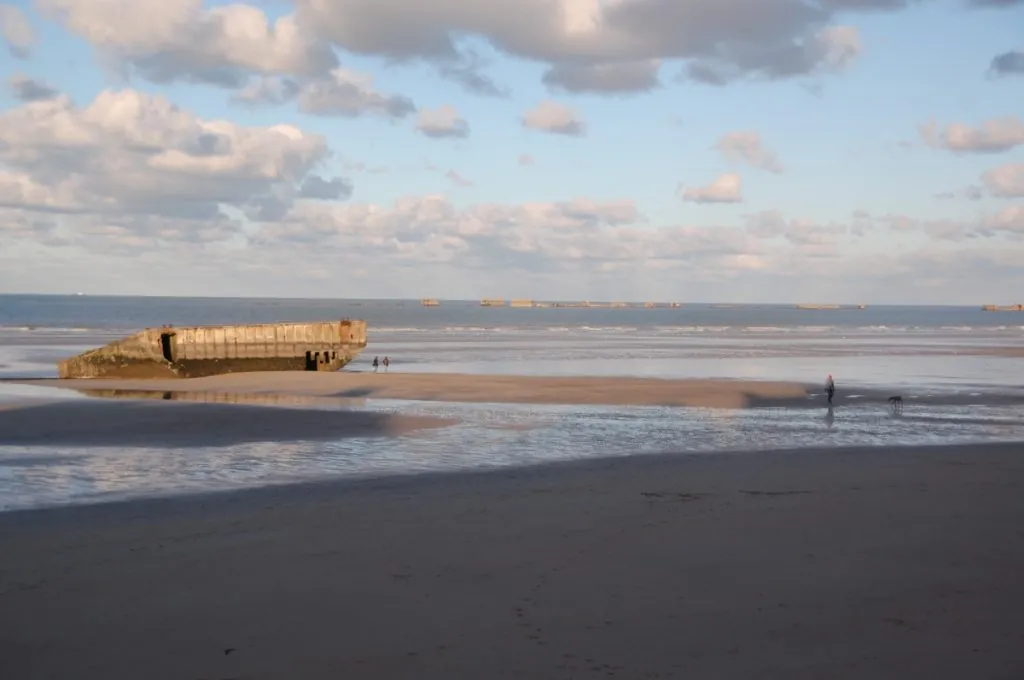
The remains of the port still exist.
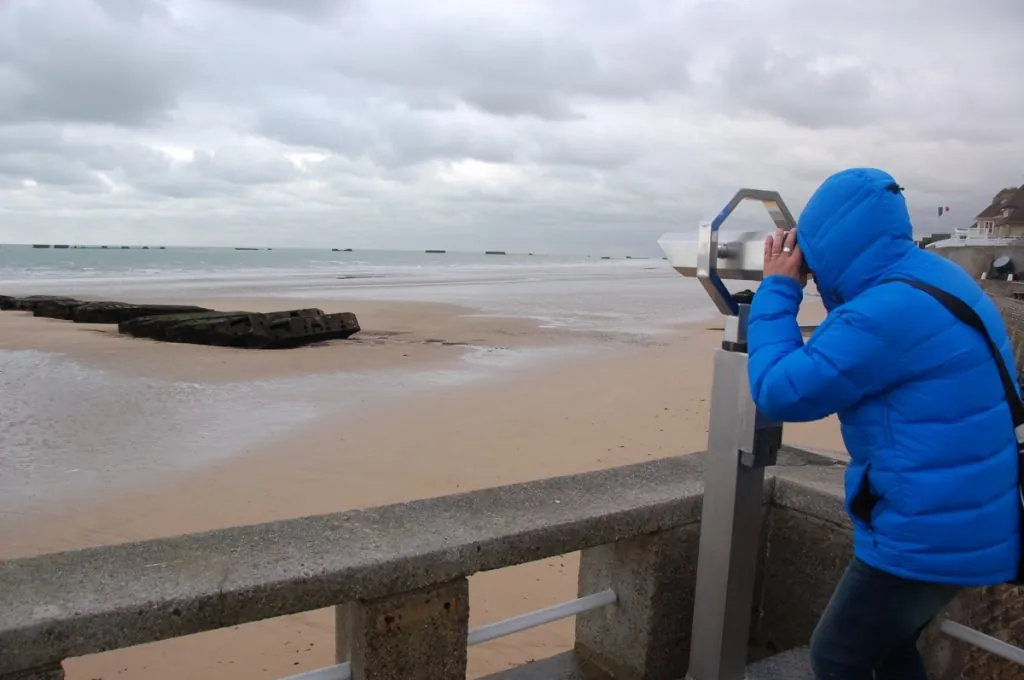
If you stand on the beach in Arromanches you will see the large concrete structures lying out in the sea. At low tide even more parts become visible. It is truly fascinating to stand here and look and at the same time try to understand what once took place in this place.
In one way it is very recent and in another way an incredibly long time ago. When you are there, the history becomes very concrete. You think of all the people who were here and all the misery they had to endure during the war. For us it was difficult not to be moved.
Museum of Débarquement in Arromanches
Right next to the beach is the Musée du Débarquement, the D-Day landing museum in Arromanches. When we visited the town, we toured the museum that was there at the time, with models, objects and films that told the story of the landing and the artificial harbor.
We were affected by the visit. Perhaps the experience would not have been quite the same if the museum had been located anywhere else in the world. But here we could go out and see the remains of the Allied port still lying out in the water. Then everything became incredibly real.
Since our visit, the museum has completely changed. The old museum closed in 2022 and in the spring of 2023 a new Musée du Débarquement opened on the same historic site.
The new museum tells the story through original artifacts, archival footage, models and large digital presentations. A particular focus is on how the two artificial Mulberry harbours were constructed and their significance during the Battle of Normandy.

See Arromanches from above
For a better perspective of the beach and the artificial harbour, you can climb the cliffs above Arromanches. From here you can see how Arromanches is sheltered between the cliffs and how the remains of the Mulberry Harbour lie scattered in the sea beyond.
Also located on the hill is Arromanches 360, a circular cinema that shows a film about the hundred days that followed from the preparations for D-Day until the liberation of Paris. Even if you don't visit the cinema, the view from the area is worth experiencing.

Stroll along the beach in Arromanches
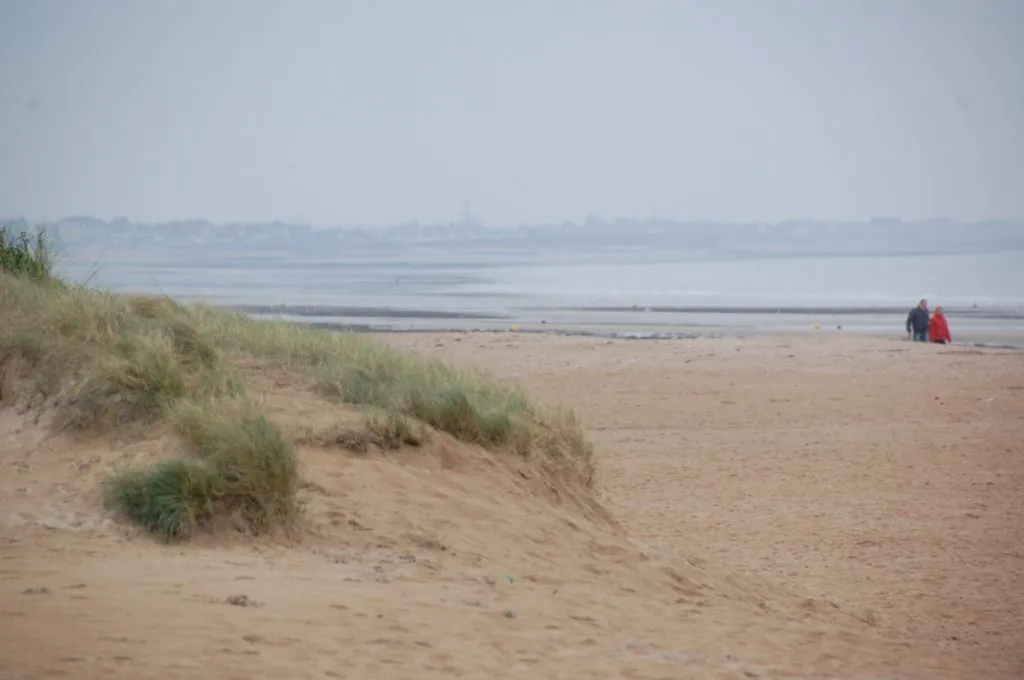
It's also nice to simply walk along the beach. Normandy's tides change the landscape quickly and the difference between high and low tide can be huge. On our visit we walked along the water and looked at the large remains of the Mulberry Harbour out to sea.

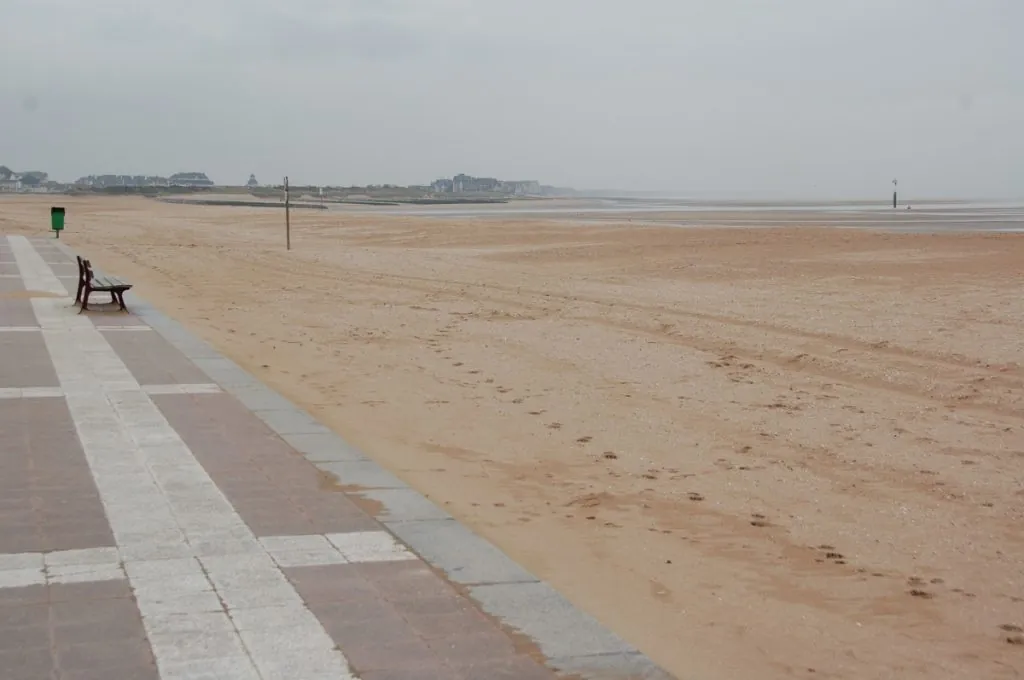
The contrast is special. Today Arromanches is a seaside resort with a sandy beach and beautiful houses along the coast. At the same time, you only have to look out over the sea to be reminded of what happened here in 1944. It is an ordinary beach and at the same time anything but an ordinary beach.

Arromanches by motorhome
We came to Arromanches by campervan and stayed overnight at a campsite near the centre. When we made our trip the site operated differently than it does today, so our old information about prices and service is no longer up to date.
Today, there are two municipal motorhome sites in Arromanches-les-Bains. One is located on Avenue de Verdun, near the Musée du Débarquement. The other is located along the D514, near Arromanches 360. Both have access to fresh water and emptying facilities, and the sites are open all year round.
Good to know: Prices, service and rules for motorhome pitches are subject to change, so always check the latest information before your trip.

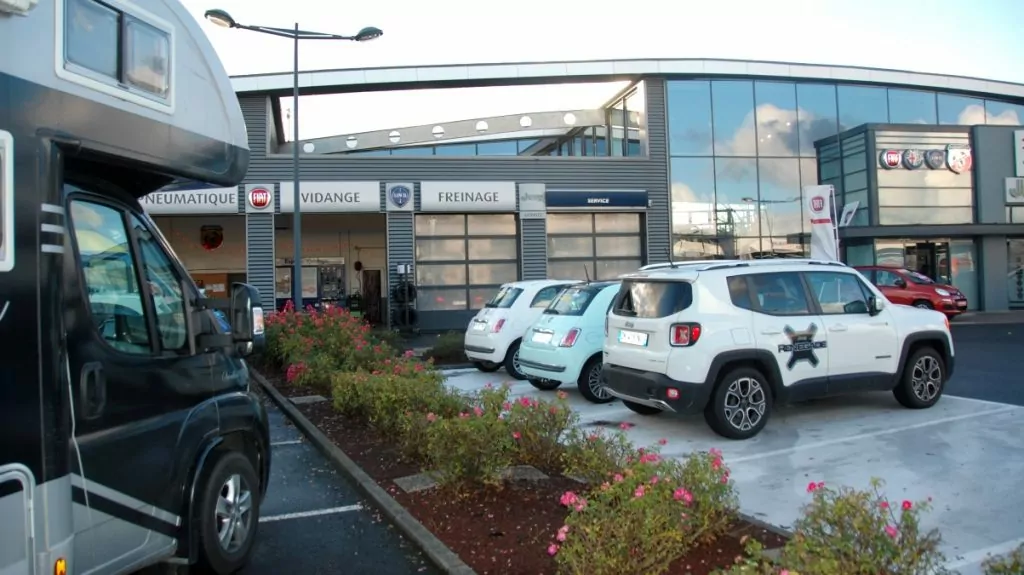
When we were here, we had a problem with the camper. The engine's coolant leaked out through a hole in a hose, and to solve the problem we went to a workshop in Caen. The guys at the workshop didn't speak any English, but good will, gesticulation and Google Translate go a long way. Thanks to good help at the workshop, we were able to move on again.
Is Arromanches worth a visit?
For anyone interested in the history of World War II, Arromanches is definitely worth a visit. But we think the place is moving even if you are not particularly interested in military history.
We had of course read about the Normandy landings before. But standing on the beach in Arromanches and seeing the remains of the artificial harbor still lying out in the water was something else entirely. Suddenly the story became concrete. It was no longer just black and white pictures and dates in a history book. It had happened right here.

See more in Normandy
Want to see and experience more during your trip to Normandy? Here you will find more tips and reports:
You might also like:
 Visiting Rocamadour in France - a sacred pilgrimage site
 Visiting Chateau de Beynac in France - a historic gem
 Visiting La Romieu in France - a gem of Unesco heritage and feline legend
 Visiting La Couvertoirade in France - a fortified knightly town
 Visiting the Chauvet cave in France - with 36,000-year-old paintings
 Roussillon in southern France – mountains, medieval towns and Catalan culture



 English (UK)
 Svenska
Belfina says:
I look in my travel report from 2011 and there is a photo from exactly the same place where Peter is standing. The small souvenir that we brought home and which does not take up much space was a metal "cricket". These were used by the American soldiers at the landing to communicate with each other. There is a clicking sound. Whether it sounds like a cricket, as cricket means, I don't know. Continuing to revive memories with you.
05 December 2014 - 18:44
Ditte says:
Yes, a historical journey here in the region is almost a must. Hard to even imagine what it was like. But I have been told everything by my father (died 2005) and he used to stand on one of the rocks, when it was low tide, and tell his cadets, Nordic politicians and others who were on the annual trip here to Arromanches about what really happened. A good book to read is D-Day by David Howard, who was also involved in the invasion.
I hope you will also visit the Pegasus Bridge and Café Gondré, which also played an important role in the liberation of France.
Enjoy! And for me, it will be another trip to Normandy for sure.
05 December 2014 - 19:28
admin says:
Belfina, fun that you were in exactly the same place! Funny also that you tell about your little souvenir, I had not heard of them!
Ditte, interesting to hear that it was precisely here to Arromanches the travellers used to go! We have crossed the Pegasus Bridge. What is Café Gondre?
05 December 2014 - 19:51
BP says:
Thanks for that tip! I have seen a number of films about D-day, but never seen the famous beach. Nice that Ditte complements your post with additional information.
05 December 2014 - 21:06
Matts Torebring says:
Everyone should go here to experience all the curses of war, straight from the history books. Enjoy your trip
05 December 2014 - 21:14
Ulla & Torgny says:
We made that trip four years ago and it was a reminder not to forget.
Happy Advent!
06 December 2014 - 0:27
Marina says:
It is always exciting to "experience history in situ". And it becomes even more interesting when it's about history that feels within reach and you have people around you who have experienced it (even if it starts to thin out on those who were involved in the Second World War, it still feels like quite "modern history").
06 December 2014 - 4:36
Mycket annat och lite betong says:
What a varied coastline! So beautiful with the high cliffs and then the long sandy beaches.
Interesting with some history too!
Have a nice trip!
Agneta
06 December 2014 - 7:23
Nils-Åke Hansson says:
Refrigerator
Remove the grille on the outside of the car and you will see the burner. Carefully take it easy to break off the spikes that lock it. Do not touch the burner with your fingers when blowing on the burner. It may be a soot flake that has settled.
This has helped me
Worth a try
Nisse
06 December 2014 - 10:37
admin says:
BP, you've heard about the landing many times, but there was still a lot that was new to me!
Matts, everyone should get a little more history! It became very real here, where so much remains.
Ulla & Torgny, what a reminder! More interesting and a greater experience than we had expected.
Marina, can agree. This story is not so distant, which makes it even more real.
Agneta, the coast is incredibly beautiful and dramatic!
Nisse, thank you very much for the tip! We think it might be a soot flake. Peter "knocked a little" yesterday and then it started, may have been a soot flake that got stuck. But many thanks for the tips, we have learnt a little more now, and we do not know if the problem will return.
06 December 2014 - 11:28