



Writer: Helena Bergström
Updated: September 2026 | Thoronet Abbey, Abbaye du Thoronet, is one of the best-preserved Cistercian monasteries in Provence. It was built in the 12th and 13th centuries and impresses with its simple architecture, beautiful light and special atmosphere. We stopped during a motorhome trip through southern France and also got a welcome break from the 35-degree heat.
 Tweet
 Share
 Share
 Pin
 Share
 Share
Table of contents
The Abbey of Thoronet in Provence
We had left Cannes and were heading west through Provence. Our destination for the day was the small village of Belgentier, where we were invited to dinner by Swedish blogger friends, but along the way we took the opportunity to stop at Thoronet Abbey.

Surrounded by forest in the Var department, the abbey is considered one of the finest examples of Cistercian architecture in Provence. Along with the monasteries of Sénanque and Silvacane, it is often referred to as one of the ”three Cistercian sisters of Provence.” All three were built according to the Cistercian ideal of a simple life characterized by work and prayer.
A monastery from the 12th century
The Thoronet Abbey was built between around 1160 and 1230 by Cistercian monks. During the 12th century, around 20 monks lived here, together with lay brothers who worked with agriculture and other practical tasks, among other things.
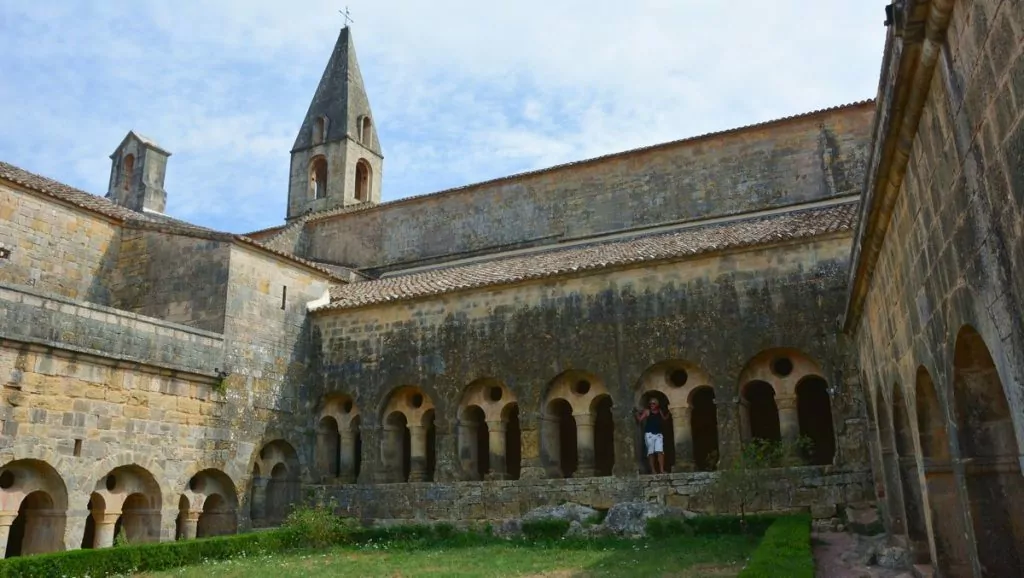
Almost 900 years later, it is still easy to be impressed by the buildings. Here, the abbey church, the cloister, the chapter house, the dormitory, the lay brothers' building and the wine cellar are still to be discovered. What impressed us most was their simplicity.

Simple Cistercian architecture
Cistercian architecture was not to be overloaded with ornamentation that could distract the monks from prayer and work. Therefore, Thoronet Abbey is almost austere in its expression, with stone, clean lines and sparse decoration. Of the three famous sister monasteries, Thoronet is usually described as the most stripped-down.
But pared-down definitely doesn't mean boring. On the contrary, the proportions, the high arches and the light that falls through the small openings make the building very beautiful.

When we walked around here, we were struck above all by how modern it almost feels. The form is simple and functional, even though the building is from the Middle Ages.

The monastery church and its special acoustics
One of the most impressive parts is the monastery church. Like the rest of the complex, it is austere, lacking the splendor and abundance of decorations found in many other historic churches. Instead, it is the space itself, the stone and the light that create the experience.

Thoronet is also known for its special acoustics. The stone vaults give a long reverberation, which suits the Gregorian chant that was part of the monks' religious life. The monastery is still used today for concerts and other cultural events.

The crusade and monastic life
Another nice part of the complex is the cloister, which connects several of the monastery's most important buildings. Here you can try to imagine how the monks moved between the church, the chapter house, the dormitory and the other parts of the monastery.
The life of the Cistercians was simple and regulated. The days consisted of prayer and work, and the monastery itself was designed to support this existence. This is still evident in the architecture. Almost nothing feels superfluous.

From flourishing monastery to decay
Thoronet was not to remain a flourishing monastery forever. In the later Middle Ages, the community declined and the buildings began to fall into disrepair. The monastery survived centuries of decline and change, but after the French Revolution its future was uncertain.
In the 19th century, the building's great architectural value was recognized. In 1840, the author and monument inspector pointed out Prosper Mérimée Thoronet was recognized as a significant example of Romanesque architecture, and restoration work began the following year.
Thanks to these and later restorations, we can today experience a facility that feels surprisingly complete.

A source of inspiration for modern architects
Perhaps most fascinating is that the almost 900-year-old architecture has continued to inspire well into modern times.
The French-Swiss architect Le Corbusier was impressed by Thoronet's clean forms and materials when he visited the site in the 1950s. The monastery's simplicity, light and use of massive stone surfaces have made it a reference even in modern architecture.
When you walk around here, it's actually not that hard to understand why. There's something timeless about the building.
Cool behind thick stone walls
We visited Thoronet in the middle of a major heat wave. The thermometer outside was around 35 degrees and Provence felt more or less like an oven.
Stepping inside the monastery's thick stone walls was therefore an experience in itself. The temperature dropped, the sounds became muffled and suddenly we found ourselves in a completely different world.
Of course, that wasn't why the Cistercian monks built the monastery the way they did. But almost 900 years later, we still have them to thank for air conditioning.

Visiting the Abbey of Thoronet
Abbaye du Thoronet is open to visitors and includes the abbey church, cloister, chapter house and several of the historic monastery buildings. Concerts and other events are also held here.
We previously had an exact admission price from our 2018 visit in the report, but such prices change. Therefore, check current opening hours and ticket prices before your visit.
We came here by camper. When we visited, the parking situation was a bit difficult for a larger vehicle, so here too it is wise to check current parking options instead of assuming what it looked like when we were here.
The three Cistercian sisters of Provence
Anyone fascinated by Thoronet can continue to the two other famous Cistercian monasteries in Provence.
Senanque Abbey is located near Gordes and is perhaps the most photographed of the three, not least when the lavender blooms in front of the monastery. There is still an active monastic life here. Silvacane Abbey is located at La Roque-d'Anthéron and, like Thoronet, is known for its stripped-down Romanesque architecture.
Together, the three monasteries tell the story of the great importance of the Cistercian order in Provence during the Middle Ages.

Swedish crayfish platter in Provence
After our visit, we continued to Belgentier, where a completely different experience awaited us. We had gotten to know Monika and Bengt through the blog back in 2015, when they helped us with lots of tips during our long motorhome trip through France. Now we were invited to their home in Provence.

And it wasn't exactly a Provençal dinner. After small sandwiches and a starter with avocado, smoked salmon and Skagen mash, crayfish, bread, Västerbottens cheese, beer and nubbe appeared. To finish, there were strawberries and ice cream. In the middle of Provence!

It was both fantastically delicious and a very fun contrast to the first half of the day. In the morning we had wandered around an almost 900-year-old French monastery. In the evening we sat with Swedish crayfish and nubbe at a friends' house. Travel days can be quite strange sometimes. And very good!

Is Thoronet Monastery worth a visit?
Yes, especially if you enjoy history, architecture or historical settings. Thoronet is not a grand monastery in the sense of gold, artwork and lavish decorations. What is impressive instead lies in the simplicity, proportions, light and the feeling that the buildings still tell the story of life that was lived here almost 900 years ago.
For us, it was also a perfect stop on the way through Provence. And that Swedish crayfish platter? It's hardly included in any official guide to attractions in Provence. But it was the highlight of the day nonetheless.
More to see in the neighbourhood
Are you planning to continue your trip in France? Here are some tips for more interesting places to visit nearby:
- Saint-Tropez
- Saint-Maximin-la-Sainte-Baume
- Gorges du Verdon
- Esterel Mountains in France
- Guide to the French Riviera

You might also like:
 Visiting Rocamadour in France - a sacred pilgrimage site
 Visiting Chateau de Beynac in France - a historic gem
 Visiting La Romieu in France - a gem of Unesco heritage and feline legend
 Visiting the Chauvet cave in France - with 36,000-year-old paintings
 Postel in Belgium - Aunt Anna enters a convent
 Visiting Gouffre de Padirac in France - a fascinating cave



 English (UK)
 Svenska
Lena - gott för själen says:
What a powerful monastery. I visited a monastery on my recent trip to Samos. It wasn't nearly as big, but it was more beautiful with more interior decoration. Four monks still live there.
What a nice end to the day. The blogging world is amazing!
Hug Lena
03 August 2018 - 6:31
Helena says:
Monasteries can be nice and soothing 🙂 Agree that the blog world is fantastic. Sooo fun with all the people you get to meet and get to know!
03 August 2018 - 17:38
Nils-Åke Hansson says:
Being invited home to such a "Tabberas".
was not bad.
03 August 2018 - 8:41
Helena says:
Absolutely fantastic! 🙂
03 August 2018 - 17:38
Ama de casa says:
But how delicious! Yes, the monastery was nice, but I'm mainly referring to the food 😀.
It will be fun to see what you come up with after all the good tips 🙂 .
Have a happy Friday!
03 August 2018 - 10:10
Helena says:
We have received lots of exciting tips! Let's just see how we will have time for all the fun and interesting things 🙂 .
03 August 2018 - 17:40
Steve says:
There are so many magnificent and exciting castles and abbeys in France. I remember this so well from when D and I drove through France in August 2000. It was our last trip before my stroke. How lucky we were to have made it. A wonderful last trip to remember.
"SWEDISH CRAFT MEAL IN PROVENCE" A somewhat dreamy way to describe the fantastic meal you were treated to.
03 August 2018 - 10:34
Helena says:
It sounds like you can think back on a really nice trip in France! 🙂 This meal will also be a memory that we won't forget!
03 August 2018 - 17:41
Ditte says:
Nice with a lot to see along the way and a cooling monastery is good, but I think the visit to your friends was the best. So good and a lovely environment.
Wishing you a continued good journey.
03 August 2018 - 13:30
Helena says:
Provence is beautiful and it feels like coming to a really genuine part of France. Then it is fun to meet friends, and interesting to talk to people who live in a country, and not just tourists in it. Interesting to get a little insight 🙂
03 August 2018 - 17:45
Britt-Marie Lundgren says:
How wonderful to be invited to a crayfish disc in Provence! The blog world is cool and it will be fun to see what you do in the future.
We will also be feasting on crayfish tomorrow, lovely home-fished delicacies!
03 August 2018 - 16:42
Helena says:
It's fantastic with all the meetings that take place through blogging, in different ways. And not wrong with crayfish! 🙂 Wish you a wonderful crayfish disc!
03 August 2018 - 17:47
Deciree says:
It was a nice monastery ???To then be invited home on holiday is not entirely wrong either ???Hugs?
03 August 2018 - 17:52
Helena says:
Really not wrong 🙂 Have fun!
04 August 2018 - 11:36
Matts Torebring says:
But how nice to be invited like that and what cultural buildings. One beats the other.
03 August 2018 - 19:15
Helena says:
Yes, isn't it? Being invited home like this is fantastic in several ways! 🙂
04 August 2018 - 11:37
Liniz Travel says:
But oh so nice and luxurious 🙂 when are you coming home? Hugs
03 August 2018 - 21:02
Helena says:
I start working on 3 September, so until then we'll be home 🙂.
04 August 2018 - 11:37
BP says:
The monastery was a luxury building, really! I've always thought that monks and nuns lived in poverty, but this is anything but a life of "misery".
So much fun with a crayfish disc on French soil! As fun as possible! Wonder what the French had liked about it;-)
I hope you will stay in Marseille!
03 August 2018 - 22:27
Helena says:
I think these monks lived in simplicity in many ways, but certainly in grand buildings with plenty of space 🙂 The crayfish disc in France was a fantastic experience that we won't forget! 🙂
04 August 2018 - 11:38
Kors och Tvärs says:
Really nice monastery! Fun to go to Provence and eat crayfish! 🙂
04 August 2018 - 20:28
Monet says:
Thank you Helena and Peter for the great visit! It's great to meet you in real life too and it's especially nice that you, like us, like France so much. We also enjoyed sharing typical Swedish crayfish tradition with you. Continue the wonderful and exciting journey and always welcome back Monica, Bengt and little Dessi!
05 August 2018 - 11:59
Helena says:
Many THANKS again Monica and Bengt! We will gladly come back to France!
31 August 2018 - 15:01