

Writer: Helena Bergström
Updated: August 2026 | Old Hanseatic cities, fairytale castles, thousands of lakes, long sandy beaches and exciting traces of Swedish history. Northern Germany is perfect for a round trip by car or camper – and the distances between destinations are often surprisingly short.
 Tweet
 Share
 Share
 Pin
 Share
 Share
Table of contents
Take a road trip along Germany's Baltic Sea coast
Here we recommend a round trip that starts with a ferry from Gothenburg to Kiel and continues east through northern Germany. Along the way we visit Lübeck, Wismar, Schwerin, Greifswald and Stralsund, interspersed with nature experiences among the lakes in Mecklenburg and on the holiday islands of Rügen and Usedom.
Finally, the journey continues across the border to Poland, where you can take the ferry from Świnoujście back to Sweden. The entire route can be done in about two weeks, but if you have three weeks, there is of course even more time for excursions and spontaneous stops along the way.

Tour of Northern Germany – suggested route
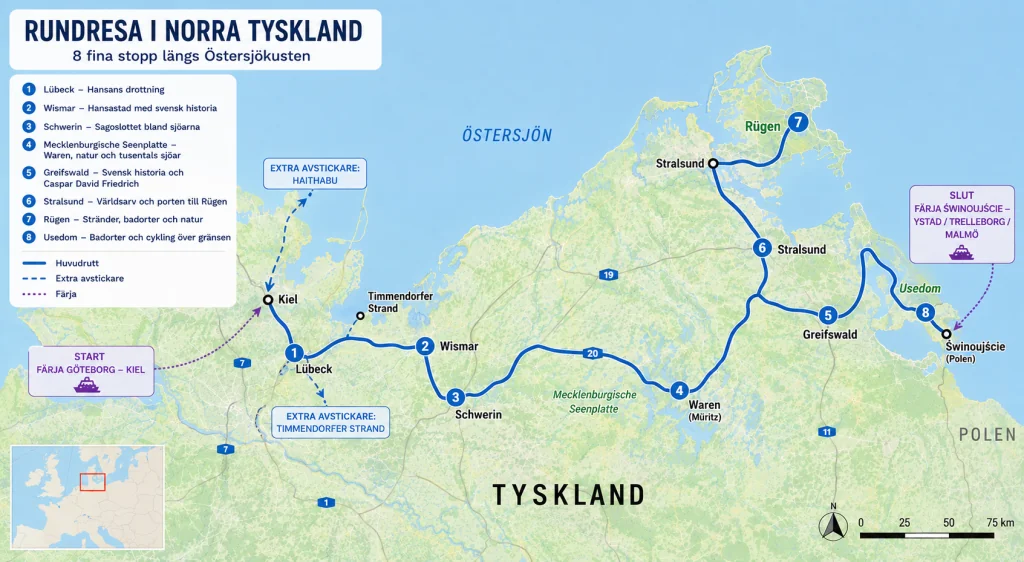
Our suggested round trip goes from Kiel in the west to the island of Usedom in the east. Then you continue the short distance across the border to Świnoujście in Poland for the ferry back to Sweden.
Kiel → Lübeck → Wismar → Schwerin → Mecklenburgische Seenplatte → Greifswald → Stralsund → Rügen → Usedom → Świnoujście
The main route itself involves approximately 700–750 kilometers of driving, depending on the roads and locations you choose. This of course includes driving to the destinations and any detours.
The beauty of the trip is that the driving distances between many of the stops are relatively short, so instead of long days of transport, you can spend most of your time discovering the places along the way.
Start the round trip by ferry to Kiel
A convenient way to start the round trip is to take night ferry from Gothenburg to Kiel. Then you can have dinner and sleep on board and roll off the ferry in Germany in the morning.
From Kiel it's just under ninety kilometers to Lübeck, which will be the first actual stop on the round trip. But if you have plenty of time, there's an interesting detour to make even before you start driving east.

Extra detour: Haithabu and the Vikings' Hedeby
Northwest of Kiel lies Haithabu, or Hedeby as the place is usually called in Swedish. During the Viking Age, this was one of northern Europe's most important trading posts, strategically located between the Baltic Sea and the North Sea.
Today you can visit the Viking Museum Haithabu and the reconstructed Viking community with houses and pier. Haithabu and the nearby Danevirke defense works have been on the UNESCO World Heritage List since 2018.
The detour means that you drive in the opposite direction to the rest of the round trip, so it is best suited if you have plenty of time and want to spend an extra day in Schleswig-Holstein.

1. Lübeck – Queen of the Hanseatic League
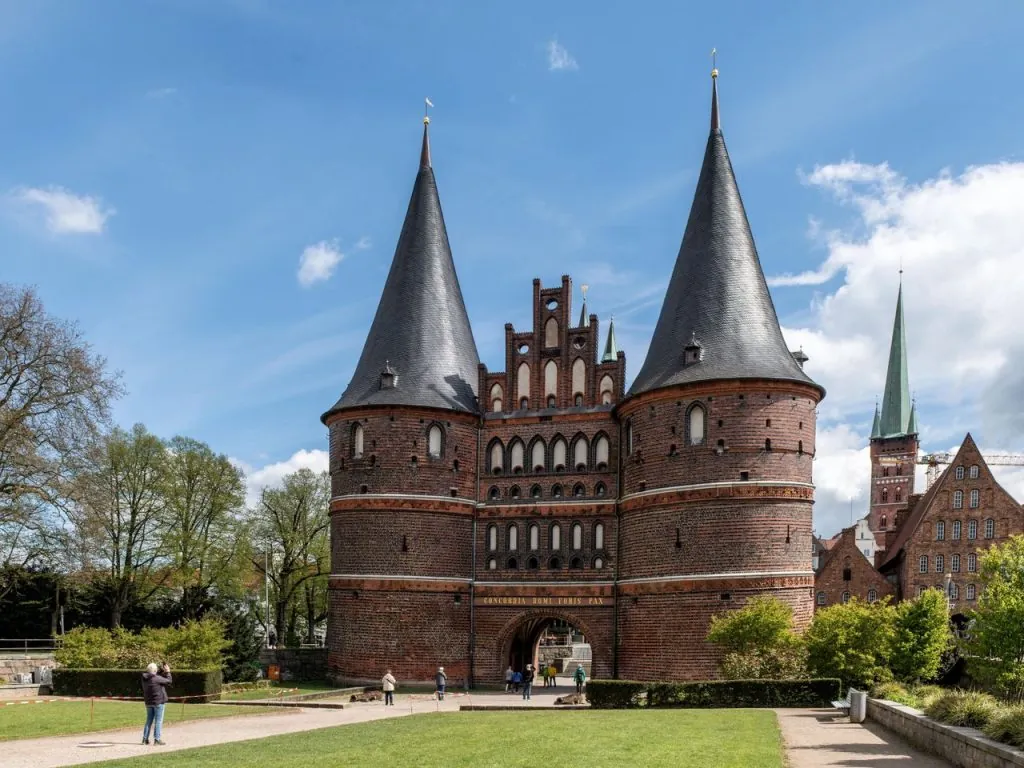
The first stop on our tour is Lübeck, one of Germany's most famous Hanseatic cities. The historic city center is located on an island surrounded by water and has been on the UNESCO World Heritage List since 1987.

The city's most famous landmark is the Holstentor, the mighty city gate with its two characteristic towers. But perhaps the best way to experience Lübeck is to simply stroll around among the churches, old merchant houses, cobblestone alleys and small courtyards.
Lübeck is also famous for its marzipan. The most famous is Niederegger, which has both a shop and a café in the middle of the old town. Be sure to try a marzipan cake or buy some treats for your camper.
Just in time: 1–2 days.
READ MORE: Things to do in Lübeck – 12 attractions and experiences
Extra detour: Timmendorfer Strand
If you want to combine a city visit with the sea and beach, Timmendorfer Strand only about twenty kilometers from Lübeck. Here you will find a long sandy beach, a promenade and the classic German seaside resort feel with the characteristic beach chairs.
It can be a nice day trip – or a place to stay overnight if the weather invites swimming.

2. Wismar – Hanseatic city with Swedish history
From Lübeck it is just under seventy kilometers to Wismar, the next historic Hanseatic city along the way. Wismar was an important trading city during the Hanseatic era, and the well-preserved old town is, together with Stralsund, on the UNESCO World Heritage List. Here you will find impressive brick Gothic architecture, colorful historic houses and a large square that is the perfect place to start your exploration.

For us Swedes, there is also another reason to visit Wismar. After the Thirty Years' War, the city became part of Swedish Pomerania and remained strongly linked to Sweden for a long time. The Swedish history is still celebrated, not least during the annual Schwedenfest.
Don't miss the harbor either, where you can stroll among boats and old warehouse buildings and maybe buy a Fischbrötchen – a fish sandwich that belongs to the northern German coast.
Just in time: 1 day, or 2 if you want to take it easy.
READ MORE: Things to do in Wismar – 12 tips for the Hanseatic city

3. Schwerin – the fairytale castle among the lakes
From Wismar it is only about 30 kilometers to Schwerin, the capital of the federal state of Mecklenburg-Western Pomerania. The main attraction is of course Schweriner Schloss. The magnificent castle is located on an island in Schweriner See and looks almost as if it were taken from a fairy tale, with towers, spires and a beautiful castle park.
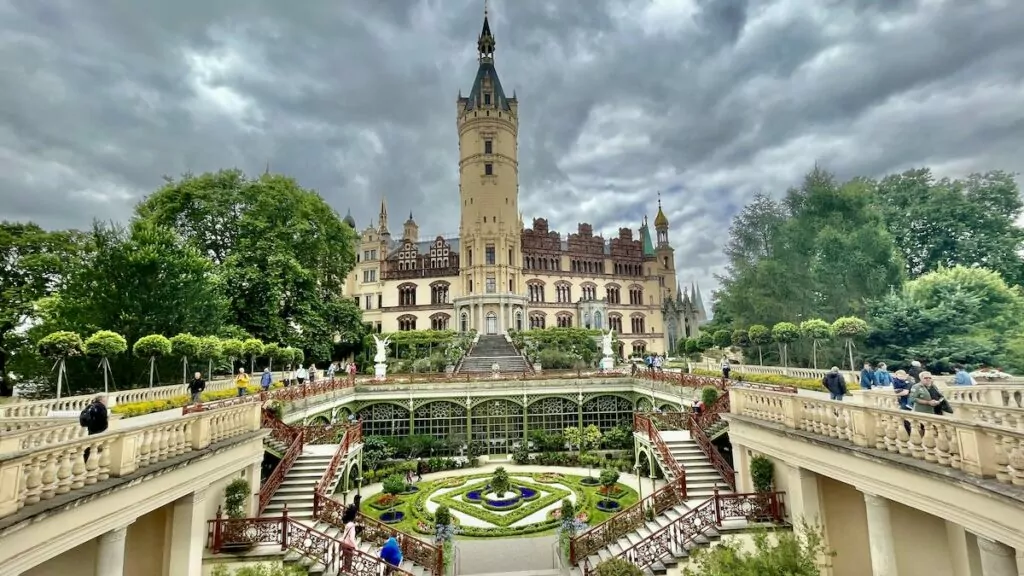
The palace and other buildings in the Schwerin residential ensemble were included in the UNESCO World Heritage List in 2024. Today, parts of the palace are used by the Mecklenburg-Western Pomerania state parliament, while other parts can be visited as a museum.
But Schwerin is more than its castle. The city is surrounded by lakes and has a pleasant historic center, making it a nice contrast to the coastal cities on the tour.
Just in time: 1 day.
READ MORE: Schwerin Castle – a guide to a fairytale castle in Germany

4. Mecklenburgische Seenplatte – lakes, nature and small towns
After Schwerin we leave the coast for a while and drive about ten kilometers east towards the Mecklenburgische Seenplatte, the large lake area in Mecklenburg-Western Pomerania.
There are a multitude of lakes, canals, forests and small towns here. The area is perfect for canoeing, cycling, boat trips or a few lazy days by the water.

Waren an der Müritz
A good starting point is Waren, located on Lake Müritz. The city has a charming old town, marina and plenty of restaurants and cafes.
There is also the Müritzeum, a modern nature experience center with large aquariums where you can get to know fish and other species that live in the region's lakes and waterways. Also nearby is the Müritz National Park with forests, wetlands and a rich birdlife.

Camping Havelberge and canoeing among the lakes
Another nice area you can find around Camping Havelberge at Lake Woblitzsee. While staying here, we went on a fantastic canoe trip through lakes and canals – an experience that really made us understand why the Mecklenburgische Seenplatte is so popular with nature lovers.
From the area you can also make excursions to, for example, Wesenberg and Mirow with their small castle and royal history.
Just in time: 2–3 days, preferably more if you like nature and paddling.

5. Greifswald – Swedish history and Caspar David Friedrich
After the lakes, the journey continues back towards the Baltic coast and Greifswald. Greifswald is an old Hanseatic city with colorful historic houses, large brick churches and one of Germany's oldest universities. The city also has a strong connection to Sweden through time as part of Swedish Pomerania.

The romantic artist Caspar David Friedrich was also born here in 1774. His life and art run like a red thread through the city, and at the Pommersches Landesmuseum you can see works by Friedrich and other artists.
Don't miss the area around the Ryck River and the Museumshafen, where over 50 historic ships are moored. If you want to take a longer excursion, you can follow the Ryck out to the old fishing village of Wieck and the ruins of the Eldena monastery – a motif that Caspar David Friedrich returned to in his paintings.
Just in time: 1–2 days.
READ MORE: Things to do in Greifswald – attractions and Swedish history

6. Stralsund – World Heritage Site and the Gateway to Rügen
Just under 40 kilometers from Greifswald lies Stralsund, another old Hanseatic city with clear Swedish connections. Along with Wismar, Stralsund's historic center is on the UNESCO World Heritage List. On Alter Markt you will find the impressive town hall and the Nikolaikirche, and all around you will find cobblestone streets, brick Gothic and colorful gabled houses.

Stralsund belonged to Swedish Pomerania for more than 160 years, and to this day there are traces of the Swedish era around the city.
The harbor also houses the Ozeaneum, a large aquarium and museum focusing on life in the Baltic Sea and the northern seas. The sailing ship Gorch Fock I, built in 1933 and currently undergoing restoration, is also located here. Stralsund is also the natural gateway to the next destination. From the city, the bridge leads to Rügen.
Just in time: 1–2 days.
READ MORE: Things to do in Stralsund – attractions and Swedish history

7. Rügen – beaches, seaside resorts and dramatic chalk cliffs
Rügen is Germany's largest island and deserves more than a quick stop. It has seaside resorts with grand turn-of-the-century architecture, long sandy beaches, beech forests, chalk cliffs and several unusual sights.
Binz and Sellin are among the classic seaside resorts, while the Rasender Roland steam train offers a significantly slower way to travel between several towns on the island.

One of Rügen's most unusual sights is Prora, the kilometer-long holiday complex that began construction during the Nazi era. Today, large parts of the buildings are used in completely different ways, but the history of the place still remains.
For nature experiences, there is Jasmund National Park with its famous white chalk cliffs and beech forests. Another option is the Naturerbe Zentrum Rügen, where you can walk on a long treetop path and reach high above the forest.
Just in time: at least 2 days, preferably 3–4.
READ MORE: Things to do on Rügen – 10 tips for Germany's largest island

8. Usedom – end the tour by the sea
The last German stop on the round trip will be Usedom, a long, narrow holiday island shared between Germany and Poland.
On the German side, the classic seaside resorts of Heringsdorf, Ahlbeck and Bansin line the coast. Here, you'll find long sandy beaches, beautiful villas from the seaside resort's heyday and some of Germany's most characteristic piers.

A nice way to discover the area is by bike. The cycle paths follow the coast and you can cycle across the national border to Świnoujście in Poland without much drama.
Usedom is therefore a particularly good last stop. After a few days of beach, cycling and seaside life, you just need to continue across the border to Poland to take the ferry back to Sweden.
Just in time: 2–3 days.
READ MORE: Things to do on Usedom – 25 tips for a Baltic Sea paradise

End the tour by ferry from Świnoujście
From Heringsdorf and Ahlbeck it is only a short distance to Świnoujście on the Polish part of Usedom.
Ferries from Świnoujście go to Ystad, Trelleborg and Malmö, which means that the journey has a natural end without having to drive back west through Germany. Which ferry is best depends on current departures and where in Sweden you want to land. Therefore, check timetables and prices before your trip.

How long does it take to travel around northern Germany?
Of course, it is possible to make the trip both shorter and significantly longer. The eight stops are intended as inspiration, and you do not have to visit all of them.
Do you have about 10 days we would choose to eliminate some destinations and concentrate on the places that attract the most.
Med about two weeks you have time to do the entire main route, but it is wise to prioritize what you want to see on, for example, Rügen and the Mecklenburgische Seenplatte.
Do you have three weeks you can travel much slower, stay several days at the lakes and on the islands and also make detours to Haithabu and Timmendorfer Strand.
Northern Germany by motorhome
Northern Germany is a great area to explore by motorhome. The distances are relatively short and there are plenty of campsites and parking spaces along the route.
In and around several of the cities there are campsites within walking or cycling distance of the city centre, while the lake area and islands offer plenty of camping opportunities for those who want to stay a few days.
Keep in mind that conditions can vary between locations and seasons. In popular holiday destinations such as Rügen and Usedom, it may be wise to book camping in advance during the height of summer.
READ MORE: Travelling by motorhome in Germany - all you need to know

Good to know before a driving holiday in northern Germany
Germany does not have a general road toll for passenger cars. Nor are regular motorhomes automatically subject to the German truck toll just because they weigh over 3.5 tons.
However, some German cities have environmental zones where vehicles need to have a special environmental sticker. The rules change over time, so check what applies to the places you plan to visit.
On German motorways there are still stretches without a general speed limit, but many stretches have posted speed limits. With motorhomes, there are also special rules depending on the weight of the vehicle.
This round trip is largely on regular roads and shorter stretches of motorway, and many of the stages are so short that the actual driving is a fairly small part of the travel day.

When is the best time for a tour of northern Germany?
Spring, summer and early autumn are good times for a round trip along the German Baltic Sea coast.
During the summer, the seaside resorts and islands are at their liveliest, with opportunities for swimming, boat trips and other outdoor activities at their best. Meanwhile, July and August are high season, especially on Rügen and Usedom.
May, June and September can therefore be nice months for those who would like to have a little less congestion but still want to be able to enjoy coastal towns, cycling and nature.
FAQ – frequently asked questions about touring northern Germany
How long does it take to travel around northern Germany?
About two weeks is a good starting point for this route. That will give you time to visit all eight main stops, although you will need to prioritize what you want to see at the larger destinations. Three weeks will give you a much more leisurely pace.
How far is the round trip?
The main route from Kiel via Lübeck, Wismar, the Mecklenburg Lake District, Rügen and Usedom to Świnoujście is approximately 700–750 kilometres. The actual distance is longer when excursions and local driving are included.
Is northern Germany suitable for motorhomes?
Yes, northern Germany is very suitable for a motorhome holiday. There are plenty of campsites and parking spaces and the distances between many of the destinations are short. During high season it may be wise to book accommodation or camping in advance on popular islands and seaside resorts.
Can the round trip be done in a regular car?
Absolutely. The route works just as well as a road trip, and there are hotels, guesthouses and other accommodations at all major destinations.
Which cities should not be missed in northern Germany?
Lübeck, Wismar, Schwerin, Greifswald and Stralsund offer different experiences and fit nicely together on a round trip. Lübeck, Wismar and Stralsund are particularly interesting for those who like Hanseatic history and historic architecture.
Where is Swedish history found in northern Germany?
Especially in Mecklenburg-Western Pomerania there are clear traces from the time when parts of the area were part of Swedish Pomerania. Wismar, Greifswald and Stralsund all have interesting Swedish history.
Which islands can you visit in northern Germany?
Rügen and Usedom are two of the most popular holiday islands on the German Baltic coast. Rügen is known for its seaside resorts and chalk cliffs, while Usedom attracts with its long beaches and classic seaside resorts such as Heringsdorf and Ahlbeck.
Do you need an environmental sticker in Germany?
Some German cities have environmental zones where vehicles need an approved environmental sticker. The rules vary and change, so check the current regulations for the places you intend to drive into.
Is it possible to take a weekend trip to northern Germany?
Yes, but then it's better to choose one or two destinations instead of the whole round trip. For example, Lübeck is easy to reach from Kiel, while Wismar and Schwerin work well to combine over a slightly longer weekend.
How do you get by ferry between Sweden and northern Germany?
An alternative is the night ferry Gothenburg–Kiel on the outward journey. If you follow our route eastwards, you can then end in Świnoujście in Poland, from where there are ferries to Sweden. Ferry routes and timetables are subject to change, so always check current departures before your trip.
You might also like:
 Calanche di Piana - dramatic mountain roads in western Corsica
 The Atlantic Road in Norway – and smoked salmon in Bud
 By motorhome along the south coast of Norway – coastal roads, fishing villages and white wooden towns
 Around Siljan by car or motorhome - our top tips
 10 picturesque towns in Germany - a great road trip
 Europe's most beautiful coastal routes by motorhome - 10 magical road trips


 English (UK)
 Svenska
Emma, Sol som sol? says:
There are undoubtedly many gems there to visit! That's a nice route you've found, indeed!
24 August 2019 - 11:58
Britt-Marie Lundgren says:
After the beach basket trip we have realised how many great places there are in northern Germany. We will definitely go back and visit Usedom as well.
24 August 2019 - 16:29
Helena says:
Britt-Marie, can only agree! And Usedom surprised, can really recommend a visit there!
25 August 2019 - 9:05
Helena says:
Emma, really! And many nice places are also within easy reach! 🙂
25 August 2019 - 9:04
Jörgen Lundqvist says:
kühlungsborn is not to be missed!
25 August 2019 - 15:21
Helena says:
Thanks for the tips!
06 January 2020 - 16:35
Helena says:
Really! Germany positively surprises us all the time!
06 January 2020 - 16:36
Geddfish says:
It was a good bunch of rarities you showed!
I have been a lot in Germany, but never camped with anything but a tent there, or stayed in a hotel, or with friends. Certainly it is nice in the north with sandy beaches and the picturesque houses. Liked!
24 August 2019 - 15:44
Helena says:
There are many ways to travel!!! Northern Germany is nice, and it is not far away either! 🙂
25 August 2019 - 9:06
Britt-Marie Lundgren says:
After the beach basket trip we have realised how many great places there are in northern Germany. We will definitely go back and visit Usedom as well.
24 August 2019 - 16:28
Helena says:
I agree! There are really a lot of nice things in Germany, we fell in love with Usedom!
06 January 2020 - 16:35
BP says:
I remember your "beach basket trip" well. You have really found many nice and for me completely unknown gems in Northern Germany. And you have marketed them well!
24 August 2019 - 20:46
Helena says:
Yes, it was a special trip! 🙂 Now we also added some destinations that we have visited in other contexts. There are many nice places here!!!
25 August 2019 - 9:07
Ralf Mattsson says:
Just north of Binz there's a Whonmobil Oase car park, but don't forget to check out Hitler's showpiece PRORA.
25 August 2019 - 15:28
Helena says:
Thanks for the tips! We looked at Prora, very interesting!
06 January 2020 - 16:34
Reiselinda says:
We will see if there are any stops along this route when we leave next week. There were a couple of places from the Beach Basket Challenge we would like to revisit, but I don't think it will be the same route again this year though... Germany has so many nice things to offer!
28 August 2019 - 21:31
Helena says:
Of course there are many nice things to see in Germany! There will be more Germany for us too!
06 January 2020 - 16:35