


Writer: Helena Bergström
Updated: September 2026 | What's on a Swedish Christmas table and in what order should you actually eat all the dishes? The Christmas table is one of our strongest food traditions, with herring, salmon, Christmas ham, meatballs, Jansson's temptation and much more. At the same time, Christmas food changes all the time – and different families have their own must-haves. Here we dive into the Swedish Christmas table, from herring and nubbe to meatballs and marzipan bread.
 Tweet
 Share
 Share
 Pin
 Share
 Share
Table of contents
What is a Swedish Christmas table?
A Swedish Christmas buffet is a buffet with many different cold and hot dishes served during Christmas. It can be served at home on Christmas Eve, but it is also common to eat a Christmas buffet at a restaurant in the weeks before Christmas.

Unlike a Christmas dinner where a single main course is the centerpiece, the Christmas table consists of many smaller dishes. You can eat several times and eat the food in different rounds – or ”turns”.
There is of course no set rule for exactly what should be on the Christmas table. Traditions differ between different parts of Sweden, between different families and from one generation to another. But certain dishes have become so common that for many they are almost synonymous with Swedish Christmas.

What's on a classic Swedish Christmas table?
A large Christmas table can contain lots of dishes, but instead of trying to list everything, you can divide the food into a few main groups.
Herring and other fish
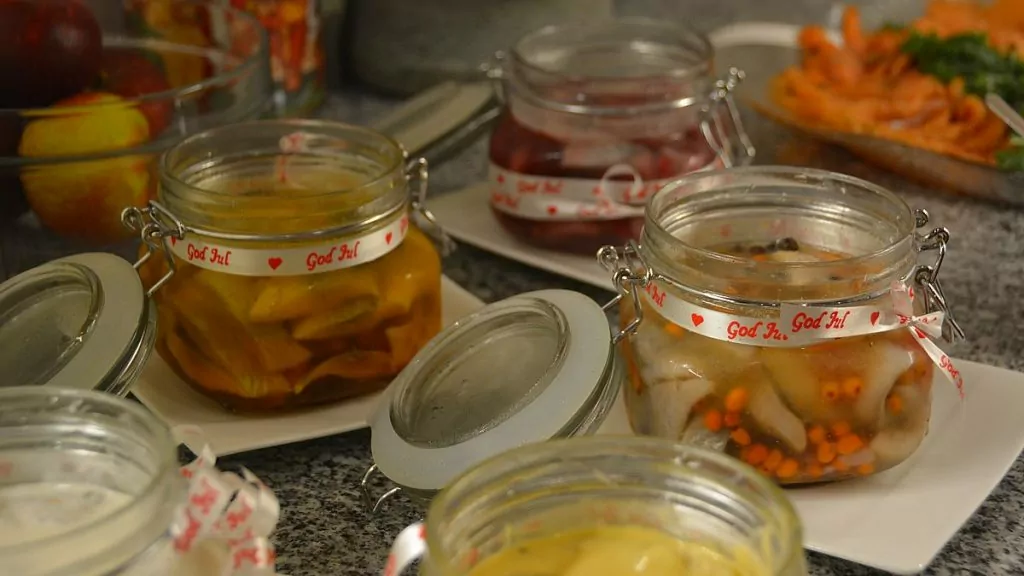
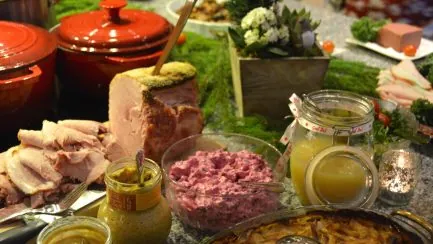
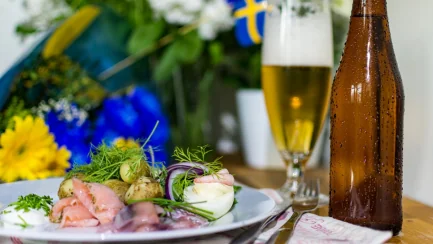
Herring has a natural place on many Swedish Christmas tables and is often served in several variations. It can be, for example, onion herring, mustard herring or some more modern flavored herring.
This is often accompanied by pickled or smoked salmon and sometimes other fish. For me, herring and salmon are among the most important things on the entire Christmas table – and of course, the herring is often accompanied by a nubbe.

Christmas ham and other cold cuts
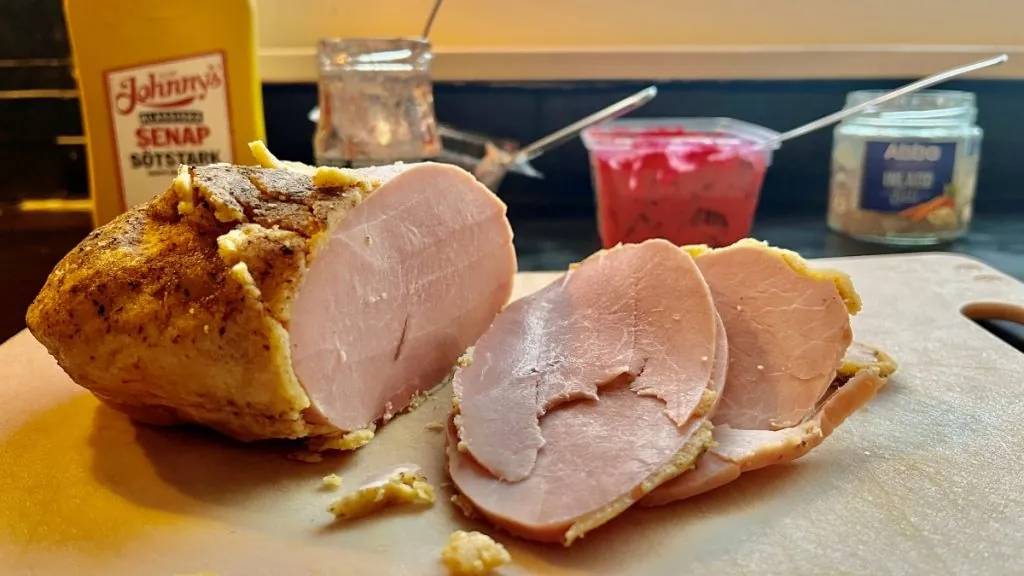
Christmas ham is another Swedish Christmas classic. It is usually served cold and grilled, with mustard as a side dish.
On larger Christmas tables, there may also be various sausages, pâtés and other charcuterie. In the past, jam was a common feature and it is still present on many traditional Christmas tables, even if it is not one of our personal favorites.

For Peter, however, Christmas ham is important. He would prefer to have it with mustard on a hard sandwich.

Meatballs, Janssons and other hot dishes
After the cold comes the hot – or ”småvarmt”, as this part of the Christmas table is often called. Here you will usually find meatballs and prince’s sausage, and on many Christmas tables you will also find Jansson’s temptation, spare ribs and various types of cabbage.
For Peter, meatballs with potatoes and beetroot salad are a must, while I'm happy to go straight for Jansson's temptation. If there are also Brussels sprouts on the table, I'm extra happy.

Bread, cheese and accessories
The Christmas table also includes different kinds of bread, butter, cheese and mustard. Crispbread and wortbread are two classics, but even here traditions vary.
Beetroot salad is a common side dish, especially with meatballs and other Christmas food. Mustard, of course, goes with Christmas ham – at least if you ask Peter.

Something sweet at last
After a hearty Christmas table, it can feel almost superhuman to start over with dessert, but many Christmas tables still have a sweet ending.
This can include rice porridge, Ris à la Malta, cookies, crackers, iced chocolate, marzipan and other Christmas sweets. What is actually served varies at least as much as the rest of the Christmas table.


How to eat Christmas dinner? – Christmas dinner tours
MAN can of course, take a little of everything on the same plate. But if you want to eat Christmas dinner in the traditional way, there is another method: you take several turns. Exactly how many turns a Christmas dinner should be divided into varies. At some classic restaurant Christmas dinners, they talk about seven turns, while others make a simpler division. The basic principle is usually something like this:
- Herring and Baltic herring – preferably several varieties.
- Salmon and other cold fish – for example, pickled and smoked salmon.
- The cold cure – Christmas ham, sausage, pâté and the like.
- Slightly warm – meatballs, prince sausage, Jansson's temptation and other hot dishes.
- East – with bread and suitable accessories.
- Dessert and Christmas sweets – if there is still any space left.
On really large and traditional Christmas tables, the categories can be further divided into seven or even more rounds.
The advantage of not putting everything on the same plate is quite obvious when you think about it. Herring in mustard sauce, pickled salmon, meatballs, beetroot salad and Ris à la Malta don't actually need to get to know each other that well. Plus, you get a chance to taste the food properly – and hopefully have a little more stamina.

The history of the Christmas table – from brandy table to Christmas table
The Swedish Christmas table has changed a lot throughout history. Some of its roots can be found in the so-called the brandy table, which occurred in affluent environments during the 18th century.
Before the actual meal, guests could have brandy along with bread, butter, cheese, fish and meat, for example. The brandy table eventually developed further into the Swedish smörgåsbord, which in turn has influenced the shape of today's Christmas table.

At the same time, Christmas food has older roots than that, and many dishes have been added at completely different times. Something that is today perceived as an ancient Christmas tradition may in fact have become common on the Christmas table quite late.
If you want to know why we eat Christmas ham, herring, Jansson's temptation, meatballs, lutfisk and other classics, we have delved into the history behind the food in a separate report.
READ MORE: 13 dishes on the Christmas table - the history of Christmas food

Christmas food differs between different parts of Sweden
There is also not a single historical Swedish Christmas table that has looked the same from Skåne to Norrbotten.
In the past, food was largely determined by what ingredients were available locally and what could be grown, fished, hunted and preserved for the winter. As a result, various regional Christmas traditions developed. Traces of them still remain today.
In Halland, for example, long cabbage has a strong tradition, while brown cabbage is associated with the Skåne Christmas table. On Gotland, saffron pancakes can appear as a festive food, and further north there are completely different traditions.
Nowadays, of course, we can buy roughly the same ingredients no matter where in Sweden we live. But the regional specialties make the Christmas table much more enjoyable – and at the same time tell us about how people lived in the past.
READ MORE: Regional specialities on the Christmas table – from Norrbotten to Skåne

What do you drink at the Christmas table?
For many, Christmas must is the obvious non-alcoholic drink on the Christmas table. Beer is another classic, and those who want can combine the herring with schnapps.
Schnapps also has a historical connection to the older brandy table, where brandy was served with small dishes before the meal. And which brandy should you choose? If I had to choose, I have a definite opinion: preferably spiced brandy.
Mulled wine is of course also part of Christmas, but is often drunk as a separate part of the Christmas celebration rather than throughout the entire Christmas table – perhaps when guests arrive or later in the evening.

Christmas table in a restaurant
Going out to eat a Christmas feast has become a Swedish Christmas tradition in its own right. Restaurants, hotels, castles, manors and other establishments set up Christmas feasts in the weeks leading up to Christmas, sometimes as early as mid- or late November.
We have tried many different Christmas tables over the years. Some have been very traditional, while others have had a more modern profile or placed extra focus on fish and seafood, for example.

And the environment can of course be a big part of the experience. A Christmas table in an archipelago setting or at a castle will be something different than a modern restaurant Christmas table in the middle of Stockholm, even if many of the dishes are the same.

On large restaurant Christmas tables, the idea of different courses on the Christmas table also becomes extra relevant. When the buffet contains lots of dishes, it's easy to get overenthusiastic at first glance. Start carefully – the meatballs are unlikely to run away.

The Swedish Christmas table is changing
It can be easy to think of Christmas food as a collection of unwavering traditions, but that's never really how it works. Traditions change. Some dishes become less common, others move onto the Christmas table, and things that one generation took for granted may be skipped by the next generation.
Today, vegetarian and vegan options are common on many Christmas tables, while classics can get new flavors and influences from other food cultures can find their way into Christmas dishes.

But perhaps the families' own traditions are at least as important as the great national ones. In one family, Jansson's temptation is unthinkable without. In another, a certain kind of herring must be present. Someone loves lute fish – while someone else can't for the life of them understand why it's on the table.
This is also what makes the Christmas table come alive. Tradition doesn't have to mean that everything always has to be exactly the same.

What must be on our Christmas table?
At home, there are definitely some different opinions about what is most important. Peter wants meatballs, potatoes and beetroot salad. There will also be Christmas ham with mustard, and he likes to eat it on a hard sandwich. He also wants herring, salmon and nubbe.
I prioritize herring and nubbe, and the nubben may well be a spiced brandy. Jansson's temptation is also important, and there is Brussels sprouts makes the Christmas table even better. We can do just fine without the fish, jam and dip in the pot, however.
And then we have a little Christmas luxury together: Anthon Berg's marzipan bread. If we are home in Sweden over Christmas, we like to treat ourselves to some of these.

At the same time, we are no more bound by tradition than we can ignore the entire Christmas table. We have celebrated many Christmases abroad, and if we find ourselves somewhere where Swedish Christmas food neither exists nor feels natural, we don't need to try to recreate it. Then Christmas dinner can be something completely different. And that's okay too. Christmas doesn't actually have to taste the same every year.


Swedish Christmas food – traditions that keep changing
The Swedish Christmas table is both old and new at the same time. It includes food traditions with long historical roots, dishes that were added much later, regional specialties and families' very own must-haves.
Perhaps that is precisely why the Christmas table continues to be so strongly associated with Swedish Christmas. There is a common ground, but at the same time plenty of room to create your own Christmas table.
For some, Christmas ham is a must. For others, it's herring, Jansson's temptation or meatballs that make it Christmas. And for still others, celebrating Christmas far from home works just fine – without a single sausage in sight.
What dishes must be on your Christmas table? And is there any classic Christmas dish that you'd rather let someone else eat?

You might also like:
 Facts about lussekatter - 12 things you (maybe) didn't know?
 13 dishes on the Christmas table - the history of Christmas food
 Regional specialities on the Christmas table – from Norrbotten to Skåne
 Christmas sweets and biscuits in different countries - a sweet round trip
 Midsummer food - 15 classics & readers' favourites
 Christmas fruits - Aunt Anna's pineapple



 English (UK)
 Svenska
Marias memoarer says:
I will make a salad based on kale and red cabbage this year actually ? The Swedish Christmas table is very similar to the Finnish-Swedish one, but we have boxes instead of Janssons and ribs? But sometimes I eat ribs and a few other little things at my mum's for Christmas lunch, so it doesn't look too much like the Christmas table served at my dad's in the evening? I'm a bit unsure how much we differ from the real Finnish Christmas table though, I'll try to research it.
22 December 2019 - 8:41
Helena says:
Nice to have something new on the Christmas table! 🙂 Very interesting about how the Finnish-Swedish and Finnish Christmas table differs. Feel free to tell me if you find out more! 🙂
22 December 2019 - 16:26
Ama de casa says:
1: When I was little, there were always pig's feet on the Christmas table. I liked them a lot and when I think about it, I probably didn't really know what I was eating. I was quite fussy about the food when I was little 🙂.
2: Not that I can think of ... We are struggling to try to get a classic Christmas table that (usually) is enjoyed out on the terrace. But some years we have had cauliflower son instead of the usual. Maybe that can be considered a new approach?
3: There is no local speciality for the Christmas table here in Spain for Christmas Eve. It's just an ordinary day. But I remember that when I was in Kalmar one Christmas Eve, I was very surprised that there were body cakes on the Christmas table. Surprised and happy - I love body biscuits 🙂.
Have a nice fourth advent!
3:
22 December 2019 - 10:34
Helena says:
I don't think I've ever actually tasted pig's feet. It doesn't sound like much fun, but who knows, maybe it's delicious? (And as a child it is sometimes good to know. I loved black pudding until I began to understand what it was ;)) I had also been surprised by the body cakes, but now I have understood that they can be found on the Christmas table in some places!
22 December 2019 - 16:28
Ditte says:
Fun and interesting compilation. Now Christmas food is not exactly my thing to eat but I like to read about it. I realise that I will probably have to try very little on Christmas Eve, but also hope for some seafood (I usually eat fresh lobster).
This week I have looked a lot in Jan Öjvind Swahn's book "Stora Julboken", including when I wrote the post about gingerbread a while ago. An exciting book where many of our traditions and origins in terms of food are discussed.
22 December 2019 - 10:43
Helena says:
I also think it is super interesting with traditions! Lobster does not sound stupid 😉 We have actually bought some Christmas food for ourselves today, but we only choose what we think is best 🙂 .
22 December 2019 - 16:29
Nils-Åke Hansson says:
Christmas food is always good in moderation. But I have never understood vegan Christmas food You can't call herring herring that is made from vegetables.
Easter and Midsummer are a bit the same the older you get, so I think it decreases with expectations.
But have a good Christmas and relax now
Greetings from us
22 December 2019 - 15:38
Helena says:
Agreed, it can be delicious in moderation! I (not being vegan or vegetarian) would never choose a vegan alternative to herring. However, I think it's nice that there's a bit more green on the Christmas table since there's so much meat and fish 😉.
22 December 2019 - 16:34
Maria / MagnoliaMagis says:
I agree that vegan ham, meatballs, sausages, herring etc. sounds so wrong! The son is vegan and there we have different views on the matter. Otherwise, there are many good things such as mushrooms in a classic 1-2-3 dish. Hot vegetable dishes and cold. But I'm not much for substitutes... Merry Christmas!
26 December 2019 - 14:25
BP says:
Yes, imagine how much you (read: I) didn't know about Christmas food. Pig's feet are actually still sold ready-cooked in cans but also fresh. I actually tried for the first time in my life to cook them myself. Was inspired by Finnish-Swedish Paula (https://paulaz.se/) who ate them for the Nobel dinner on TV. I didn't really understand what it was you could eat, but the jelly was incredibly good, as I spiked it with a lot of spices.
One thing I haven't seen in a long time is Aladåb, a kind of jam. No great loss...
It would actually be interesting to know how many fish shops/restaurants still sell/offer eel. I actually love eel, but it is said to be endangered. I thought it was mostly in Skåne that you "must have" eel on the Christmas table.
22 December 2019 - 17:07
Helena says:
Wow, how brave of you to try cooking pig's feet yourself!!! Right, aladåb, I had almost forgotten that word 😉 But in general, jams and similar products are not a favourite for me ... Eels are well restricted, but when we were on the coast outside Åhus, we understood that you can fish eels there. I see that eel is on my list for Småland too. The information comes from Wikipedia, but have not double-checked in other ways.
23 December 2019 - 10:12
Elisabeth says:
There will be lots of good things of all kinds!
Have a very Merry Christmas and a Happy New Year!
Elisabeth and Lennart
22 December 2019 - 23:03
Helena says:
Thank you very much! Wishing you a Merry Christmas and a Happy New Year!
24 December 2019 - 9:28
Maria / MagnoliaMagis says:
Imagine how much good food there is anyway!... In our house, more vegetables have come in as the son is vegan. Something that is really good is to replace the herring in the pickling with mushrooms !!! Really nice as it lightens up and does not become so powerful! Kale is quite new to us, while the sausage has always been there and still exists as it is a must for my brother and dad, as well as the brown beans (yes we are from Västergötland). The veal jam has disappeared and it's nice!
Merry Christmas!!!
23 December 2019 - 21:27
Helena says:
Interesting to hear what has changed in your house! We have always eaten kale (since my parents are from Halland) but today it is sometimes served in new and interesting ways! I don't miss jam either ... Merry Christmas!
24 December 2019 - 9:30
Lena - gott för själen says:
Hmm, yes, grandma always had veal stew, I remember. I haven't seen it on any Christmas table for a long time.
Cinnamon pork is something new we have quite often nowadays. It's pork belly fried with an embarrassing amount of cinnamon. Sounds crazy, but it's really good.
Hug Lena
26 December 2019 - 18:00