



Writer: Helena Bergström
Updated: August 2026 | Bastei in Saxon Switzerland is one of the most spectacular natural experiences in eastern Germany. Here, dramatic sandstone cliffs rise high above the Elbe River, and amidst the cliffs is the famous Bastei Bridge. We have visited the place twice – once by hiking up from Kurort Rathen and once by making our way to Bastei from the other direction.
 Tweet
 Share
 Share
 Pin
 Share
 Share
Table of contents
Bastei in Saxon Switzerland
Bastei is one of the most famous tourist destinations in Saxon Switzerland, or Sächsische Schweiz in German. The area is located southeast of Dresden, near the border with the Czech Republic, and is known for its dramatic sandstone cliffs, gorges, forests and spectacular views of the Elbe.

On the other side of the border, the natural area continues into the Czech Republic, where it is called Bohemian Switzerland.
The main attraction at the Bastei is of course the fabulous Bastei Bridge, which can be found in many pictures from the area. Also nearby is Felsenburg Neurathen, an old rock castle among the sandstone formations. The Bastei and the Bastei Bridge can be visited for free all year round.
Two ways to get to Bastei
We have visited the Bastei on two different occasions and got to the bridge in two completely different ways. The first time we stayed at Camping Königstein. From there we took the train to Kurort Rathen, the ferry across the Elbe and then hiked up to the Bastei. It was a fantastic experience, but the hike was also quite demanding with lots of stairs.

When we returned a few years later, we instead drove to the parking area above the Bastei and walked to the bridge with almost no difference in elevation. So it's a great way to experience the Bastei even if you don't want to or can't do the steep hike from Rathen.

Start at Camping Königstein
On our first visit we took our camper van to Camping Königstein, which we really liked. Here we were nicely situated on the Elbe, and since the campsites were in terraces we had a view of the river.

The staff at the campsite spoke almost no English, but we still felt very welcome and received all the help we needed. The man at the reception was very careful to make sure we understood how to get to Bastei and showed us slowly and educationally on the campsite's large map.


Train and ferry to Kurort Rathen
When it was time to visit Bastei, we walked a short distance to the train station and took the train one station to Kurort Rathen.


After we got off, we walked down to the Elbe and took the little ferry across the river. The ferry is part of the experience and takes you across to the car-free spa town of Rathen. We then strolled through the charming little town and followed the signs to the Bastei.


Hiking from Rathen to Bastei
From Rathen, the hike up to the Bastei began – and yes, it included a long series of stairs. All you had to do was start walking!

Here and there we paused to catch our breath and drink water. But after a while of hiking uphill, the reward began to come in the form of fantastic views of the Elbe and the surrounding sandstone landscape.
Allow about 40 minutes for the actual ascent from Rathen, depending on your pace and how often you stop to take photos and enjoy the view.


Bastei Bridge – the area's major attraction
Eventually we arrived at what we had been waiting for: the Bastei Bridge! Of course, we had seen it in pictures before, but seeing it for real is something completely different.
The rock formations at Bastei rise almost 200 meters above the Elbe. The first bridge at the site was built of wood in 1824, and in 1851 it was replaced by the current sandstone bridge.


The Bastei Bridge is 76.5 meters long and has seven arches. It spans the approximately 40-meter-deep Mardertelle Gorge, connecting the dramatic rock formations.

From the bridge and the surrounding viewpoints you have a fantastic view of Saxon Switzerland and the winding Elbe valley. Bastei is also one of the most popular sights in all of Saxon Switzerland. When we arrived in the morning on our first visit it was quite quiet, but as time went on it became more and more crowded.

When we returned a few years later, the weather was completely different. The sun had been replaced by rain and fog – but despite that, there were plenty of visitors. The landscape was almost as spectacular in the gray weather, although in a completely different way.


If you want to avoid the biggest crowds, it is therefore a good idea to arrive early in the day, especially during weekends and high season.

Restaurants and bars at the Bastei
On our first visit, we were a little surprised to discover that on the "other side" of the bridge, from the direction we came, there was a road, parking, a hotel and restaurants.
We settled down for a beer at a beer garden. Here you could also buy simpler food, but we chose to save ourselves for a late lunch down in Rathen. It was also here that we realized how easy it actually is to get to the Bastei from the other side – something we tested ourselves when we returned a few years later.

Felsenburg Neurathen – the rock castle at Bastei
Right next to the Bastei Bridge is Felsenburg Neurathen, a medieval cliff castle that was once built among the dramatic sandstone formations. On our first visit we were able to enter the area. Here we walked on small bridges between the rocks and, if possible, got even better views of both the landscape and the Bastei Bridge.


Not much remains of the castle itself, but there are traces of carved rooms, passages and a water cistern, which give an idea of how people once used the strange rock formations as part of the fortification.


When we returned a few years later, Felsenburg Neurathen was closed due to safety concerns. The cliff castle remains closed until further notice, while the Bastei Bridge and the surrounding area can be visited as usual.

To Bastei by car, bus or camper
So you don't have to hike up from Rathen to visit the Bastei. On our second visit we came by camper to the parking area above the Bastei. We parked in the larger parking lot a few kilometers from the bridge and walked about three kilometers to the Bastei.
From the larger car park, there is also a bus to the Bastei during parts of the year. There is also a parking lot closer to the attraction for those who want to minimize the walk.
And here we learned the hard way that you have to read the parking conditions carefully. We thought we had paid for an overnight stay, but the fee was calculated per calendar day. Since we arrived in the evening and wanted to stay after midnight, our night became significantly more expensive than we had expected.
With a motorhome, it is therefore wise to check current prices and conditions carefully. In the larger parking lot, it is possible for motorhomes to stay for up to 24 hours, but it is a parking lot rather than a campsite or traditional parking area.

Food and ice cream in Rathen
On our first visit, we hiked back to Rathen the same way we came up. Going down was of course much easier!
In the village we found a restaurant with a nice outdoor seating area. We weren't particularly impressed with the food for the price, but after the hike a meal was still very good. Then of course we had an ice cream too.


Amselsee and Schwedenlöcher
Starting from Rathen, there are many more hikes to do than just the hike up to the Bastei. After our visit to the bridge, we decided to continue walking. We passed Amselsee, a small lake where you can rent a rowboat or pedal boat during the season.


On the way we also saw a sign for Schwedenlöcher, a dramatic gorge with stairs and narrow passages between the sandstone cliffs.
The name roughly means ”Swedish hole” and has a connection to the Thirty Years’ War. When Swedish soldiers ravaged the area in the 17th century, the locals used the inaccessible ravine as a hiding place.
Today, Schwedenlöcher is a popular hiking destination and can be combined with Bastei and Rathen for a nice round trip.

Is Bastei worth a visit?
Yes! We have visited Bastei twice and would definitely consider returning again.
Of course, it is the Bastei Bridge that has become the area's great symbol, but it is the combination of the bridge, the sandstone cliffs, the Elbe, the views and the hiking trails that make the place special.
And the two visits have also shown us that Bastei can be experienced in very different ways. If you want the hiking experience itself, we recommend the tour from Rathen. If you mainly want to see the bridge and the views, you can instead come from the parking area above.

More to see and do in Saxon Switzerland
Bastei is just one of many natural experiences in Saxon Switzerland. If you have more time in the area, there is much more to discover.
Hiking in Saxon Switzerland
The area is full of hiking trails through forests, ravines and strange sandstone formations. We have done a full-day excursion from Děčín in the Czech Republic via Bad Schandau and on through Saxon Switzerland to Schmilka.
READ MORE: Day trip from Czech Republic to Saxon Switzerland

Visit Königstein Fortress
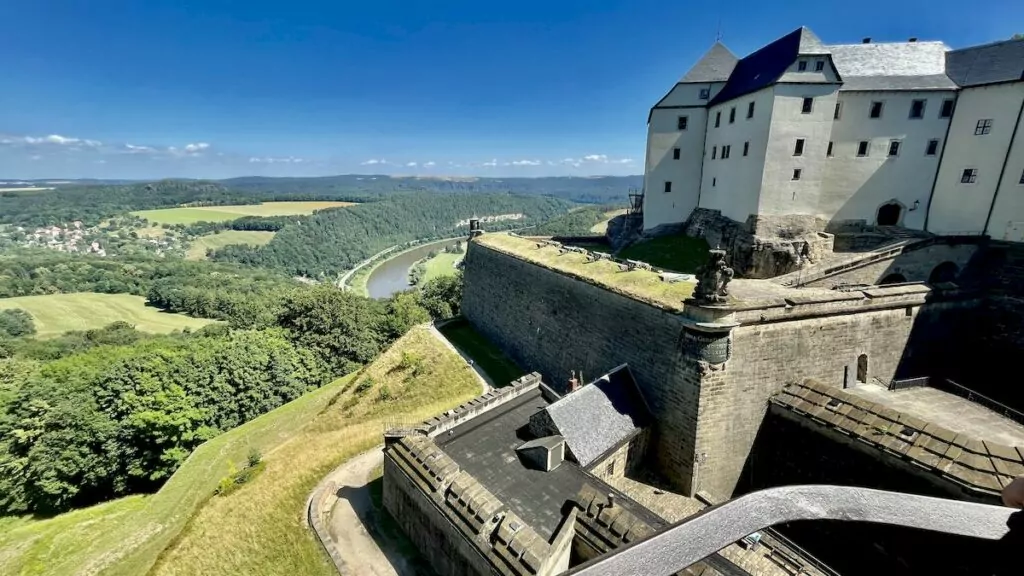
Not far from the Bastei is Festung Königstein, an enormous fortress high above the Elbe. It is worth a trip in its own right and offers both history and great views.
READ MORE: Festung Königstein - mighty fortress in Germany
Discover Dresden
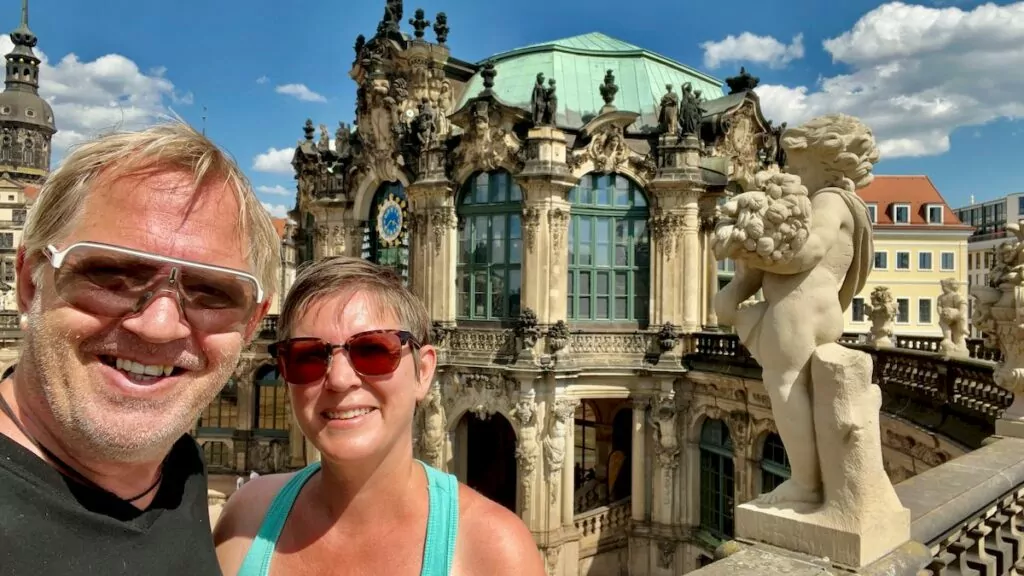
Dresden is just a few kilometers from the Bastei and is an excellent place to combine with Saxon Switzerland. Here you will find magnificent architecture, museums, churches and a beautiful location on the Elbe.
READ MORE: Things to do in Dresden – attractions and experiences
Continue to Bohemian Switzerland in the Czech Republic
The natural experiences don't end at the German border. On the Czech side, the sandstone landscape continues in Bohemian Switzerland, also known as Bohemian Switzerland.
Here you can visit, among other things, the enormous the sandstone arch Pravčická brána, hike in the national park and discover the spectacular the rock formations of Tisá, where scenes from the Narnia films were filmed.

FAQ – frequently asked questions about Bastei and Saxon Switzerland
Where is Bastei located?
Bastei is located in Saxon Switzerland in the state of Saxony in eastern Germany, about 30 kilometers southeast of Dresden and close to the border with the Czech Republic. The nearest town is Kurort Rathen on the Elbe River.
What is Bastei famous for?
Bastei is primarily known for its spectacular sandstone cliffs and the famous Bastei Bridge from 1851. From the area there are extensive views of the Elbe and Saxon Switzerland.
Does it cost anything to visit the Bastei Bridge?
No. The Bastei and Bastei Bridge are free to visit and are accessible year-round, however some other activities and attractions in the area may cost money.
How to get to the Bastei?
A nice alternative is to take the train to Kurort Rathen, take the ferry across the Elbe and then hike up to the Bastei. It is also possible to arrive by car or camper to the parking area above the Bastei and continue on foot or, during parts of the year, by bus.
Do you have to hike to get to Bastei?
No, you don't have to make the steep hike from Rathen. From the parking area above the Bastei you can reach the bridge with significantly less elevation gain.
How long does it take to hike from Rathen to Bastei?
Allow around 40 minutes for the ascent from Rathen to Bastei. The time it takes depends on your pace and how often you stop along the way.
What is Felsenburg Neurathen?
Felsenburg Neurathen is the remains of a medieval rock castle right next to the Bastei Bridge. The castle was partly built using the natural sandstone formations. The area is currently closed until further notice due to safety concerns.
What are Swedish holes?
Schwedenlöcher is a dramatic gorge near the Bastei with narrow passages and many stairs. The name comes from the Thirty Years' War, when locals used the gorge as a hiding place from Swedish soldiers.
When is the best time to visit the Bastei?
Bastei can be visited all year round. If you want to hike, spring, summer and autumn are popular periods. Since Bastei is a very popular attraction, it may be wise to arrive early in the day, especially during weekends and high season.
Can you visit Bastei with a camper van?
Yes. There is parking for campervans in the area above the Bastei, from where you can walk or, during parts of the year, continue by bus. Check current parking regulations and fees before visiting.
You might also like:
 Visiting Robberg Nature Reserve in South Africa - at Plettenberg Bay
 15 beautiful islands in Europe you won't want to miss
 Getsvedjeberget – hike to the pulpit on the High Coast


 Visiting Gorropu Canyon in Sardinia - hiking with dramatic views
 Hike to the Gerolimni waterfall on Andros Island - a hidden gem



 English (UK)
 Svenska
Solan says:
Wow, so many rocky stairs you've climbed...you must have lost weight too, but I'm thinking about kilos....
In the spring we plan to travel to Dresden and the surrounding area. For spa visits and some reasonable hiking. Thought to go along the Elbe on the way home.
Continuing to follow your path to the homeland! 🚐 🌍 👍
16 July 2022 - 8:15
Helena says:
Yes, sooo many stairs, we promise! However, we "managed" to effectively prevent the decline of kilos, there were many stairs, but also plenty of food and beer ... 😉 So wonderful that you are planning for Dresden! 🙂 Will be a part about Dresden here soon 🙂
16 July 2022 - 11:12
bmlarsreseblogg says:
We thought Bastei was a really nice experience, so therefore the nature of the northern Czech Republic attracts us a lot! We just have to wait and see how it goes with covid, war and other things that can affect our travelling...
16 July 2022 - 14:32
Helena says:
I'm sure you would like the northern Czech Republic! Well, yes, the world is a bit more uncertain nowadays. As long as it is possible to travel, we are happy to do so! (Not least now when you get used to the fact that it can suddenly be limited ...)
16 July 2022 - 20:17
BP says:
How much you have walked during your long journey in Germany and the Czech Republic. Guess you've gained a lot of new muscles that you didn't know existed.
I thought you were afraid of heights Helena. Walking on these small bridges - it was well done! Oh the stone formations are so majestic:-)
16 July 2022 - 18:01
Helena says:
Yes, a lot of training pain, haha! And yes, I am very afraid of heights, but here it actually went quite well (although I may not have hung out over the edges directly ...). Do not really know why, but generally think that tall houses feel worse than nature in some way ... 😉.
16 July 2022 - 20:19