


Writer: Helena Bergström
Christmas is certainly a Christian holiday, but Christmas traditions also include a wild mix of folklore and pre-Christian winter rituals. Throughout Europe, Christmas stories are populated by witches, goats, demons and various mythical animals. Join us on a journey through Europe's darker, stranger and sometimes frightening Christmas traditions...
 Tweet
Tweet Share
Share Share
Share Pin
Pin Share
Share Share
ShareTable of contents
When Christmas was a little wilder
What European Christmas traditions have in common is that they remind us of a time when winter was seen as dangerous and the supernatural was present in people's stories. We have delved into six magical creatures that populate Europe during the Christmas season.
1. The Nordic countries: The Yule Goat
Long before Santa Claus became a popular figure, he ruled Yule goat in the Nordic countries. The goat has its roots in pre-Christian Norse mythology, where the thunder god Thor's chariot was pulled by two goats.
The goat has long been associated with Christmas. As early as the beginning of the 18th century, young people would go around the farms performing plays or singing songs – and one member of the group would usually be dressed up as a goat.
In Sweden and Finland, the tradition of a Christmas goat that roamed between farms during Christmas, sometimes to distribute gifts, remained for quite some time. Today, the Christmas goat is mainly a decoration, often made of straw. Perhaps the most famous is The Gävle Goat, which is built up every year, and just as often burns down.

2. Italy: The Christmas witch La Befana
In Italy, Christmas presents are not always brought by Father Christmas, but can also be distributed by the witch. La Befana, who flies over the rooftops on his broomstick on the night of Twelfth Night.
According to legend, La Befana was the woman who refused to help when the three wise men asked for directions to the baby Jesus. Full of regret, she later set out to look for the child, laden with gifts – and continues to do so to this day.
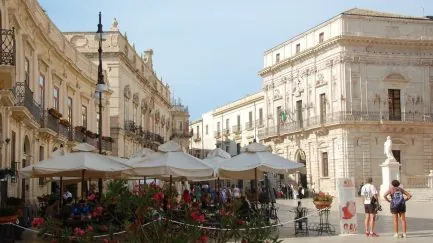
Today, La Befana is celebrated throughout Italy, especially in Rome, where Piazza Navona is filled with market stalls, sweets and broom-decorated figures. Good children receive presents, naughty children receive coal – albeit usually in the form of sugar.

3. Iceland: Christmas meat
Iceland's Christmas cat is not something you want to encounter in the winter darkness. Christmas meat is a huge black cat, which according to legend eats children (and adults) who have not received new clothes for Christmas.

The story has its roots in Iceland's harsh farming society, where new clothes signalled hard work with the autumn wool before Christmas – if you had worked hard during the year, you would get something new to wear for the winter.
Today, the Christmas cat lives on in culture: in children's books, songs and as a giant statue in Reykjavik. Threatening, but also loved – from a safe distance.

4. The Alps: Krampus
In Austria, Bavaria and parts of northern Italy, Krampus during Advent. With horns, fur, chains and frightening masks, he represents the dark counterpart to Saint Nicholas at Christmas.
Krampus punishes disobedient children, at least symbolically, and his origins can be traced back to pre-Christian rituals linked to the chaos and forces of nature in winter.
Today, the tradition lives on strongly through Krampuslauf, where hundreds of masked participants run through various cities in noisy, often quite wild processions.

5. France: Père Fouettard
In northern and eastern France, as well as in French-speaking parts of Belgium and Switzerland, Saint Nicholas is not accompanied by Krampus, but instead by Père Fouettard – ”The Whip Father”.
This somewhat unpleasant figure may be dressed in dark clothing and seen with a cane in his hand, symbolising his role in keeping an eye on children's behaviour. The figure is believed to have emerged during the Middle Ages, possibly based on older figures of fear used to maintain order.

6. Wales: Mari Lwyd
In Wales, a strange figure wanders through the villages around Christmas: Mari Lwyd – a horse's skull on a stick, covered with white cloth. The tradition is that Mari Lwyd, together with a group of companions, goes from house to house singing different verses in a kind of singing duel. If they win the duel, they are invited in for food and drink.
It is still a living tradition today, especially in southern Wales – a mixture of celebration, folklore and collective improvisation.

What is your relationship to Europe's Christmas spirit?
What is your relationship to Europe's magical Christmas creatures? Which ones do you know, and which ones have you heard stories about? Are there perhaps other magical figures that you have heard about?
You might also like:
 Christmas rhymes - 25 tips for Christmas presents with rhymes


 9 places associated with Lucia
 Christmas trees through the ages – Aunt Anna and the Christmas trees
 Christmas markets in Sweden – 12 cozy Christmas markets to visit
 Celebrate New Year's abroad - 10 memorable New Year's on trips

 English (UK)
  Svenska
BP says:
Well, I've learned (a lot) of new things again. Orsakullan told me about Krampus the other day. I didn't know anything about this character, even though I've lived in Munich for almost seven years. Yep, you always learn something new.
Some of the characters seem to have confused Halloween with Christmas/Epiphany – hahaha:-)
Excellent research, well done :-)
20 December 2025 - 17:24
Helena says:
I completely agree that it sometimes feels like a mix between Halloween, Christmas and Epiphany... and then there's the celebration on 6 December too!
20 December 2025 - 18:36
Znogge says:
I am familiar with the Yule goat, and we also have the black cat, but that is at Easter. It is undeniably a colourful mix, and it is not surprising that Ásatrú is in the background. Our Christmas traditions are not quite as old, not yet anyway.
Wishing you a wonderful Christmas holiday!
21 December 2025 - 9:23
Tove says:
Wow, this is a delightful read, Helena!
Back home in Norway, we had a tradition of dressing up and going carol singing – julebokk – in the courtyards. It was mostly children, but adults too. Sometimes it was impossible to recognise the people who came. Once, on Boxing Day, my then partner and I had a Christmas party at our place with friends. We were surprised by my father and some other relatives dressed up, my father in a Fidel Castro mask and clothes. It took a while to guess who they were.
I save some of your posts as shortcuts on my desktop so I can go back and read them.
Wishing you a Merry Christmas and a Happy New Year 🎄🥂🍾
22 December 2025 - 8:38