



Writer: Helena Bergström
Updated: August 2026 | Neuzelle Abbey in Brandenburg is a surprising sight. In the middle of the East German landscape stands a magnificent monastery complex with churches, a monastery garden and an almost overwhelming Baroque interior. There is also an unusual museum with enormous Baroque theater sets - and right next door is a historic monastery brewery.
 Tweet
 Share
 Share
 Pin
 Share
 Share
We came to Neuzelle during a campervan trip through eastern Germany and were impressed to say the least. You definitely don't have to be particularly interested in churches to be fascinated by this place.
Table of contents
Neuzelle Abbey in Brandenburg
Neuzelle is located in Brandenburg in eastern Germany, close to the border with Poland and about 130 kilometers southeast of Berlin. The town itself is small, but in the middle of the community lies one of the region's major cultural and historical attractions.
Neuzelle Abbey was founded as early as 1268 by Margrave Henry the Enlightened of Meissen and belonged to the Cistercian order. The complex developed over the centuries and is today one of the few completely preserved monastic complexes in Europe.

What really sets Neuzelle apart from many other monasteries in northern Germany is the architecture. Here you won't find the relatively austere style you might associate with Cistercians – but Baroque, so it's almost enough to last.
Brandenburg's Baroque Wonders
After the Thirty Years' War, the monastery began to change. From around 1650, Bohemian builders rebuilt the originally Gothic monastery church, creating the magnificent Baroque environment that remains today.
The result is so special that Neuzelle is marketed as the ”Baroque wonder of Brandenburg” – Brandenburg's Baroque Wonders.

And it's actually not hard to understand why. From the outside, the monastery complex is impressive, but it's only when you step inside the Catholic monastery church that you realize how impressive it is. St. Mary's like things really happen.
Abbey Church of St. Mary
The interior of St. Mary's is almost hard to take in. The walls, ceiling and altars are filled with paintings, sculptures, stucco, ornaments, saints and angels. There is hardly anywhere for the eye to rest.


The lavish decoration also had a purpose. After the Reformation and the Thirty Years' War, Catholic Neuzelle was located in an area that had largely become Protestant. The monastery developed into a kind of model Catholic monastery, and the magnificent Baroque became a way of expressing and conveying the Catholic faith.
When we visited the church, we could walk around for a long time and just discover new details. And above all, we were captivated by the angels.

Angels with fish, tools and dice
Here, there are not only angels sitting still and looking heavenly. They seem to be busy with both. We found one with a fish, another with a hammer and pliers, and yet another with dice at Jesus' feet.


The dice also have a fairly logical explanation. According to the Gospels, Roman soldiers cast lots for Jesus' clothes at the crucifixion. Tools and other objects in Baroque church art can similarly symbolize different parts of the story of Jesus' suffering. Suddenly, all those slightly strange objects become a kind of story in pictures.

Himmlisches Theater – a unique attraction
Part of Neuzelle's real treasure is now in Museum Heavenly Theater, the heavenly theater museum.
In the 18th century, an enormous baroque stage work was created, Theatrum Sacrum, where the suffering, death and resurrection of Jesus were depicted with painted canvases and wooden backdrops. The work consists of 15 scenes in five large sets and was created by the Bohemian artist Joseph Seifrit.
Today, parts of this are displayed in a special museum, where the large original sets have been built up with lighting to recreate the depth and drama. We did not see this on our visit, but for those who come to Neuzelle today, the museum is another reason to stay a little longer.
The monastery garden in Neuzelle
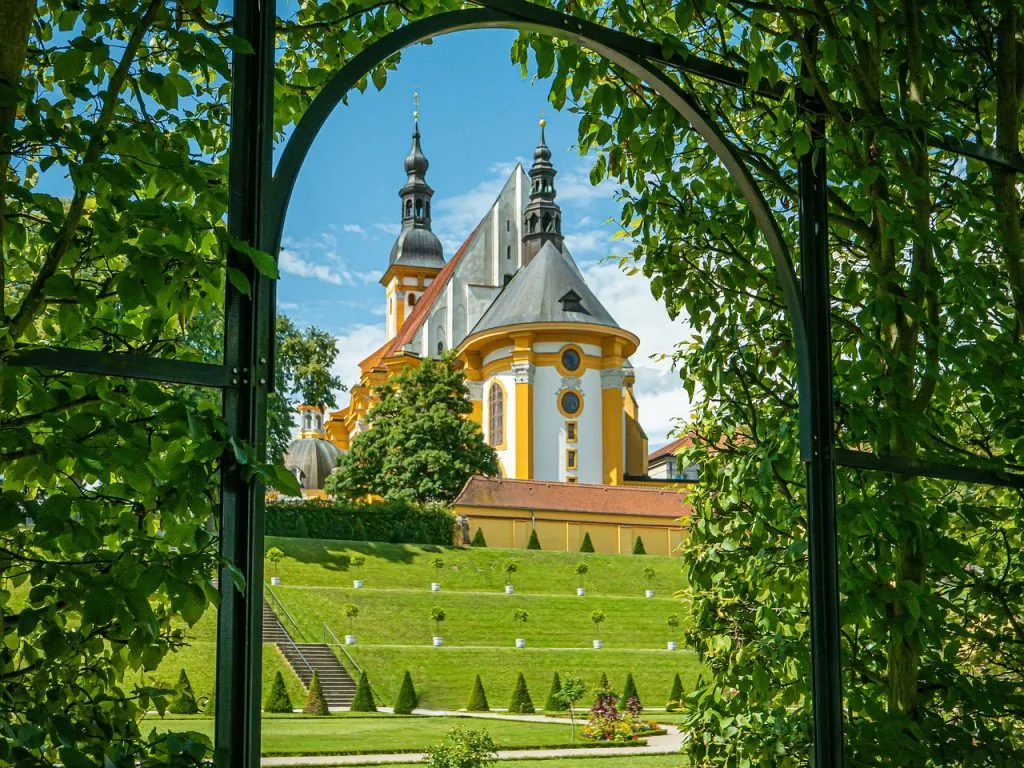
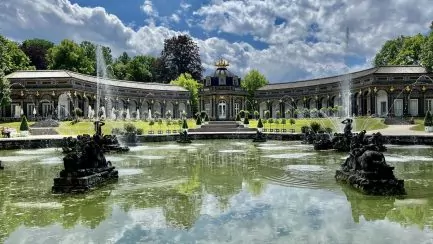
Behind the monastery, the large Baroque garden spreads out. It covers about five hectares and has been restored according to original drawings from the monastery's atlas from 1758.
It is Brandenburg's only preserved Baroque garden of its kind and is considered one of the most important historical gardens in Germany. It features straight paths, terraces, water features and old trees, and the garden offers views of the landscape towards the Oder.
The orangery also houses overwintering more than a hundred citrus trees and other sensitive plants. The monastery is therefore much more than just the stunning church, and it is worth taking the time to walk around the entire area.
The Cistercian monks have returned
The monastery was dissolved in 1817, and for about two hundred years there was no more Cistercian monastery here. But the story took an unexpected turn.
In 2018, Cistercian monks returned to Neuzelle, this time from the Austrian monastery of Heiligenkreuz. This means that Neuzelle once again has a vibrant Cistercian monastic life after a break of just over 200 years. St. Marien also functions as a Catholic parish and pilgrimage church.
Two churches – two denominations
Another special detail is that there are two baroque churches in the area. In addition to the Catholic St. Mary's, there are To the Holy Cross, Church of the Holy Cross. It was originally built as a church for the local population, while St. Mary's was the church for the monks.
After the monastery was dissolved in 1817, Zum Heiligen Kreuz became Protestant, while St. Marien remained Catholic. To this day, a Catholic and an Evangelical congregation still exist side by side on the old monastery grounds.
The monastery brewery in Neuzelle
And what would a German monastery be without beer? Very close by is Monastery Brewery Neuzelle, where the brewing tradition goes back a long way. There is documentation of beer brewing in Neuzelle as early as 1416, and in 1589 the monastery brewery was founded as a separate business.
When we were here, we couldn't help but buy a few bottles. Among them was Schwarzer Abt, a dark specialty from the brewery. We later got to take it with us in the camper for our own little monastery beer tasting.


Neuzelle with camper
We came to Neuzelle ourselves with a camper van and tried a small camping site in the town, Zum Zickenzeller. That experience was perhaps not quite as harmonious as the visit to the monastery.
The driveway was narrow, our camper van got a scratch and once we had settled in – and received an electrical cable from the friendly owners – we discovered that the internet coverage was non-existent. As we had to work in the evening we ended up moving on. Pitches, prices and service change and circumstances may of course be different today.


Is Neuzelle Abbey worth a visit?
Yes, especially if you like history, architecture and a little more unusual sights. Neuzelle is a small town and the monastery is the obvious reason to travel here. But it is the contrast that makes the experience special. In the middle of the peaceful landscape of Brandenburg you will find an abbey church that is so lavishly decorated that it almost feels like it was taken from southern Germany, Austria or Italy.
Add the Baroque garden, the heavenly theater museum and the historic brewery, and there is actually more to discover here than you might first think.
For us, Neuzelle became one of those unexpected places that you might have never heard of – and then are very glad you found.

See more in Germany
There is, of course, much more to see around Germany. Here are a few places not too far from Neuzelle that are worth a visit.
FAQ – frequently asked questions about Neuzelle Monastery
Where is Neuzelle located?
Neuzelle is located in the state of Brandenburg in eastern Germany, near the border with Poland and about 130 kilometers southeast of Berlin.
When was Neuzelle Abbey founded?
The Cistercian monastery was founded in 1268. The medieval structure was later rebuilt and St. Mary's took on its magnificent Baroque appearance from the mid-17th century onwards.
What is special about Neuzelle Abbey?
The monastery is known for its unusually magnificent Baroque architecture and is one of the few completely preserved monastic complexes in Europe. It includes two Baroque churches, a historic monastery garden and the Museum Himmlisches Theater.
Are there monks in Neuzelle today?
Yes. Cistercian monks returned to Neuzelle in 2018 after the monastery had been dissolved since 1817.
Can you visit the church and monastery?
Yes. The monastery grounds, churches, monastery gardens and museums are open to the public, but opening hours vary throughout the year. Please check for current information before visiting.
Is there a monastery brewery in Neuzelle?
Yes. The Klosterbrauerei Neuzelle is located next to the monastery grounds. Beer brewing has been documented in Neuzelle since 1416 and the brewery was founded as an independent business in 1589.


 English (UK)
 Svenska
Ruth i Virginia says:
Have had problems getting my comments through, but
here we go again.
Absolutely amazing to find something like that in a small village.
Where did the money come from? Who were the artists? I think about
the ceiling paintings; Michelangelo was praised for all time, but who
know who painted these ceilings?
Angels of all kinds - smoky is the word.
08 July 2018 - 6:17
Helena says:
How sad that you had a hard time commenting Ruth! I don't know what the reason is... I hope things will go well in the future! And it is impressive to have such a masterpiece in a small village ...!
08 July 2018 - 16:54
Conny says:
Go to a convent?!
08 July 2018 - 6:53
Helena says:
Can be interpreted a bit differently 😉
08 July 2018 - 16:55
Our Vantastic Travels says:
If we had known this, we would have made a visit there because we were so close. We visited Kromlau which Imelda wrote about on her blog Livets Goda in April. Unfortunately, the bridge is under reconstruction so everything was fenced off and the bridge lost its lustre.
08 July 2018 - 10:45
Helena says:
Too bad the bridge was under construction when you went there... The monastery is highly recommended!
08 July 2018 - 17:01
Maria / Magnolia Magis says:
Just saying one thing: WOAW! 😉
08 July 2018 - 12:02
Helena says:
We said just that quite a few times as we walked around the monastery 😉.
08 July 2018 - 17:01
Steve says:
Parking in the total shadow of the internet doesn't sound too good.
The decoration of the church Pooh! Now that's what I call overkill.
Great film, as always. Was surprised by the Wild West element though.
Czech Republic next, that sounds interesting.
08 July 2018 - 13:17
Helena says:
Overkill is a good word! The Wild West became after our visit to the Wild West Park in Templin 😉 And yes, now it will be the Czech Republic for a while 😉.
08 July 2018 - 17:20
Britt-Marie Lundgren says:
What a monastery! The kind of building you can walk around for ages and discover new things all the time.
It's opulent, not entirely beautiful but incredibly fascinating and definitely a place to visit if the roads lead that way.
08 July 2018 - 17:15
Helena says:
You can walk around for quite a while, and all the time you will find new interesting figures and decorations 🙂.
08 July 2018 - 17:21
BP says:
Sumptuous is exactly the word that first came to mind. And so did Steve, apparently. And I thought that monastic life is/was very spartan. Well, there you go.
The film was great as always. The Wild West part reminds me of old cowboy films shown in the 1960s.
08 July 2018 - 19:23
Helena says:
Haha, I thought monastic life was spartan and simple? 😉
10 July 2018 - 7:45
Matts Torebring says:
I have read many times about Solomon's Temple in Jerusalem. Now I am wondering, without ever getting an answer, which was the most ornate.
09 July 2018 - 18:29
Helena says:
There are quite a few decorated places like this from the past. Impressive what they managed to achieve!
10 July 2018 - 7:46
ReiseLinda says:
Impressive what decorations were made in the past! They did not have all the tools we have today either... We were in Andechs monastery a few days ago and the monastery church there was of the same class as the one in your photos.
09 July 2018 - 20:30
Helena says:
Right? They must have used simple wooden scaffolding and it must have taken many people a long time ...
10 July 2018 - 7:47
Lena i Wales says:
Exciting! I haven't been there.
11 July 2018 - 9:56
Helena says:
There are a lot of places to see and discover in Europe ðŸ™'
31 August 2018 - 16:42