



Writer: Helena Bergström
Updated: August 2026 | What to do in Quedlinburg, Germany? This city is a UNESCO World Heritage Site for its cathedral, castle and old town. A wonderfully beautiful and charming city! Here are our top tips for things to see and do!
 Tweet
 Share
 Share
 Pin
 Share
 Share
Table of contents
Quedlinburg in Germany
Quedlinburg is on the UNESCO list because of its ”unusual example of a medieval European town.” The town has around 2,000 half-timbered houses, and is therefore also located on the German holiday route.”Korsvirkesvägen”.

Quedlinburg is located in the federal state Saxony-Anhalt in Germany, about 65 miles southwest of Magdeburg.
What to do in Quedlinburg?
So what can you see and do in Quedlinburg? First and foremost, you can stroll through the charming half-timbered houses, but there is much more to see and discover. We've put together a list of our top tips here.
1. Stroll among half-timbered houses
What comes naturally in Quedlinburg, and is impossible to miss, is strolling through the half-timbered idyll. Just about everywhere in the city you will find charming, beautiful and imaginative half-timbered houses. Almost like a fairy tale!


Every house is different, and it's a joy to look up at every facade.

Don't miss out on the beautiful signage. Above shops, hotels and restaurants, you'll see signs with text explaining the business, but also with all kinds of creative figures to make things clearer.



2. Visit the Corsica Museum in Ständerbau
The Ständerbau is the very oldest half-timbered building, dating from the first half of the 14th century. It is now home to a half-timbered museum that tells the story of half-timbered architecture from the 14th to the 19th century.

3. Climb the Castle Hill in Quedlinburg.
The Castle Hill, or Stiftsberg, is one of the most important places in Quedlinburg and even though you have to walk a little uphill, it is well worth going up here. The area has undergone extensive renovation and here you can find, among other things, the Collegiate Church of St. Servatii, the church treasury, gardens and the Schlossmuseum. From the height you also have a fantastic view of Quedlinburg.



The view of the city from here is very nice. You can look out over the low half-timbered houses and the church tops that stand out here and there.


4. Take a look inside the St Servatius Collegiate Church.
At the top of the Castle Hill sits the Collegiate Church of St. Servatius, one of the most important Romanesque buildings in Germany. The church was consecrated in 1129 and can be visited together with the valuable church treasure, the Domschatz. The crypt contains, among other things, the tombs of Henry I and his wife Mathilde.

The interior of the church can be visited for a fee. It displays a collection of Quedlinburg's church treasures, and Henry I of Saxony and his wife Mathilde are buried in the crypt.

5. Admire the town hall in Quedlinburg
One of the places you don't want to miss in Quedlinburg is the Market Square, which is a lively square surrounded by beautiful houses and cafés. Here you will also find tourist information.

Perhaps the most beautiful building on the square is the Town Hall. Don't miss the Roland statue that stands in front of the building, symbolising freedom and rights.

6. Coffee in cosy cafés
Quedlinburg is the city of cozy cafes. Whether you want to sit outside or inside, on the bustling square or on a quieter street, you will find a place that suits you.


7. Shopping for crafts and delicacies
If you like shopping for crafts and delicacies in cosy shops, you've found heaven. There are lots of small shops selling honey, mustard, whiskey, venison sausages and all kinds of crafts. Each shop is more cosy than the next.


8. See the view from the Münzenberg
Just outside the centre of Quedlinburg is the built-up Münzenberg hill. Here, among other things, are the remains of the Marienkloster (Mary's Monastery) where Benedictine nuns lived until the unrest of the Peasants' War in 1525. Later, the hill was settled by the poor, musicians, multitaskers and sax grinders ...

Today, Münzenberg is a charming place where the fine residential buildings are densely packed and the alleys wind back and forth.


From the hill you have a view of central Quedlinburg, with the Castle Mountain, and in the evenings you can get nice photos from here.

9. Step down into the St Wiperti crypt
Just outside the very centre of Quedlinburg is St Wipertikirche, famous for its crypt. The crypt was built around the year 1000, into the structure that already existed, a church built in the 10th century. The church and crypt were unfortunately not open when we were here, but it was also nice to stroll around the historic cemetery.


10. See art at Lyonel-Feininger-Galerie
The Lyonel-Feininger-Galeri is a museum of graphic art, located at Schlossberg 11 in the centre of Quedlinburg. Lyonel Feininger was a German-American painter, printmaker and cartoonist who was born in New York and later moved to Germany.

11. Visit the Klopstockhaus
Klopstockhaus is the birthplace of poet Friedrich Gottlieb Klopstock. The house, built around 1560, is beautiful and located on a nice square surrounded by several other beautiful houses. Today the house serves as a biographical and literary history museum.


12. Have dinner in the historic Wordgarten
When we visited Quedlinburg, we had dinner at the Word-Haus, which was located in a beautiful half-timbered house from 1699 at the Wordgarten. The Word-Haus restaurant closed in 2023, but today the TATU restaurant is located in the same historic building.
We have fond memories of this evening, when Helena ordered white asparagus with hollandaise sauce, salmon and truffle gnocchi, and Peter opted for lamb fillet with rosemary potatoes and green beans.


Here we also decided to try a German dessert each. For Peter it was apfelstrudel with ice cream and cream, while Helena ordered a "windbeutel" (large petit-chou filled with cream and jam). Delicious!


More things to do in Quedlinburg
If you have more time in Quedlinburg, there is of course even more to discover. Here are some more attractions and experiences that may be worth adding to your visit.
See the view from the Sternkiekerturm
The Sternkiekerturm is a historic defense tower in Quedlinburg's old town. From the tower you can look out over the city's rooftops, church towers and all the old half-timbered houses.
Visit the Marktkirche St. Benedict
Marktkirche St. Benedikti is located in the middle of the historic city center, near the Marktplatz. The Gothic church is one of Quedlinburg's most important churches and you can also climb the church towers for views over the city.
Stroll in Brühlpark
South of the old town centre lies Brühl, a green park area that is great for a walk or a break from sightseeing among the half-timbered houses. The park is also close to Stiftsberg and St. Wiperti.
Ride the Harzer Schmalspurbahnen
Quedlinburg is connected to the Harzer Schmalspurbahnen, the Harz's famous narrow-gauge railway. From here you can travel on historic trains through the Harz, including to Alexisbad and further into the railway network.
Take a ride on the tourist train
If you want to rest your legs for a while, you can discover Quedlinburg with the little tourist train that runs through the city. This can be a fun option, especially for families with children, or for those who want to get an overview of the city before continuing on foot.

Where can you live or stay with your campervan?
There are of course many different hotels and other accommodation options in Quedlinburg to choose from. We visited the city by motorhome and stayed at the car park Castle car park on Schenkgasse. This place has very great location for visiting the city and most of the services you need are available here.
The place looks more or less like a regular parking lot and regular cars are also parked here, but there is also a toilet, garbage disposal, the possibility of emptying the toilet cassette and the possibility of filling fresh water and connecting to electricity. If you want electricity, you have to go across the street to the bowling alley and buy tokens. Please note that you have to buy a ”tourist tax” to stay in the city, which you can pay at the tourist office.

What to do in Quedlinburg - on film
More things to see and do around Quedlinburg
There is of course more to see and do near Quedlinburg. We can recommend several nice places such as:
FAQ – frequently asked questions about Quedlinburg
What is there to see and do in Quedlinburg?
Quedlinburg is primarily known for its well-preserved old town with over 2,000 half-timbered houses. Don't miss the Marktplatz and the town hall, the Stiftsberg with the Collegiate Church of St. Servatii, the Münzenberg and the Fachwerkmuseum im Ständerbau. It is also a town where the walk through the historic alleys is one of the greatest experiences.
Why is Quedlinburg on the UNESCO World Heritage List?
Quedlinburg became a World Heritage Site in 1994 thanks to its exceptionally well-preserved medieval townscape, the many historic half-timbered houses, the Collegiate Church and the buildings on the Castle Hill. The city is also of great importance for German medieval history and the Ottonian dynasty.
How many half-timbered houses are there in Quedlinburg?
Quedlinburg has over 2,000 half-timbered houses from different periods. Together, they show how half-timbered construction developed over several centuries, and the historic townscape is an important reason why Quedlinburg is a World Heritage Site.
How old is the oldest half-timbered house in Quedlinburg?
One of the city's oldest preserved half-timbered houses is the Ständerbau from around 1300. Today, the house houses the Fachwerkmuseum im Ständerbau, where you can learn more about the history of half-timbered construction.
Who was Henry I and why is he important to Quedlinburg?
Henry I was king of the East Frankish kingdom and made Quedlinburg an important center of Ottonian power. He died in 936 and was buried on the Castle Hill. His wife Mathilde then founded a female diocese there, which existed for almost 900 years.
How much time do you need in Quedlinburg?
You can experience the main sights in a full day, but two days give you more time to explore the half-timbered alleys, the Castle Hill, the museums and the Münzenberg at a leisurely pace. Quedlinburg is also a good base for excursions in the Harz.
Can you take the train to Quedlinburg?
Yes. Quedlinburg has a train station and the Harzer Schmalspurbahnen, the Harz's famous narrow-gauge railway, also departs from here. This makes it possible to combine a visit to the city with train journeys further into the Harz.
Can you visit Quedlinburg by motorhome?
Yes. There are special facilities for camper vans, including the Schlossparkplatz near the historic city center. The location means you can easily walk to many of Quedlinburg's most important sights.
You might also like:
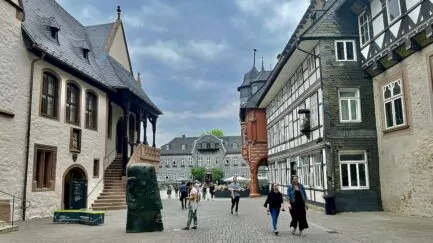 Things to do in Goslar - 11 tips for a historic town in Germany
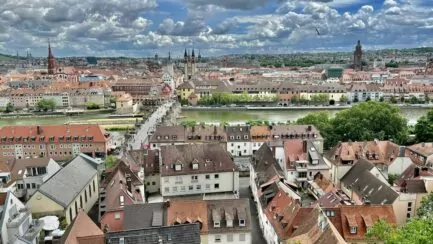 Things to do in Würzburg - 12 sights and experiences
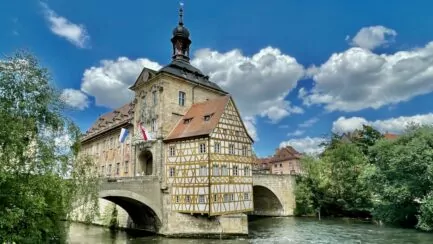 Things to do in Bamberg - 14 tips for a lovely German town
 Things to do in Bayreuth, Bavaria - our top 11 tips
 Chemnitz, Germany - European Capital of Culture 2025
 Things to do in Hildesheim – 15 tips for UNESCO World Heritage sites, half-timbered houses and roses



 English (UK)
 Svenska
bmlarsreseblogg says:
Thanks for the review of our favourite half-timbered city. Admittedly, we haven't seen them all....
01 June 2022 - 14:40
Helena says:
Isn't it a wonderful city! I understand that you have it as a favourite! This city is on our top list too. although we have seen a few more charming cities.
01 June 2022 - 20:12
BP says:
What a cute little town! The half-timbered houses are like something out of a fairy tale. Not a straight wall/facade as far as the eye can see, I would say. Wouldn't want to live in any of the houses, especially not during the winter, but strolling around there is like a dream.
Question: Did the German tourist office select/recommend the cities you visited to promote them, or did you select them?
01 June 2022 - 20:06
Helena says:
Sure it's a cute city! No idea how it is to live in the houses though 😉 It is Peter who chose the cities we visit. We are collaborating with both the German Tourist Board and Fachwerkstrasse (the half-timbered road) to write a report on the half-timbered road (a sponsored report, coming later), but we have chosen the places ourselves. Peter did some research and settled on a number of cities, and I'm sooo happy with his choice I must say! 🙂
01 June 2022 - 20:17
Lena+i+Wales+och+Spanien says:
I have completely missed this city!
Thought I had seen most of Germany, but this was clearly wrong. Have been to the towns around the city, but not there.
Very beautiful and interesting.
Take care!
02 June 2022 - 7:47
Helena says:
So glad we could tell you about something "new"! 😀
06 June 2022 - 15:37