

Text and photo: Helena Bergström
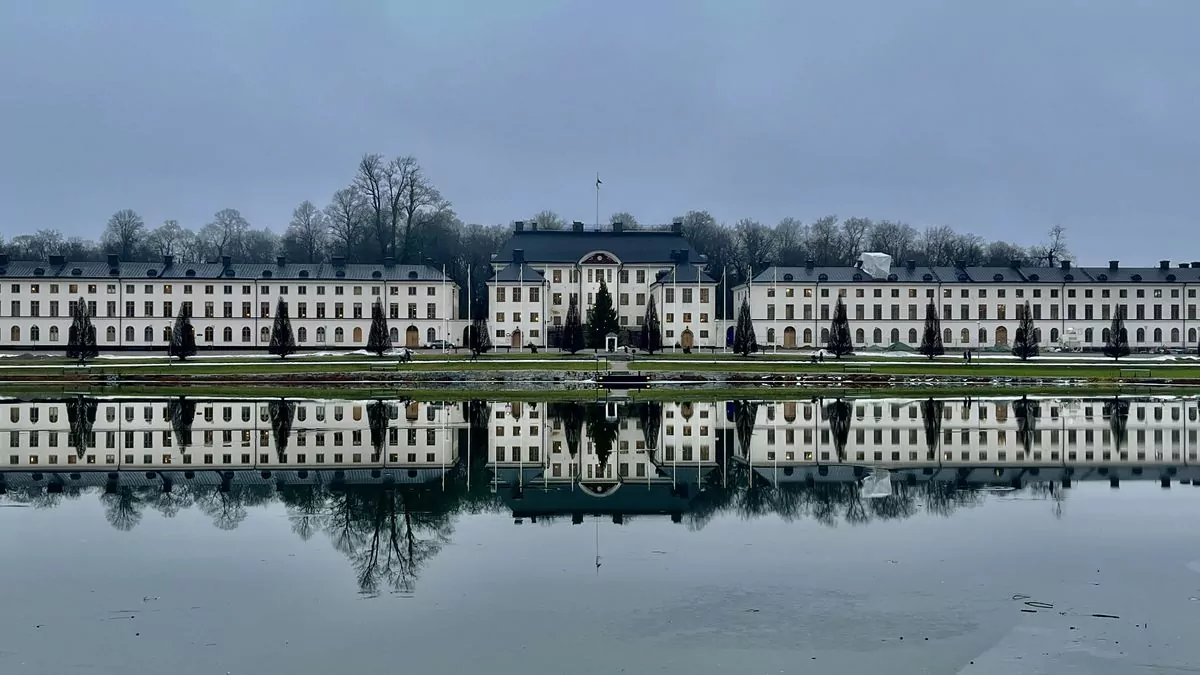
Updated: September 2026 | Karlberg Castle and Castle Park are located on the border between Solna and Stockholm, right next to the Karlberg Canal. Here you will find a beautiful 17th-century castle, a historic park, a runestone, a royal dog grave and several traces of Sweden's military history. For us, Karlberg is also part of everyday life - we live on a houseboat in Pampas marina nearby and often walk past.
 Tweet
 Share
 Share
 Pin
 Share
 Share
Table of contents
Karlberg Castle and Castle Park – a part of our everyday life
Karlberg Castle has been in our lives for much longer than we have lived on a houseboat. Peter grew up on Karlbergsvägen and lived there from the time he was born until he was 12. He remembers visiting Karlberg Castle Park as a child.
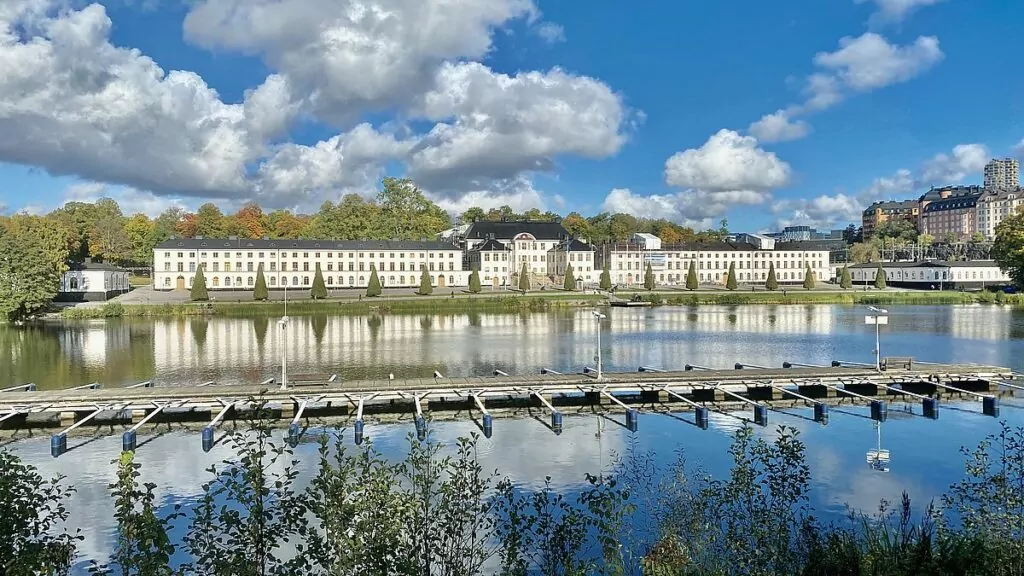
Since 2013 we have been living together on a houseboat in Pampas marina, just a short walk from Karlberg. The castle and the castle park have therefore become part of our everyday environment and we often pass by here during our walks.
And yet I never tire of photographing the castle. ”Don’t you have enough photos of that castle?” Peter might ask when I once again take out my camera or mobile phone.
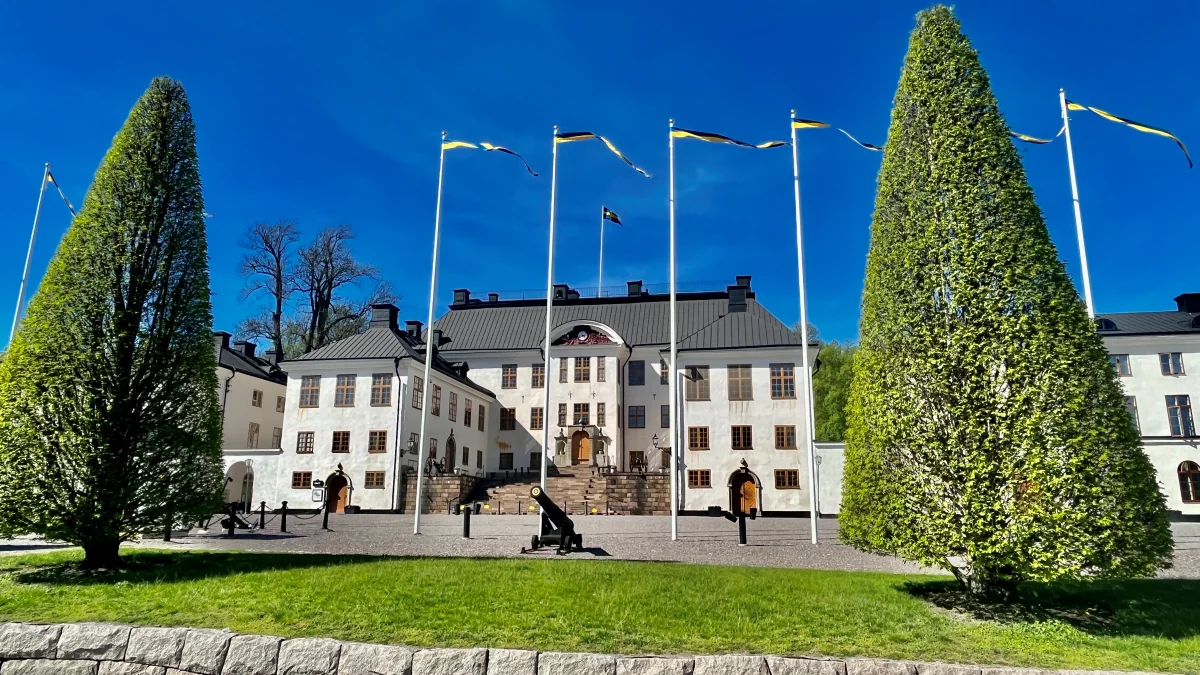
But apparently not. Karlberg Castle looks different all the time! In the summer it is framed by greenery, in the fall by colorful leaves and sometimes the snow lies white over the area in the winter. Add morning light, evening light, sun, fog and darkness and there is always a reason to take another picture.

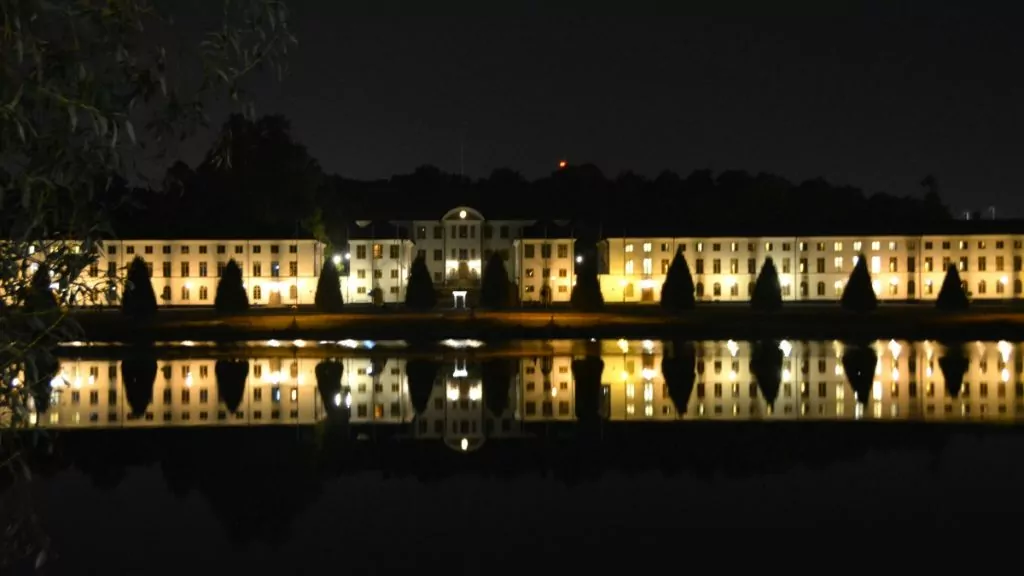
The castle is also beautiful from both sides of the Karlberg Canal. And if you stand in front of the castle and turn the camera the other way, you get nice views over the water instead.


Karlberg Castle – from the 17th century to a military academy
Karlberg's history dates back to the early 17th century. Carl Carlsson Gyllenhielm, son of Charles IX and half-brother of Gustav II Adolf, had a castle built here in the 1630s. The property was named Karlberg.

After Gyllenhielm's death, Karlberg came into the possession of Magnus Gabriel De la Gardie. During his time, the complex was expanded and given more of the grandeur associated with a castle.

In 1688, Karlberg became royal property and became a royal pleasure palace. After the Tre Kronor Palace burned down in 1697, the royal family lived for a period at Karlberg, which was then used as a summer residence, among other things.

In 1792, a whole new chapter began when the Royal Swedish Military Academy was established at Karlberg. Since then, officers have been trained here in unbroken succession. The Karlberg Military Academy is therefore described as the world's oldest military academy with officer training in unbroken succession at the same location.
Today, the castle is still used by the Karlberg Military Academy. It houses offices and teaching facilities, and is also used for representation and ceremonies.

Can you visit Karlberg Castle?
Karlberg Castle is beautiful to look at from the outside, but it does not function as a regular visitor castle with regular tours. The castle is a workplace for the Karlberg Military Academy and is a military protected object, which means that the public does not have access to the building itself. The castle park, however, is normally accessible to the public.

Karlberg Castle Park – from Baroque park to walking area
A magnificent park was laid out at Karlberg as early as the 17th century. It was designed using French Baroque gardens as a model, with straight axes, plantings and a clear symmetry.
During the late 18th century, parts of the area took on a freer character, inspired by the English landscape park. In the 1780s, the architect Fredrik Magnus Piper was commissioned to change parts of the park and the previously strict park landscape was supplemented with softer and more romantic elements. However, some of the straight Baroque road system still remains today.
Today, Karlberg Castle Park is both a historical environment and a green area where you can walk and exercise.

Our own regular tour starts at home in Pampas marina. We walk along the water and past Karlberg Castle, and when we have passed the castle we turn into the park and head back towards Pampas.
Most of the time we walk just to get some exercise and get outside for a while, but sometimes we've also jogged the same distance. Then one of the park's hills has served as an extra challenge, where we've tried to increase the pace a little on the way up.

It's surprisingly easy to get the feeling of being out in nature here, despite Stockholm's inner city being right next door. We've seen both rabbits and squirrels during our rounds and the park offers a nice mix of more open spaces, large trees and a bit more wild nature.
Furthermore, there is much more to discover along the way than you might first suspect.

Attractions in Karlberg Castle Park
The first few times we walked through the park, we mostly thought of it as a nice area for walking and exercising. Gradually, we began to discover all the historical details scattered among the trees. Here are some of them.
Charles XII oak
In the park is the old so-called Karl XII oak. According to tradition, the future Karl XII is said to have played by the oak together with his sisters Hedvig Sofia and Ulrika Eleonora when they were children.
The story is a tradition rather than something we can know for sure, but the oak is another reminder of Karlberg's long royal history.

Runestone U 124
Even older history can be found at the runestone U 124. It was erected during the Viking Age and the inscription tells of a stone that Anund and Torgils had erected after Åsgöt. The stone does not stand in its original place but was moved to Karlbergsparken during the 20th century.
It's quite fascinating to walk around among buildings and monuments from the past few centuries and suddenly stand in front of a runestone that is about a thousand years old.

Gravity pumps
One of the park's more unusual attractions is Pompe's grave. Pompe was the name of Charles XII's dog – or rather dogs. The king is said to have had three dogs, all named Pompe. The first died on Karlberg in 1699 and was buried here. Pompe number two died in Poland in 1703 and the third in Hungary in 1714.
Amidst all the grand royal and military history, the small dog grave feels like an unexpected and rather charming feature.

Temple of Neptunii – or Temple of Diana
One of our personal favorites in Karlberg Castle Park is the small classicist temple that is usually called both the Temple of Neptune and the Temple of Diana.
The temple was built in the early 1790s and designed by architect Carl Christoffer Gjörwell. It was built on a raised terrace in the castle park and was originally called Neptunii Temple. Later it came to be called Diana's Temple.

The name may have been confused with an older hunting temple in the park, Dianaberg or Dianeberg, which existed here during the time of Magnus Gabriel De la Gardie. The older temple fell into disrepair and was demolished in 1787, before the current temple was built.
Regardless of the name, it is a very nice little building and a place we always enjoy passing on our rounds through the park, regardless of the season.


Military history among the trees
Since Karlberg has been used for military training since 1792, there are of course plenty of traces of that activity.
One of the memorial stones is dedicated to Wilhelm von Döbeln, who became a cadet at Karlberg in 1802 and later fell at Leipzig in 1813. It is not the more famous general Georg Carl von Döbeln that the stone is about, although the name may easily lead one to think of him.

The park also contains memorial stones for the 100th and 200th anniversaries of the War School, in 1892 and 1992.


A much darker memory is the so-called Sprängstenen. It recalls an accident on July 29, 1942, when an exercise with tank mines had catastrophic consequences. Six people died. According to the contemporary official investigation, the exact cause of the accident could not be determined.

Here you will also find the so-called Fyverkarhuset, a small building that is associated with Karlberg's military history.

Walk and exercise in Karlberg Castle Park
For us, it's not the individual sights that primarily make us return to Karlberg Castle Park. It's the whole thing.
We usually go here to get some exercise and get outside for a while. Sometimes it's a brisk walk, sometimes a jog, and sometimes we stop to look at something, take photos, or just enjoy the environment.

And perhaps it is precisely the combination that makes Karlberg special. One moment you pass a magnificent 17th-century castle, the next a thousand-year-old runestone or a royal dog grave, and soon after you find yourself among trees, squirrels and rabbits.
There is a lot of nature and history in a relatively small area – and surprisingly quiet considering how close you are to Stockholm's city center.

Why is the Pampas marina called ”Pampas”?
For us, there is also another connection between Karlberg and the place where we live. Pampas marina is located west of Karlberg Castle, at the mouth of the Karlberg Canal towards Lake Ulvsunda. The name Pampas was used long before today's marina existed and was a name for the open training area at Karlberg.
The name is believed to have originated among the cadets, who called the training field Pampas – likely in allusion to the large open pampas plains in South America.
It's a bit funny to think about when we walk home from Karlberg. The name of the place where our houseboat is located most likely has its origins in the military activities at the castle.
READ MORE: Pampas marina in Solna - all you need to know

Visiting Karlberg Castle Park – good to know
Where is Karlberg Castle and Castle Park located?
Karlberg Castle is located in Solna municipality, right next to the border with Stockholm and close to both Vasastan and Kungsholmen. The address of the Karlberg Military Academy is Karlbergs slottsväg 1.
Is Karlberg Castle Park open to the public?
Yes. The area is fenced and the gates are normally open every day from 6 am to 10 pm. At that time, the park and the exercise tracks are available to the public for exercise and recreation. Since Karlberg is a military area, it can also be closed during the day when operations require it.
Can you visit Karlberg Castle?
No, not as a regular tourist. The castle is a workplace and military protected object and the public does not have access.
How do you get to Karlberg Castle Park?
It is easy to walk here from, for example, Vasastan or Kungsholmen. If you are coming by public transport, there are several options in the area, and it is wise to check the current route before your visit.
Good to know in 2026
Extensive construction and renovation work is currently underway in the Karlberg area. Among other things, a new dining hall is being built while older buildings are being renovated. The palace's facade and windows are also being renovated.
During the construction period, walkways may be rerouted and parts of the area may be closed. The Fortifications Agency states that the work will continue in the coming years. Therefore, follow the signage on site and please check the latest information before your visit.

For us, Karlberg will continue to be a part of everyday life. We will walk through the park, run on the slopes occasionally, and pass the castle on our way to and from Pampas.
And I will most likely continue photographing Karlberg Castle, no matter how many photos I already have.

You might also like:
 Museums in Stockholm - guide to the city's best museums
 10 beautiful islands in Sweden you won't want to miss
 Nordiska museet 150 years - Jubilee bridge and new exhibitions
 Junibacken Stockholm with the grandchildren - Aunt Anna walks in childhood
 Swedish Museum of Natural History - Grandma Anna's secret winter journey





 English (UK)
 Svenska
Anonymous says:
It's great to find new attractions in your own neighbourhood!
10 October 2019 - 6:23
Helena says:
Really! Unexpected and fun! You don't always have to go that far 🙂 .
10 October 2019 - 7:51
Anette says:
Perfect to have a nice track so close to home.
Is it illuminated so you can use it even during darker periods?
We have an area with several loops, but the longer ones have no electric lights. You can also walk or run along the river, but there are not many sights on the exercise circuits here. If you are interested in locks, you can of course examine them ?
10 October 2019 - 6:27
Helena says:
What a good question you ask! We haven't had time to check the lighting yet. We've been there a few times on weekends, and Peter usually takes a walk through sometimes when he gets home from my job. But then it has been bright ... But now it's getting darker, so lighting is important. I'm not sure, I'll make sure to check it out!
10 October 2019 - 7:53
Travelsis says:
Wonderful! Love to discover gems in your neighbourhood?./ P
10 October 2019 - 7:41
Helena says:
Right? Sometimes you don't have to go so far 🙂
10 October 2019 - 7:53
Marina says:
We have the "new" Göta Kanal 3 min from us...by new I mean renovated canal and canal bank ⚓️⛵️?
10 October 2019 - 8:01
Helena says:
Sounds like a nice walking destination! 🙂
10 October 2019 - 19:17
Nils-Åke Hansson says:
Karlberg, there are probably several of you who have become tired. Certainly it is good to be close to nature and be able to walk the dog. Have the forest at a reasonable distance
10 October 2019 - 8:19
Helena says:
Fantastic to have nature close by. And good to have a dog to walk with 🙂 .
10 October 2019 - 19:18
Ditte says:
Karlberg is so beautiful! And with an exciting history. Charles XII also lived here when Stockholm Castle burned down.
I had the entire park at Kallberg to play in when I moved to Stockholm as a child and lived here. Yes, we were several children who lived here ... I did not live in the castle itself but in the area, so Karlberg is a bit "home" for me. (My father worked here for more than 40 years and I have had a student party, we have baptised the children and have strong ties to Karlberg in general... is still here from time to time.) Glad that the exercise trails are still there. At least one was already in the early 60s that I used to run in. (Did a lot of free sports) Wondering if the obstacle course is still there. I find that it gave a good workout.
10 October 2019 - 8:53
Helena says:
You really have a relationship with Karlberg!!! Yes, the obstacle course is still there, but you're not allowed to use it. There are ribbons around it and prohibition signs.
10 October 2019 - 19:19
Solan says:
We poked around there when we lived on Tomtebogatan. But we didn't discover everything you did. I remember Pompe. However, there was an obstacle course for the cadets, but it may not be there anymore. Fun scouting Freedom! ?
10 October 2019 - 12:36
Helena says:
Really fun to walk around there and scout! 🙂 The obstacle course is still there! But you are not allowed to use it ...
10 October 2019 - 19:19
bmlarsreseblogg says:
Sure, it's fun to have sights at home, but sometimes you get a little blind to them. Great with a jogging track within walking distance, fits well with your new lifestyle ...
10 October 2019 - 16:52
Helena says:
How easy it is to become blind to what is closest! And yes, we can imagine alternating with jogging outside, at least during the day and before it gets too cold.
10 October 2019 - 19:20
BP says:
So it's absolutely incredible! Now we do not live as close to Karlberg Castle as you do. but we have still walked past the castle a number of times. That's right, passed by. Have never visited the park. Oooops! Not bad at all to play tourist on your home turf.
10 October 2019 - 17:19
Helena says:
Really fun and interesting to play tourist at home sometimes! 🙂
10 October 2019 - 19:20
Lena - gott för själen says:
Hehe, what a "little" find you made. How wonderful it looks. Fantastic what nice, and large, walking areas there are in Stockholm.
We'll have to go out and see if we can find some undiscovered castle park here in Enköping 🙂.
Hug Lena
10 October 2019 - 21:49