



Writer: Helena Bergström
Updated: October 2026 | At the Pythagoras Industrial Museum in Norrtälje, it feels as if time has stood still. Here is an old engine factory where machines, offices and furnishings remain as they were when the business was in operation. We visited the museum during a motorhome trip in Roslagen and got a fascinating insight into both Swedish industrial history and the lives of the people who worked here. Come with us to the promised land of spark-ignition engines!
 Tweet
 Share
 Share
 Pin
 Share
 Share
Table of contents
Why is it called the Pythagorean Industrial Museum?
Pythagoras was a Greek philosopher and mathematician who lived in the 5th century BC. But what does he actually have to do with an old engine factory in Norrtälje? The company AB Pythagoras was founded in 1898 by people who were interested in number mysticism and occultism, among other things. The name has therefore been linked to the Greek philosopher, who is also associated with mathematics and the importance of numbers.
The factory initially had difficulty finding the right products, but eventually they began manufacturing spark-ignition engines, which became a great success. The engines were used in boats and for various tasks in agriculture and industry, and were exported to many parts of the world.


One of the advantages of the spark plug engines was that they could be run on a variety of fuels. It was jokingly said that they could run on almost anything that could be melted in a frying pan!
Operations continued until the mid-1960s. Today, the old factory is a living industrial museum where you can discover both the technology and the history of the people.
That we can visit the old factory today is actually not a given. During the 1980s, there were plans to demolish the buildings and build housing on the site. But committed enthusiasts in the Pythagoras Vänner association fought to save the industrial environment. The factory became a listed building in 1991 and was also named Industrial Monument of the Year in 2024. How lucky that it was allowed to remain!
A journey through time with an audio guide at the Pythagoras Industrial Museum
When we visited the Pythagoras Industrial Museum, we were given the opportunity to explore the factory with the help of an audio guide. It turned out to be a very enjoyable way to discover the environment, as we could walk around at our own pace while listening to stories about the people who worked there.

Among other things, we got to imagine what it was like to start working in the factory at the age of 13, how cold the winters could be and what everyday life was like for the workers. There is something special about hearing such stories while standing in the middle of the old machines. Just look at the overhead cranes! Here it becomes clear what a large and advanced operation the factory once housed.
The museum offers both audio guides and guided tours, depending on how and when you visit. The audio guide is also available in a version for children and in English.


When the old spark plug engines start
One of the coolest experiences at the Pythagoras Industrial Museum was when it was time to start one of the old spark-ignition ball engines. Suddenly, the factory premises were filled with a powerful throbbing and pulsating sound. Several of the belt-driven machines were also set in motion, and for a moment it almost felt like the factory had come back to life.
It was truly fascinating to see and hear! I actually didn't photograph that particular engine, as I was busy filming it for an Instagram Story.
Experiencing the machines in operation gives a completely different understanding of the old industrial environment than just looking at stationary objects. If you want to experience an engine start-up, you should check what tours or demonstrations are offered during your visit.

The old office – as if someone had just left
Another part of the museum that caught our eye was the old office. It almost looks as if the staff have just gone out for a while and will soon be back. Furniture, papers and office equipment are still there, and there are drawings on a table.
It's easy to imagine how people once sat here planning production, taking orders and managing the factory's business. One detail that we found particularly amusing was the old photocopier. It may not look very modern to today's eyes, but in its time it was of course an impressive tool!

The caretaker's residence – life at the factory
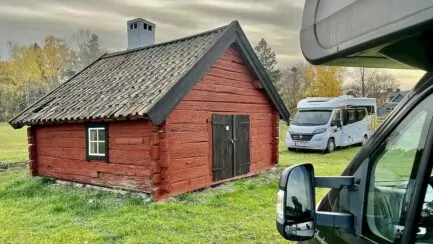
The area also includes the old caretaker's house, where you can get an insight into what life was like for those who lived and worked at the factory. A family with three children lived here. The father worked in the factory during the day and also did caretaker duties in his spare time. In exchange, the family was allowed to live in the house for free. Today, the house has been redecorated to show what a workers' home might have looked like in the 1940s, with a kitchen, pantry and a small paddock outside.

The small cottage is charming, with a kitchen, pantry and a garden where you could grow crops. But life was hardly always as idyllic as the environment might give the impression. In the winters it could be cold, and the working days were long.
We thought the residence was a nice complement to the factory. Here you can get close to people's everyday lives and see a different side of industrial history than the one that deals with machines and production.

Children's Pythagoras – discover technology through play
For families with children, there is also Barnens Pythagoras, located in the factory's old test drive hall. Here, children can discover technology and mechanics in a playful way and get a feel for what it was like to work in a factory.
The old hall is also called the Wolf Pit. The name does not come from any four-legged wolves, but from the factory's test runs. When an engine did not work as it should, you could say that there was a "wolf" in the engine.
The Children's Pythagoras makes the museum a destination for younger visitors as well. It's not just about looking at old objects, but also about trying, playing and discovering.
Viewpoint behind the museum
Just behind the caretaker's residence there is also a lookout point. Of course we took the opportunity to go there and see what we could discover. The view may not be the most magnificent we have seen, but it is still a nice little stop when you are already there. And so we got another picture of Norrtälje from a slightly different perspective!


Good to know before visiting Pyhagoras Industrial Museum
- Where is the museum? Pythagoras Industrial Museum is located at Verkstadsgatan 6 in Norrtälje, within walking distance of the city center.
- What can you see? A preserved engine factory with old machines and spark-ignition engines, a historic office, caretaker's residence and exhibitions about the people who worked here.
- Are there guided tours? Yes, the museum offers guided tours and an audio guide that can be used to discover the factory at your own pace.
- Can you see the engines starting? Engine starts occur in connection with certain shows and demonstrations. Check the current program if there is something you particularly want to experience.
- Is the museum suitable for children? Yes, there is also Children's Pythagoras, where children can learn more about technology through play and activities.
- When is the museum open? The museum is mainly open during parts of spring, summer and autumn. Group tours can also be booked at other times.
- Is there parking? There are limited parking options at the museum and more parking spaces in central Norrtälje.
- Is the museum accessible? Large parts of the museum are accessible, but as the buildings are old there are thresholds, stairs and some tight spaces. Please contact the museum if you have any special needs.
- Is there coffee? Yes, in the factory's old forge there is a café and a museum shop.
- Where can I find opening hours and prices? Current information is available at Pythagoras Industrial Museum official website.
More to see and do in Norrtälje
Pythagoras Industrial Museum is just one of many interesting places to visit in Norrtälje. The city has charming old wooden houses, cozy alleys, cafes and nice walking paths along the Norrtälje River. In the surrounding area, there are also nature reserves, historical sights and the Roslagen archipelago.
- Things to do in Norrtälje
- Viking village Storholmen
- Väddö sea baths and camping
- Norr Malma nature reserve
- Riddersholm Nature Reserve
You might also like:
 Museums in Stockholm - guide to the city's best museums


 Steninge castle in Uppland - Aunt Anna and the sugar bushes


 Today, Äventyrs opens in Stockholm - a modern adventure museum in the city centre
 You've never experienced Alfons Mucha like this - magical premiere at Artipelag



 English (UK)
 Svenska
bmlarsreseblogg says:
We have heard many positive comments about the Pythagorean Museum. We'll try to visit it the next time we go there!
Keep up the good work!
18 August 2020 - 9:44
Helena says:
Glad you heard good things about the museum! We really liked it! And fantastically nice staff / guides! 🙂
18 August 2020 - 20:26
Nils-Åke Hansson says:
I know we had a machine that drove the wood splitter with a belt and that ran on waste oil. May have been from there.
18 August 2020 - 12:48
Helena says:
Fun! Interesting with this kind of history!
18 August 2020 - 20:26
Ditte says:
We have been to Norrtälje many times but not yet here at the museum. Many thanks for the tips and the visit here.
18 August 2020 - 15:51
Helena says:
It is well worth a visit! Opening hours are a bit limited so check beforehand when they are open!
18 August 2020 - 20:27
Matts Torebring says:
I love listening to an ignition ball engine, it is simply a wonderful engine.
18 August 2020 - 18:02
Helena says:
I have never thought about spark plug engines before, but when I visited the museum I was a bit fascinated!
18 August 2020 - 20:28
BP says:
It was a museum completely to my taste. I just love the building as well as the interior:-)
18 August 2020 - 20:50
Lena - gott för själen says:
But oh. I'm going to love that place! I already know that I will go there at some point. Had no idea it existed, so thanks for the tip!
We found a similar museum in Lesjöfors last summer. Great museum! Posts coming soon.
Hug Lena
23 August 2020 - 8:21